
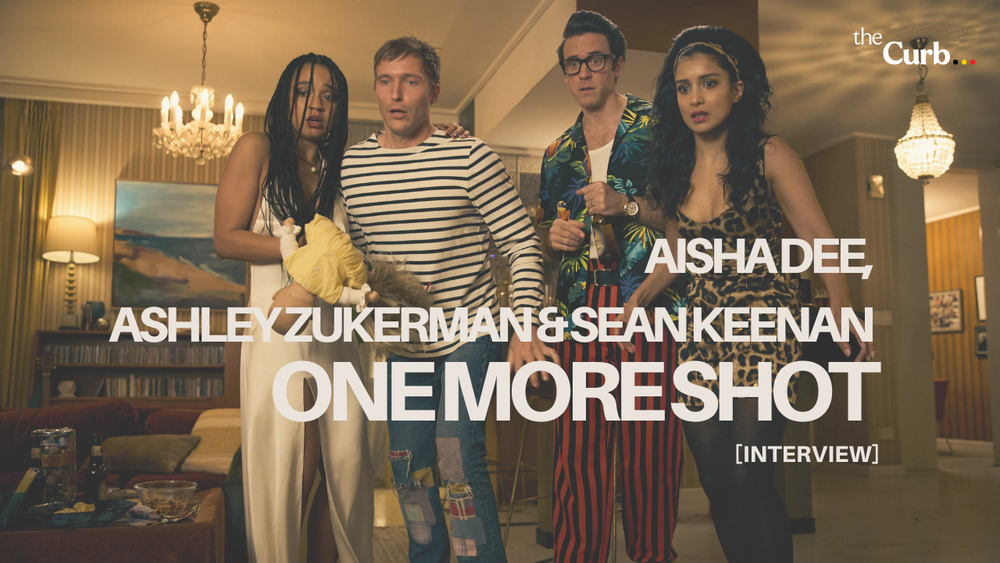
Nicholas Clifford’s feature debut film One More Shot is a delightfully fun Australian dramedy that follows Minnie (a charming Emily Browning) as she discovers that the bottle of tequila she’s brought to her friend’s party on New Year’s Eve on 1999 is the key to time looping back to her first shot from the bottle. As Minnie rocks up to her friend Rodney’s (Ashley Zukerman) house, she’s greeted by an exuberant ‘party time’ from Joe (Sean Keenan), someone who we discover along the way is a recovering alcoholic. As the time loop continues, Minnie watches her old flame Joe propose to his new partner, Jenny (Aisha Dee), leading her to once again swig the tequila and get her back onto the right timeline where her relationship with Joe is mended and her millennium life is off to a good start.
One More Shot is one of the more delightful Australian films of 2025 (so much so that it’s on my Best of the Year list), and stands as proof as to what can happen when Aussie creatives lean into the fun, creating something that’s whimsical and uplifting, even while it delves into some of the more grounded elements of its story. This is partly in thanks to the superb script from Alice Foulcher and Gregory Erdstein, which gives seasoned performers like Aisha Dee, Ashley Zukerman, and Sean Keenan to explore their comedic side on screen.
Each of these great Aussie actors discusses their work on the film in the below interview, recorded ahead of the US release of the film.
This interview has been edited for clarity purposes.
JustWatch Screening or Streaming Availability:

This is a nice, light film. It's a real delight to be able to see something that feels nostalgic, but not like nostalgia bait. Ashley, as someone from the era the film is set, what was it like to work within that vibe?
Ashley Zukerman: I had the same response that you had when I read the script. I thought, ‘we don't often get to make these films in Australia.’ I'm very certainly a child of the 90s. My favourite films, like Big and Back to the Future, are these domestic fantasies [where] there's some supernatural conceit that helps characters get to wherever they need to be going. My first draw to [One More Shot was that] we get to make an Australian one that was like that. I think it brings a whimsy and a lightness to something so that it gives it a great, fun backbone for being able to talk about whatever it is we want to talk about it in our film, and we get to talk about some pretty cool stuff.
Aisha Dee: I also love those kinds of films. I grew up on films like Life-Size where Tyra Banks plays a Barbie doll. Such an incredible concept and conceit, but it was talking about some pretty real stuff, and it got through to me as a kid. I agree that sometimes we need a bit of whimsy and a lightness in the stories we tell, and we so rarely get to do that in Australian films.
I think we're great at telling really heavy, hard hitting, traumatic stories, but it was really nice to get to tell a different type of story and live in a pretty light and kind of fun world. We live it too and in real life as actors, so it was really nice to get to delve into something a little lighter on set as well.
Sean, shifting from talking about lightness to the darkness of the film, there is a grounded aspect to the film as well, which respectfully explores aspects addiction and alcoholism. Your character brings a levity and understanding to those issues. What was it like building those aspects of Joe as a character?
Sean Keenan: I think that was what I liked about the script; the fact that it was a fun film, a silly film. And you don't get that every day in Australia, particularly. Maybe our TV has a bit more of a go at it, but our films haven't tried to do it in a while. So, I loved the concept of the time loop dramady.
But then the characters each have a real depth that I liked, and they were all on the precipice of big change in their life. I really liked that. Joe is in this new place of acceptance of who he is, but he's made some big changes; it's funny that characters like Minnie and Rodney have their own form of addiction, and it's this [avoidance of] certain things and the pain in their life, [while] Joe has kind of lived through that pain. He's on the other side and he doesn't want to go back.
I think the nature of addiction is when that urge to screw it all up creeps back in, particularly when some of the biggest challenges can be when things are going incredibly well and you're getting more responsibility and stability in your life. Joe thinks he's in this place of great acceptance, but then there is that little itch that is still pretty fresh. It hasn't been that long. It's only been a few months for him. So, put all that into the New Year's Eve party, and you've got a mix of potential catastrophe.
Because of the time loop nature of the narrative, you're often replaying scenes. How did you manage to keep similar scenes feeling fresh?
SK: It started to feel like, ‘how many more times could I do this?’ I opened that door probably over 100 times on camera, plus we rehearsed me opening with that ‘party time’ thing so many times. Nick separated each loop to the morning of a shoot day. So, for about a week and a half, we'd start in the morning, and we'd be at the door. We'd shoot 10-12 takes of us opening that door. I remember at the start just going, ‘Oh my God.’ I imagined what I was in for. But, once you're in that you're going, ‘how many more times can I do this and try something new without it starting to become silly?’
But we definitely tried a lot of things and I think it was the safety of just knowing that Joe is in the same place every time. He hasn't changed. I did talk to Nick if it was a dimension jump and different things, and he's like, “Nah man, he's just where he's at.” And, “Take in Emily. Emily's giving everything that you need to be given.” She's a firecracker and so funny, and in her sort of different states of disaster. So, I just opened the door and trust in that. I'm not really like a theatre actor, so instinctually, it's always going to be different and fun, and we had a lot of fun with it, but I think it was a new experience for all of us doing scenes that many times.
AD: I think it was. I underestimated how tricky it would be, because there's only about five to eight scenes in the film that we actually experience, we just get to experience them over and over again. It was strange for that to be complicated, because that's what we do anyway. Every take was a new version of the thing itself, so we're always just responding to what's happening in front of us and looking for new ways to like to go deeper in a scene. But it was challenging. It was definitely unique.
AZ: But I think there was something really interesting about every day getting into the same costume and the same makeup, and being in the same blacked out house, and all of us sitting around each other's phones playing the Wordle of the day, it kind of felt like this weird Groundhog Day thing. Because of the way that we had to shoot it, it almost felt like – I never went to theatre camp –, but it almost felt like theatre camp just hanging out with a bunch of theatre kids. I really enjoyed it.
AD: Because it was like, ‘Do the same thing. But now do this. Now add to this.’
It feels like a group of friends catching up, right, which is hard to imitate, but knowing that you're all on set shooting at the same time adds to the organic nature of everything.
Skewing away from the film as we wrap up. Ashley and Aisha, congratulations on your AACTA nominations for Apple Cider Vinegar is fantastic. I also want to shout out Ashley, I saw Jason is My Dad at the Adelaide Film Festival and I can't wait to see where you go as a director. It's a phenomenal short film.
AZ: That’s very kind. Did you write about it in your best of the year list?
I did.
AZ: It meant a lot.
I'm looking forward to more people seeing it, because it's a great film.
SK: I have seen it, and I second you on that.