
Since Disney acquired Lucasfilm, the Star Wars brand has rapidly become more of a corporate product and less an imaginative space opera. After countless TV series, both animated and live action, five feature films, and enough action figures and merchandise to fill a continent’s worth of landfill, the once-magical “galaxy far, far away” is now a tool of consumerist expansion. Despite a few diamonds in the rough, namely Andor and the final season of The Clone Wars, it feels like an age ago that Star Wars was a science-fiction series made by real people with real visions.
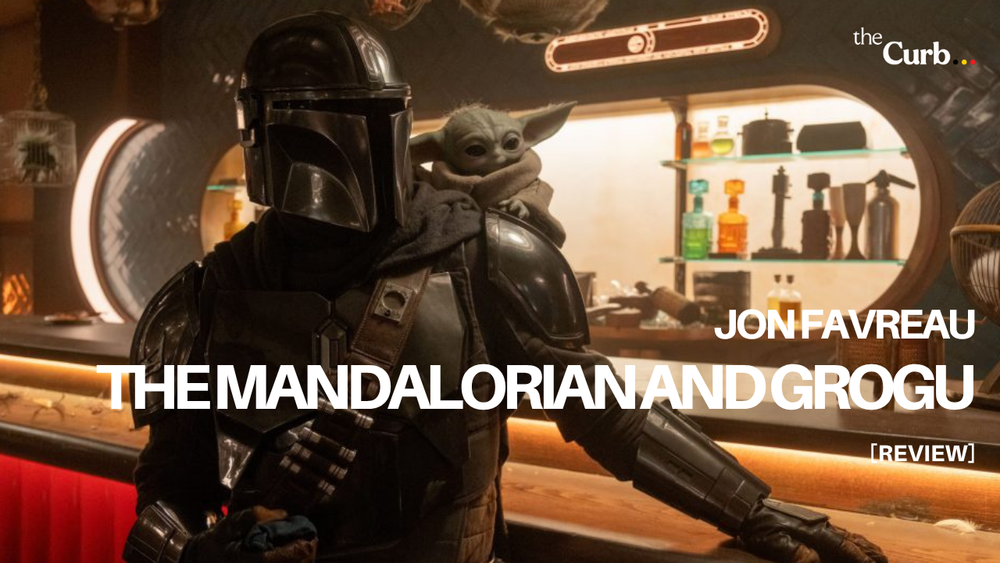
The Mandalorian and Grogu, a feature-length expansion of the successful Disney+ series The Mandalorian, feels as though Star Wars has reached a new plateau of committee-policed content creating an entropic spiral toward the franchise’s nadir of soulless moviemaking. As a standalone entry spun out of an ongoing streaming series – effectively bridging a few episodes of the show then egregiously stretching them into a two-plus-hour feature film – it’s inoffensive and harmless ”content.” As an indication of where Star Wars is both positioned and heading, it is increasingly obvious that Jon Favreau and Dave Filoni have a very low midi-chlorian count for planning the franchise’s future.
The Mandalorian and Grogu begins with some brief opening titles, quickly reminding the audience where The Mandalorian sits within the ever-expanding canon. In a post Return of the Jedi galaxy, lawlessness persists as remnants of the Empire attempt to resurface. Din Djarin (Pedro Pascal), the titular bounty hunter known as “The Mandalorian,” takes missions from the fledgling New Republic to hunt down Imperial warlords. Alongside his apprentice and adopted son, Grogu, Mando is tasked by Colonel Ward (Sigourney Weaver) with tracking an unnamed Imperial commander on an ice planet that feels very much like a knock-off of Hoth.
It is an impressively staged opening sequence, glossy, loud, and well-choreographed in the way it showcases the bounty hunter’s combat style and mysterious, cool allure. Ludwig Göransson’s bombastic, metallic, and classical score is the true beating heart of the film, carried over from the TV series and giving even the longest sequences, and they do go on and on, the tiniest sense of cinematic sparkle. The Mandalorian and Grogu is still a couple of filler episodes of a television series blown up to IMAX scale after all, and whatever story there is in the film feels as narratively complex as a video game side quest.
The film’s runtime is largely devoted to a quest to track down a shady Imperial known only as Commander Coin, a lead provided by Jabba the Hutt’s nefarious siblings, the Hutt Twins. In exchange for Coin’s location, Mando is sent to the Blade Runner-inspired planet Shakari to rescue the Hutt Twins’ nephew, Rotta (Jeremy Allen-White) from the criminal Janu (Jonny Coyne). Rotta is a muscular slug who fights in gladiatorial pits for his freedom, portrayed as having a kind-hearted spirit that contrasts with what his now-deceased father Jabba stood for.
Rotta is an eyesore drenched in CGI muck that rarely translates Allen-White’s vocal performance into his visual design. Also disappointing is the addition of Sigourney Weaver, who is underutilised and given a script that feels both stunted and artificially didactic. While some well-staged action sequences feel flashy, much of the film is spent against unrendered CGI backdrops, particularly noticeable on the planet Nal Hutta, where Mando remains stranded for what feels like a millennium. Thankfully, Grogu remains as endearing and cute as ever, cleverly paired with the returning Anzellan creatures (Shirley Henderson) in an albeit overlong subplot in which the young are forced to protect the old.
The biggest issue with the film is how safe and empty it feels. Pedro Pascal gives a listless vocal performance, doing little to dispel the allegations that Mando is little more than an amped-up action figure. Grogu’s development also rehashes character beats already explored in the television series, a frustration given this is a character with limitless potential. From beginning to end, neither character feels meaningfully challenged, elevated, or evolved enough to justify a big-screen outing. It isn’t offensive, but it does raise the question of why Disney chose to make this a feature film in the first place.
What Disney needs is a mirror to reflect on their own consumerist, nostalgia-maximising mediocrity. This applies to their endless remakes, the Marvel Cinematic Universe, and especially Star Wars. While there is some enjoyment to be found in the puppetry of both Grogu and the Anzellans, the opening sequence, and whatever Ludwig Göransson can salvage into the score, the longer The Mandalorian and Grogu goes on, the more it reminds the audience that it is every bit as generic and lacklustre as its title. It may still be about a father and his child, but Lucasfilm is more concerned with a payout than parental attachment.
The Mandalorian and Grogu makes the biggest cardinal sin of all: scamming its viewership into believing they are making entertainment when these parts of Star Wars are nothing more than a piece of capital, packaged and designed to make more toys, plushies, and general merchandise. While it doesn’t jangle legacy characters in your face, it also fails to provide what’s new with any sense of interest. It does nothing to expand the Mandoverse, nor deepen the bond between Din Djarin and Grogu. It is an aimless but occasionally entertaining product that is little more than a conveyor belt of forgettable slop parading its 'content' as a cinematic experience.
Director: Jon Favreau
Writers: Dave Filoni and Jon Favreau based on characters created by George Lucas
Cast: Pedro Pascal, Sigourney Weaver, Jeremy Allen White, Shirley Henderson
Score: Ludwig Göransson