
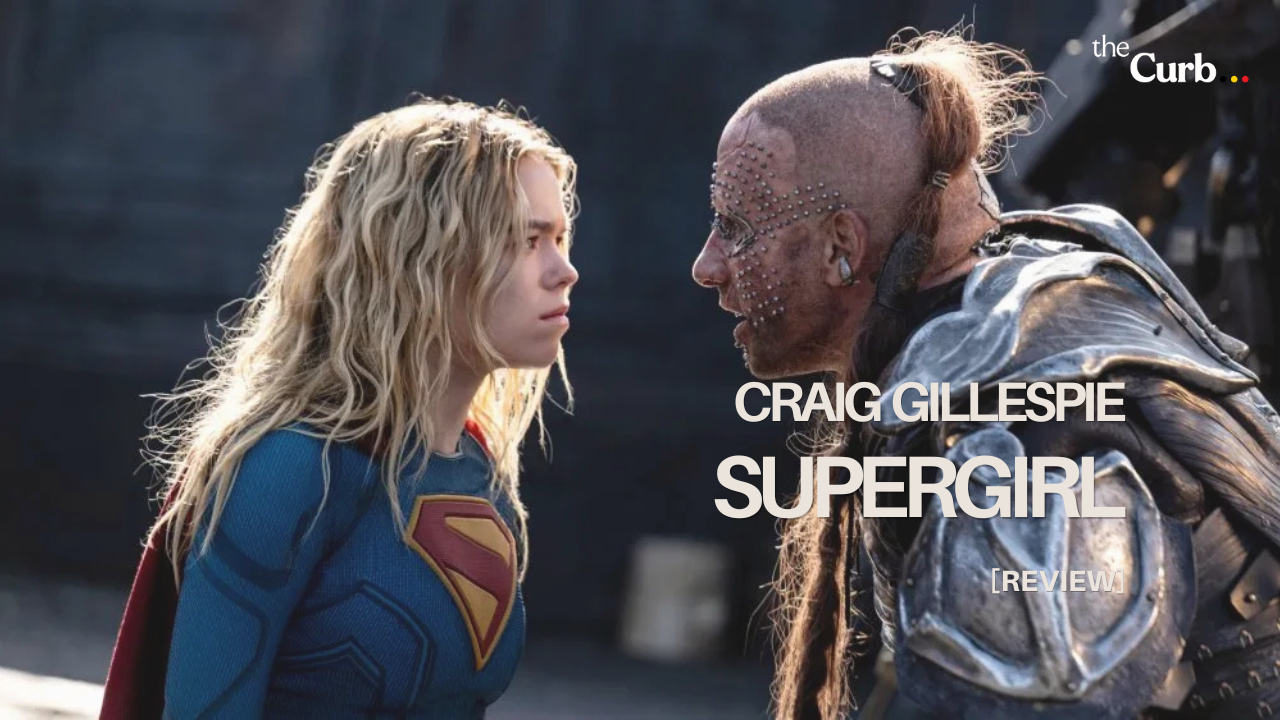
After James Gunn’s energetic but disposable Superman in 2025, I was looking forward to catching a superhero sidequel that featured a character who doesn’t have decades of cinematic history behind them, but alas, malaise kicked in pretty quickly for me as I endured Craig Gillespie’s tiring Supergirl.
Milly Alcock’s Kara Zor-El aka Supergirl had a peppy cameo at the end of Superman, leaving enough of a mark to suggest that her solo flick would be just as energetic, but instead we’re gifted with a film that comes across as a leaden pastiche of what is now nearing twenty years of cinema-disrupting superhero films.
The plot, for what it is, is rudimentary and banal. We’re introduced to Ruthye Knoll (an under resourced Eve Ridley), a vengeful youth who sees her family slaughtered by the generic Brigand leader Krem (a wasted Matthias Schoenaerts) and his equally generic cronies. Ruthye calls in at the local pub asking for help to hunt Krem down, the same pub where Kara is boozing it up, whiling away her 23rd birthday. After initially nixing Ruthye’s call to hunt down Krem and exact revenge, Kara discovers she’s been dragged into an unskippable quest that kicks off with Krypto the superdog being shot with a poison-dart that will kill him – painfully, we’re told – in three days. To save Krypto and to mark the quest as complete, Kara must administer an antidote, one that conveniently hangs around Krem’s neck.
Krem and co.’s band of villains – see, I’ve already forgotten what race they are – feel like discarded Ravager designs from Gunn’s Guardians of the Galaxy series. Their patriarchal Mad Max: Fury Road-adjacent lore has them scouring the universe for girls to breed with to maintain their misogynist society. Krem is barely an idea of a villain, rarely feeling threatening with a face peppered with ball bearings and sporting a metal grill over his teeth that would make Jared Leto’s Joker envious. Equally generic is his bottom-of-the-pile backstory; he wants the weapons that Ruthye’s dad makes, so he eats his pie, kills his family, and then conveniently forgets to steal the sword from him. That’s about it. The weapon itself is inconsequential; it’s simply a well-made sword.
You’d struggle to drown in the narrative depth at work here.
As the age of superhero films is waning and the rise of video game flicks continues, it feels apt that Supergirl acts as a nexus point for the two filmic formats: a superhero origin story by way of a bland fetch quest paired with an annoying escort mission. Along their journey, Kara and Ruthye meet a cast of rudimentary NPCs before cutting to obligatory dark and dirty consequence-free action sequences that conveniently wrap up with the villain escaping with the antidote still dangling round their neck.
Milly Alcock delivers a performance that meets the occasion of headlining the first Supergirl film in 42-years, but she’s let down by a surprise-free film that’s jam packed with tired lore-dumping cutscenes and unengaging action. Like Gunn’s Superman, Supergirl contains bouts of narrative convenience that works to inhibit or restrict the Kryptonian heroes (Krypto included) rather than utilising their foundational character traits to turn them into memorable and engaging beings, otherwise known as ‘fully formed characters’.
Take the narrative convenience solar system for example. We meet Kara when she’s on a planet bathed in the light of a red sun, something that reduces her powers and lets her get drunk. Ok, fine, I never asked if a Kryptonian could get drunk, but I guess I know the answer now. When Kara gets soaked in the rays of a yellow sun, her powers are restored as her health and stamina bar quickly replenishes. Later, Kara finds herself on a planet with two suns: one is a yellow sun, the other is a green one. Naturally, this sun adheres to the ‘green means death’ law that operates within these Kryptonian tales. Kara then becomes a character defined by the world around her, not by her own actions, hopes, and dreams. That isn’t necessarily an issue, but first-time feature screenwriter Ana Nogueira doesn’t give Kara enough agency within those parameters to become a singular entity.
We remember Tony Stark from the first Iron Man film because his character traits guide the narrative, not the narrative strongarming his character arc. In Supergirl, Kara’s growth and arc is continually thwarted by at least three instances of poisoning, featuring a self-induced vomiting sequence and a near-death kryptonite coma, all of which is as exciting to experience on screen as it sounds. Alcock pushes through these moments, attempting to bring the idea of who Kara is to life, but it’s a slog to watch, robbing the eventual third-act reveal of a flying Supergirl in her cape of its visual glory and brilliance.
This isn’t to say that there’s no depth to Kara as we experience her backstory, seeing her lose her parents and being ejected into space with Krypto as one of the last hopes for her race. This gives her a point of difference from her cousin Clark Kent (David Corenswet comfortably owning the role of Superman) and an internal anguish to process, and Alcock does bring the weight of that to life well, yet she’s perpetually dragged back to that tedious fetch quest and hobbled by character stifling moments instead of being actually able to grow.
Thwarting matters even more is the tokenistic appearance of fringe character Lobo (a role that Jason Momoa has apparently been itching to play all his life). Coming across like a mix between a failed member of Kiss and Biker Mice from Mars, Lobo roars into the film without purpose or value, other than to stake a claim for his own solo film down the line. While no doubt comic readers will get a blast from seeing him on screen, I felt bombarded by yet another bland peripheral character that served no functional purpose other than bringing a touch of chaos to the mix. And while I enjoy a bit of chaos, you could quite easily cut Lobo out of the film and it would flow as normal.
When James Gunn and Peter Safran were gifted control of the DC characters, I had a bit of hope they’d bring a dose of freshness to the universe while also managing to add something new to the superhero genre. I don’t mind a bit of CGI-soaked entertainment every so often, but after two decades of these universe building, origin story experiences, I crave a film that respects its audience to understand that we’re familiar enough with the machinations of a superhero film to take some chances and put a bit of risk in pushing the boundary a bit.
Instead, it feels like the mere concept of making a Supergirl film at all is as much of a chance as they’re willing to take.
Superhero/villain films don’t have to just be Ant-Man Saves the Cat, Again!, they could be quite a bit more than that. They weren’t just the next continuing entry in an ongoing saga that features inconsequential deaths and destruction with an obligatory cameo to introduce the next spin-off series, they could be reflective pieces that explored aspects of humanity and what it means to be a hero. Take Logan for example, a pinnacle of the genre that acts as a reflective film that explored what immortality actually means and the toll that being surrounded by and the cause of immense levels of death has on someone.
It’s also part of the reason why Ryan Coogler’s Black Panther: Wakanda Forever stands as an unsung masterwork of the genre with its eagerness to examine what heroes mean to their home nation and to the world around them. Or why Gunn’s The Suicide Squad lingers in my mind as a bacchanalian bloodbath of violence and brutality, utilising the superhero genre as a kid’s playground where boozed up adults have their fun, all the while having a dig at the American military in the process. I’ll also quietly go to bat for Joker: Folie à Deux for its attempt to swing for the fences and try something new for once. It might not have fully succeeded, but I’m certain that film will eventually have its day and find its supporters.
Supergirl isn’t interested in ‘being something more’ and maybe asking it to be is a step too far.
Gunn set the tone with Superman: don’t rock the boat too much, lean back on the familiar, and remember why people liked these characters in the first place. Throughout that bright and jubilant film, there was a sense of reassurance and reinvigoration at work. Gunn’s primary focus was aligning the character of Superman back with the concept of ‘hope’. Superman was a hero for all, going so far as to even save a squirrel during one sequence. While merely whelmed by the film, I did leave feeling like I wanted to see more of this version of Superman.
But what exactly is ‘this version’ of the DC Universe, one that’s been dubbed ‘Chapter One: Gods and Monsters’? Those superhero films I mentioned above stand out because they feel like works that have been created by writers and directors who want to tell a compelling, singular narrative within a series dripping with homogeneity. Films within Marvel various phases have struggled to stand out as a same-same tone links each entry, creating a cut and paste effect that made late works completely disposable. Part of the reason Gunn and Safran were given control of the DC universe is due to the intoxicating vibe of the Synder-verse era of films, each of which felt darker, bleaker, and far too serious for its own good.
While the Snyderverse run of films had its foibles, at least some of them gambled with the formular. Take Cathy Yan’s acidic Birds of Prey (and the Fantabulous Emancipation of One Harley Quinn) for example, a film that embraced the darkness of Harley Quinn, while also remembering to have some fucking fun in the process. I yearned for someone with an assured hand like Cathy Yan to take control of Supergirl and breath some life and personality into it.
The tone for the ‘Gods and Monsters’ era simply seems be: ‘be like a James Gunn film’. All of his tropes are at work in both Superman and Supergirl: needle-drops, ragtag teams of scavengers, unnecessary animal cruelty (seriously James, what is it with the dog suffering business?), that sweeping, rotating camera shot that he does, sardonic humour.
But Supergirl is still a Craig Gillespie film written by someone who isn’t James Gunn, and while imitation is flattery and all that, it’s also still just imitation. Gillespie, bless his Aussie socks, is a great imitator, never really leaving his own mark on his films but managing to give enough space to pay deference to those who came beforehand. With films like I, Tonya and Cruella under his belt, Gillespie has somehow become a surrogate director for rebellious or misunderstood women stories, but he's out of his depth here.
Nogueira feels like she’s been thrown to the wolves here, being asked to craft a script that sets the tone for who Kara Zor-El is as a character, but instead she delivers something that’s underbaked and formulaic; a real concern when she’s supposed to be the writer behind a few more upcoming DC flicks. The quality of the writing here also brings Gunn’s rhetoric that they’ll only greenlight films when the scripts are finished into question; yeah, they might have done their required rewrites, but is it actually any good? To paraphrase Peter Safran, this is ‘bad movie fatigue’.
These things aren’t cheap to make. Supergirl had an estimated budget of $US175 million, so about average for your regular ‘blockbuster’ nowadays – remember when that term used to be applied to a film after it was successful, not before it’s even hit cinemas? But for that money, and after almost two decades of these things, can we maybe get something a little, well, better than this? We’re stuck with getting years more of these films, so if the minds behind them could just shake things up a bit more would be appreciated.
And maybe this is the absolute kicker of it all: while Supergirl is a mess of a film, I did still leave feeling like I want to see more of this version of a character. Through the banal action and mundanity, there’s still a bit of a charm and hope that these things might work out. Whether we’ll get the chance to see this Gunn and Safran experiment play out long enough to even reach Chapter Two remains to be seen.
Director: Craig Gillespie
Cast: Milly Alcock, Eve Ridley, Matthias Schoenaerts
Writer: Ana Nogueira, (based on characters by Jerry Siegel & Joe Shuster)
Producers: James Gunn, Peter Safran
Composer: Claudia Sarne
Cinematographer: Rob Hardy
Editors: Fred Raskin, Tatiana S. Riegel
JustWatch Screening or Streaming Availability: