
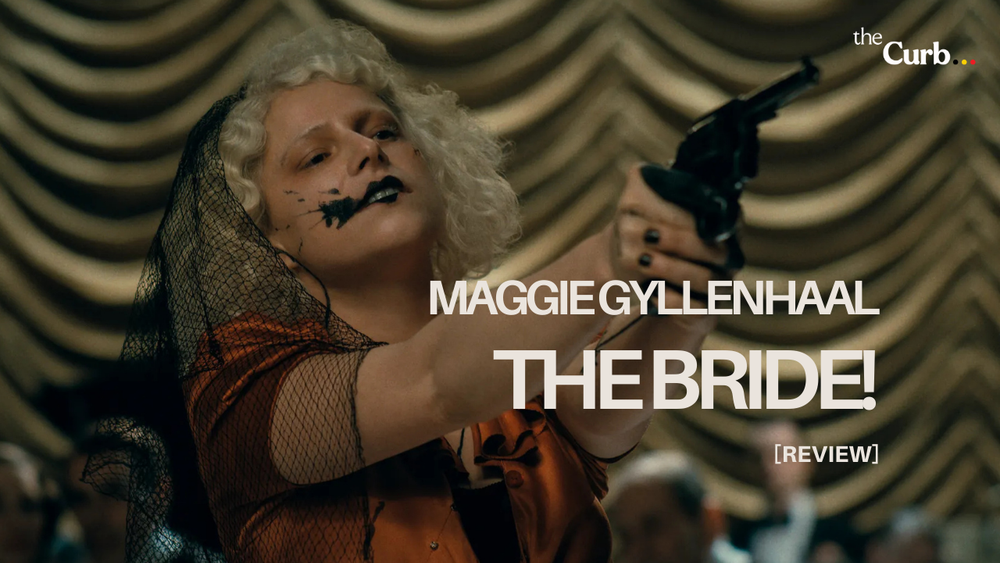
This is going to be a two-part essay. The first part is me exploring my lifelong connection to The Bride of Frankenstein—where she comes from, why she has lingered in my imagination for decades, and how she has quietly threaded itself through the story of my own life. The second part will be my thoughts on The Bride! itself—but before we get there, I need to trace the history of my fascination, this obsession, this quiet longing that has existed in the corners of my mind since childhood.
I first saw The Bride of Frankenstein when I was very young. I can still remember the flickering images on the screen, how the shadows seemed to stretch and breathe along with the characters. The storm outside my window—the crack of lightning, the rumble of thunder—felt like it was orchestrated for the film, as if the world itself had conspired to make that moment feel alive. And then she appeared. The Bride. Her presence was brief, fleeting, yet utterly unforgettable. In those few minutes, she carried a gravity, a kind of silent sorrow, that went far beyond the horror or the spectacle. She was not simply a creation; she was an absence made manifest, a story waiting to be told. I didn’t have the words to understand it, but I knew she demanded recognition.
I remember gripping the edge of the sofa as the camera lingered on her face, the uncertainty in her eyes, the way she seemed to take in the world with a mixture of wonder and fear. I remember the way the flickering light made her hair—white as lightning—look alive, as if it had a life of its own. There was a tension to her, a sense of anticipation, as though the weight of what was expected of her pressed down in every movement, every glance. I remember whispering to the screen, imagining that my voice could reach her: “I see you. I understand you.” That silent conversation stayed with me, a reminder that even the smallest spark of recognition can matter when no one else seems to notice.
Later, I read Mary Shelley’s Frankenstein, and the mystery deepened rather than resolved. In the novel, the female companion is never brought to life. She exists only as a concept, a moral question, a possibility snatched away before it could be realized. Shelley doesn’t give her thoughts, feelings, or agency. And yet, in that absence, she became profoundly present for me. I spent hours imagining her movements, her gestures, the subtle ways she might have expressed herself if the world had allowed her to exist fully. I created conversations, moments of hesitation, bursts of joy, or flashes of defiance. I built a life for her in the quiet recesses of my mind where nothing was forbidden.
Over time, she became more than just a character. She became intimate. She became a mirror for the things I had never fully recognized in myself: moments of doubt, moments of anger, longing, and resilience. Even as a child, I felt connected to her—a being made for someone else’s purposes, yet incapable of being defined by them. She reflected the times I felt constrained, overlooked, or misunderstood. She gave shape to the silent resistance that sometimes lives quietly in all of us, waiting for recognition.
As I grew older, the obsession became quieter, but it never disappeared. The Bride stayed with me, appearing in fragments across films, books, and fleeting moments of life. I saw her in empty corridors, in moments of stillness, in those who move quietly through the world, carrying their own unspoken burdens. She embodied the tension between expectation and desire, the sorrow of incompleteness, and the quiet strength of a being aware of her own potential even when the world refuses to see it.
I spent countless nights imagining her life beyond the screen: walking through empty halls, touching cold stone walls, sensing the hum of electricity, experiencing the world with both curiosity and trepidation. I imagined the moments no one witnessed, the subtle choices she might have made if anyone had offered her freedom. I began to see her not only in films but in the overlooked lives around me: the elderly woman on a park bench carrying decades of untold stories, the shy child who retreats to the corners of the classroom, the friend who softens her brilliance so others can feel comfortable. She became a lens through which I understood empathy, attention, and the power of witnessing.
Even into adulthood, that fascination has never faded. I’ve imagined conversations she might have had, questioned the choices she might have made, and felt the deep ache of her silence. Who is she, truly? What does she want, if given agency? Why has her quietness echoed louder than the words of so many other characters for nearly a century? She became more than a story. She became a companion—a presence urging me to notice, to reflect, to feel deeply, to honor absence, and to recognize the power in lives that are overlooked or unheard.
And now, after more than ninety years, that story finally exists. The Bride! (2026) is that story. It gives her voice, her agency, her full existence, acknowledging not only the decades of imagination we have carried but also the longing, the wonder, and the empathy she inspired in us. It honors a figure who was created to exist only briefly, who was defined by incompleteness, and finally grants her the life, depth, and complexity that she has always deserved. For me, for those of us who have waited, imagined, and cherished her in absence, this film is a culmination, a reclamation, a gift. It is a testament to her enduring presence, and to the power of stories that wait patiently to be told.
Now for the review...
There is something audacious, almost sacred, about witnessing a story that has haunted culture for nearly a century finally find its own voice. The Bride! has always existed as a fragment, a streak of white lightning across shadow, a fleeting spark in a laboratory that was never hers, a silhouette more symbol than woman, more idea than flesh. For decades, she lived in absence: a reflection of fear, fantasy, and longing. She has haunted imaginations, lingered in the corners of dreams, demanded recognition through silence. And now, at last, she exists fully. She thinks, she feels, she moves, she claims herself. To watch her awaken is to witness something extraordinary: a figure long defined by absence, by incompleteness, now alive, feral, tender, and incandescent. It is not merely storytelling; it is reclamation, resurrection, and revelation all at once.
From the opening frames, the film immerses you in a world both familiar and charged with danger, a 1930s Chicago that pulses with electricity and shadow. The city is crowded but lonely, the streets alive yet haunted, the shadows curling with intention. Every object, every flicker of light, every rain-slicked alley feels weighted with possibility. The film refuses to ease the viewer gently into its world. It hurls you directly into desire, chaos, longing, and frustration, into a story of love and autonomy that refuses simplicity. At the center is her—the Bride—not a prize, not a symbol, not a punctuation mark, but a fully realized being awakening to a world that has long ignored her.
Jessie Buckley’s performance is nothing short of miraculous. She does not portray innocence; she embodies intensity itself, a storm made human. Every glance, every subtle twitch, every inhalation of breath conveys a mind alive, a heart swelling, a body reclaiming autonomy with ferocity. She is curious, feral, radiant, tender, chaotic, and unapologetically alive. She refuses to shrink herself to comfort the expectations of others. She refuses to soften the edges the world has spent a century defining. Buckley renders her a creature of wonder and tempest, human yet electric, vulnerable yet unstoppable. Watching her is like watching a force of nature take shape, a storm you cannot contain, a presence that will not be ignored.
Opposite her, Christian Bale’s Frankenstein is quietly devastating. He does not scream or gesticulate wildly; he inhabits a kind of aching loneliness that makes every glance toward her charged with electricity. His longing is raw, human, fraught with desire, tinged with desperation. He wants companionship, love, recognition—but his expectation that creation equals intimacy is heartbreakingly naive. The chemistry between the two is volatile, consuming, incandescent. Their love story is not gentle; it is feral, messy, complicated, human, and utterly unforgettable.
This is a film that refuses simplification. The Bride and Frankenstein are not villain or victim, not monster or prize. They are shaped by circumstance, longing, and the fundamental human need to be seen, to be understood, to be recognized. And it is in this refusal to reduce them to archetypes that the film finds its beating heart. The feminist pulse runs deep, never didactic, always alive: this is not a story about a woman learning to love the man who made her. It is about a woman claiming her existence, asserting her autonomy, refusing to be defined by others’ expectations. Her rebellion is messy, dangerous, sometimes chaotic—but always necessary. The question the story asks is no longer “Will she love him?” but “Who is she when she is free?” And that question reshapes everything we thought we knew about her, about myth, about identity, about autonomy.
Visually, the film is decadent, sumptuous, and alive. The gothic aesthetic merges with modern sensibility, creating a world both nostalgic and immediate. Every costume, every shadow, every reflection feels deliberate, breathing with character and story. Laboratories glimmer with unseen electricity, alleys shimmer with rain, dimly lit rooms pulse with emotion, and every object feels imbued with intention. Yet, for all its beauty, style never eclipses substance. Every choice, from composition to lighting, serves character, desire, and narrative. Hildur Guðnadóttir’s music magnifies this intimacy, elevating glances, silences, and touches into seismic emotional moments. The sound is not manipulative; it is revelatory, giving heartbeat to every movement, every thought, every fear, every longing.
Written and directed by Maggie Gyllenhaal, The Bride! is, at its essence, an epic love story—feminist, modern, tragic, humorous, audacious, and over-the-top in all the best ways. It refuses to fit neatly into a box, thriving in its own identity, wild, untamed, alive. Gyllenhaal’s direction gives space for both chaos and tenderness, for the sublime and the grotesque, for laughter and heartbreak to exist side by side. It is a story that dares to be unruly, to be feral, to be spectacular, and it is all the richer for it. She allows the Bride to inhabit her body fully, to inhabit the world fully, and to insist on being recognized. Every movement, every decision, every word is a declaration: she exists, unapologetically, in full force.
The film’s narrative audacity is complemented by a dazzling supporting cast. Annette Bening as Dr. Euphronious, Penélope Cruz, Peter Sarsgaard, and even Maggie’s brother Jake populate this universe with vitality and depth, anchoring the story even as it bursts into theatricality, humor, and chaos. The story even revels in the absurd and the over-the-top—speakeasy battles, musical tributes, chaotic body-horror sequences—reminding us that selfhood, autonomy, and identity are rarely neat, linear, or polite. In the messy brilliance of it all, the Bride’s insistence on claiming herself becomes a radical, thrilling act.
By the final act, the film leaves the audience suspended in a space that is tender, aching, luminous, and feral. There are no tidy resolutions, no simple answers, no sanitized morality. Love is dangerous. Desire is chaotic. Autonomy is radical. Watching the Bride claim her existence, witness her insistence on being fully seen, is an experience intimate, transformative, and profoundly moving. She emerges not as an accessory, not as a figure of horror, but as an indelible, living presence—feral, tender, chaotic, unstoppable, fully human, fully alive.
And through it all, there is a quiet, undeniable magic—a darkness and tenderness, a feral intensity that feels almost sacred. The Bride is no longer a fleeting spark of lightning. She is storm, fire, curiosity, fury, and love. She is reclamation, chaos, tenderness, and triumph. Watching her claim herself, inhabit the world with unapologetic autonomy and feral elegance, is in every sense, pure, dark magic.
This is not just a film. It is a reckoning. It is a love letter, a feminist manifesto, a wild, uncontainable declaration that existence, autonomy, and self-possession are acts of radical power. The Bride is alive, irreducible, and unforgettable—and witnessing her awakening is a gift the world has long waited for.
Director: Maggie Gyllenhaal
Cast: Jessie Buckley, Christian Bale, Jake Gyllenhaal
Writer: Maggie Gyllenhaal
Producers: Maggie Gyllenhaal, Osnat Handelsman-Keren, Talia Kleinhendler, Emma Tillinger Koskoff
Composer: Hildur Guðnadóttir
Cinematographer: Lawrence Sher
Editor: Dylan Tichenor