
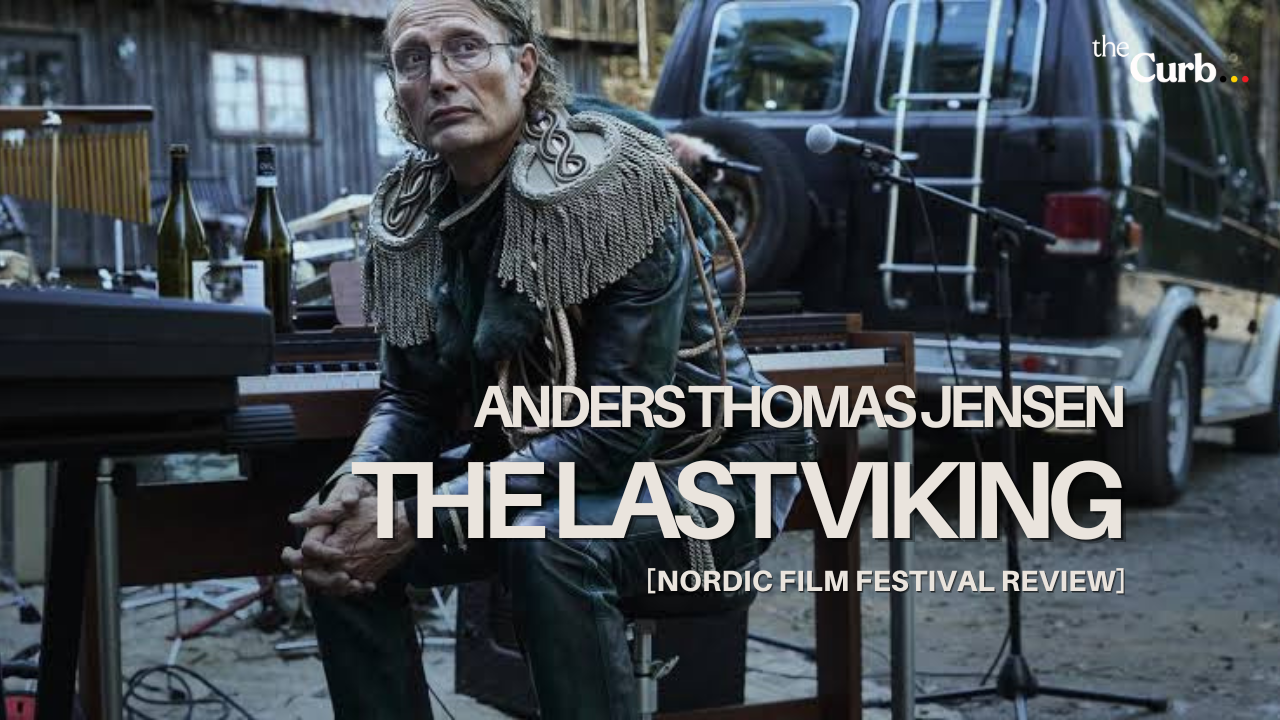
For Anders Thomas Jensen, surrogate families always come with bountiful eccentricities. Like his fiendishly good Riders of Justice, Jensen’s new film The Last Viking isn’t interested in whether crime pays as much as whether it’s worth the trouble when your brother insists he’s actually John Lennon. The crime itself is straightforward: Anker (the dependable Nikolaj Lie Kaas) has done the hard part of robbing a bank, yet, in this strange world, the part of trusting his brother Manfred (a playful and childlike Mads Mikkelsen) to bury his stolen money until the heat around the corner subsides presents itself as a much more challenging task.
After serving a considerable 15 years in prison, the mostly unaged Anker is now ready to claim his long-awaited prize, only to discover his brother Manfred has been diagnosed with dissociative identity disorder, a condition severe enough that jumping out of a moving vehicle when he’s not referred to as John Lennon is an entirely sensible decision. “You don’t even look like him. The glasses aren’t even right.” But for Manfred, his delusions outwit his reality: “We’re saving up for them.” If self-harm is a serious business, here it provides an abundance of bleak mirth, providing one of the year’s more memorable moments – a reflective, soft piano-laden sequence of injury recovery comes to a sudden halt when another mention of Manfred’s old name triggers him to jump out a hospital window. It’s an abrupt, black-hearted comedic shock that takes you off your seat in laughter. Yet Jensen never lets any suffering pass without meaning – we are told (and shown) that Manfred’s condition originates from past traumatic experiences.
The densely layered bizarreness continues to grow as the understandably befuddled Anker befriends Manfred’s doctor Lothar (a tenaciously optimistic Lars Brygmann), who during a night of alcoholic debauchery establishes a plan to break Manfred out of his delusions: they’ll travel to Amager to pick up a patient (Peter Düring) who thinks he’s Ringo Starr, then to Sweden to get Hamdan (Kardo Razzazi), whose personality can be both Sir Paul McCartney and George Harrison, but understandably not at the same time. For Anker, his mindset is one of desperation – if getting back his brother, and by extension his money, means pretending The Beatles have been reunited, then he’ll suppress his critical faculties in the face of the absurd. Even with neurotic peccadilloes, many of the characters are kept wonderfully grounded because their traits of delusion are sweetly recognisable. As underdogs, misfits, outliers, we connect to them because of their eccentricities rather than in spite of them; indeed, people with delusions of grandeur, but a sensitive, likeable grandeur. Who hasn’t imagined themselves as a successful rock star? Or felt the urge to elevate their own sense of importance? Escaping reality is part of being human: and for these characters, both diagnosed and not, they are regularly in a state of fantasy, convincing themselves of a world that supports the hiding of pain.
For Anker, finding the money might hide the ramifications of his own traumatic childhood. Yet digging holes in the woods and observing The Beatles discordantly attempt ‘Twist and Shout’ is not getting him anywhere, not least when his old criminal associate Flemming (a crude and hilarious Nicolas Bro) is hunting him down for the cash. Just as likely to break your nose as he is to fix your broken door frame, Flemming is an inspired oddity in a film brimming with them. A bearded gangster who, after a swift punch to the face, will not hesitate to apologise for being a bit too dramatic. In a film as playful as this, a simple criminal with violent tendencies becomes an opportunity to embrace and subvert our expectations simultaneously. Once again, Anders Thomas Jensen’s ability to both integrate and discard genre traditions is what makes his work feel so fresh: we get the thrills and the laughs, and neither has to be sacrificed for the other.
There’s a ruthless tonal mash-up quality too – references to IKEA, the holocaust, Heinrich Himmler, and ABBA abound in dialogue that fearlessly mines silliness and trauma together. For neighbour Margrethe (the wonderful Sofie Gråbøl), she exists in a world where she’s so beautiful, she can’t possibly be taken seriously unless she had married a husband (Søren Malling) who is decidedly not handsome. When her husband tells the group, “Without a common reality, there’s nothing,” suddenly Jensen’s script leans towards bigger questions about the world we live in and the nature of objective truth. His point is you can’t just call yourself John Lennon; you have to earn it. There has to be consensus.
Nevertheless, delusions can produce results: a concluding talent show underlines that our very eccentricities can bind us together. Maybe in this space of imagined selves, we can share the weight of our collective damage. In the collision of comedy and tragedy, The Last Viking is happy to ensure there’s plenty of space in the world for absurdity and sincerity; and thank goodness for that.
Director: Anders Thomas Jensen
Screenplay: Anders Thomas Jensen
Cast: Mads Mikkelsen, Nikolaj Lie Kaas, Sofie Gråbøl, Nicolas Bro, Lars Brygmann