
Welcome to the second instalment of the Noughts Report. A sequel to 90s All Over Me, each entry revisits a year in film from the 2000s, highlighting movies big and small and the careers and genres and trends that ignited or flamed out along the way. This attempted kaleidoscope is 100% subjective and AI-free, so if I bag or barely mention a film you love, or orate at length or heap praise upon a film you loathe, I apologise.
The first edition of the Noughts Report opened with Steven Spielberg’s A.I. Artificial Intelligence. I’ll kick off this second entry with another two Spielberg releases.
A handful of times throughout his prolific career, Spielberg has delivered two new releases in a calendar year, the sort of creative and industrial feat only the world’s most well-resourced director could engineer. Most famously, Jurassic Park and Schindler’s List were released in 1993, but there’s also Always and Indiana Jones and the Last Crusade in 1989, The Lost World and Amistad in 1997, War of the Worlds and Munich in 2005, The Adventures of Tintin and War Horse in 2011, and in 2002 Minority Report and Catch Me If You Can. That both titles swiftly followed 2001’s A.I. Artificial Intelligence, itself an ambitious sci-fi production, only adds to the accomplishment.
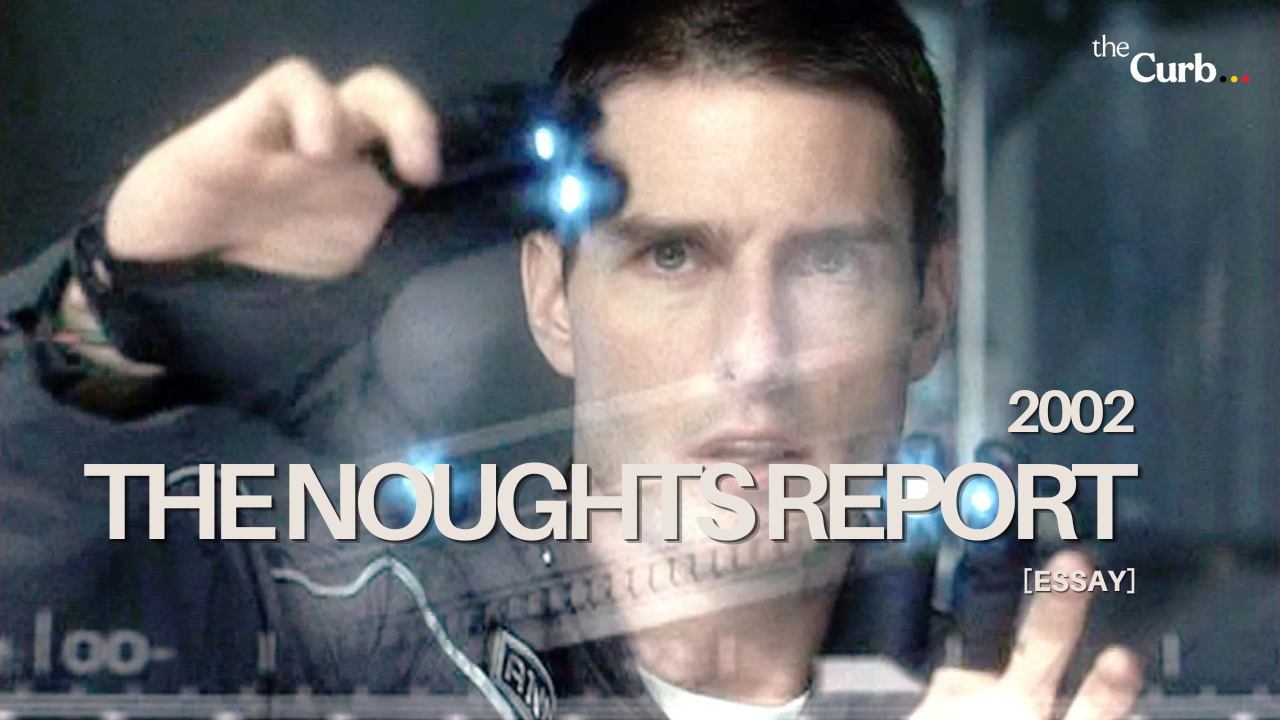
Minority Report is a futuristic action noir where Tom Cruise, who apprehends criminals before crimes can be committed, is accused of a future crime and goes on the lam. Spielberg cited The Maltese Falcon and his own Raiders of the Lost Ark as touchstones for the film, which is a pretty sound gauge. While its bleached aesthetic hasn’t aged well, Minority Report’s vision of a future in which screens are regularly swiped was certainly prescient; indeed, while a case could be made for War of the Worlds, I’d argue this was the last time Spielbergian iconography majorly indented on the broader culture. Cruise is characteristically 110% invested, the script is sturdy, the set-pieces are inventive, and there’s a streak of off-kilter comedy that evokes 1941, for good or ill.
Period comedy-drama Catch Me If You Can, meanwhile, is the true story of a youthful con artist (Leonardo DiCaprio) on the lam from a federal agent (Tom Hanks). Some heaviness and pathos underscore this very entertaining film and its ostensibly light, playful touch. The same could be said for Minority Report, making this the first time—unlike the previous Last Crusade/Always, Jurassic/Schindler’s, and Lost World/Amistad pairings—that the populist and the serious were intertwined in Spielberg’s calendar year double bills rather than segregated across them. In the case of Catch Me If You Can—at risk of re-reading the entire Spielberg filmography, post-The Fabelmans, as the director’s cosy and costly psychiatrist’s couch—fathers and sons and parental divorce have something to do with it.
Hanks and DiCaprio prove surprisingly effective foils: I say surprisingly as very little on their CVs before or since suggests they’d be fun onscreen sparring partners. Both stars were also miscast in high-profile period gangster films from major directors that year, Road to Perdition and Gangs of New York. Both are handsome, excellent, and somewhat lifeless.
Road to Perdition is a 1930s-set, Lone Wolf & Cub-esque tale of a mob killer (Hanks) and his son on the lam. The film was Sam Mendes’ follow-up to his Oscar-minted American Beauty, and one of the string of American-centric films Mendes made before realising he loved Britain and going all in on Albion with two James Bond films, 1917, and four pending Beatles biopics.
With its stately compositions—finely burnished by cinematographer Conrad Hall—and pregnant pauses, Mendes’ approach on Perdition foreshadows his approach to Bond on Skyfall and Spectre, films that project grave profundity on a series that, at its commercial zenith, saw Roger Moore drive a hovercraft through the streets of Venice causing pigeons to do double-takes. However, there’s lovely work here from Paul Newman in his final screen role and effective work from Jude Law as a weaselly hitman and future Bond Daniel Craig as Newman’s half-Sonny, half-Fredo son.
There’s nobody on the lam in Gangs of New York, set in 1860s New York and helmed by Martin Scorsese, but there are surrogate fathers & sons and a sacrificial lamb in Liam Neeson, three years before voicing another sacrificial lamb, Aslan, in The Chronicles of Narnia. Years after Neeson’s death at the hands of crime kingpin Bill the Butcher (Daniel Day-Lewis), his grown-up son (Leonardo DiCaprio) seeks revenge.
Critics who unfairly lambasted Paul Dano for being blown off screen by Day-Lewis in There Will Be Blood (not true) failed to note the same (quite true) of DiCaprio in Gangs of New York; though the film carries import as the first of six DiCaprio/Scorsese collaborations, it’s the least in terms of DiCaprio, with the newly adult leading man failing to muster gravitas. Gangs was a passion project for Scorsese, but it’s passion without focus.
In addition to Spielberg and Scorsese, two other famed Movie Brats with 2002 releases were Brian De Palma and George Lucas. De Palma’s Femme Fatale is stylishly made, tremendously watchable, and probably the last great De Palma film; later works have standout moments, but none spark from scene to scene the way this does. Those scenes are held together with one part dream logic ala the previous year’s Mulholland Drive, one part movie hokum, and the whole house of cards could come tumbling down with a wisp of air, but it’s an elegantly stacked house of cards.
Rebecca Romijn-Stamos, then a hot commodity following X-Men, is terrific as the titular femme fatale; Antonio Banderas is there mostly to react, but reacts well. To the degree that, as the saying goes, every new film is a response to its director’s previous film, this was certainly De Palma pivoting back to his signature milieu of impeccably-made Hitchcockian throwbacks after the disappointing Mission to Mars.
George Lucas, of course, continued his prequel Star Wars trilogy with Episode II: Attack of the Clones. While to some degree reacting to his previous film—most notably less of the maligned Jar Jar Binks—Lucas didn’t need to take notes and mostly doesn’t. The central romance between an emo Anakin Skywalker (Hayden Christensen) and Padme (Natalie Portman) is a slog, and there’s much woodenness and awkwardness and tin-eared dialogue, but Ewan McGregor comes into his own as Obi-Wan Kenobi, Christopher Lee has fun at antagonist Count Dooku, Yoda rips, and there are some very engaging sequences. My review of Phantom Menace mostly applies here too: it’s a “magnificent, ambitious, wildly imaginative, terribly boring space opus”.
While Star Wars and Star Trek movies have tended to alternate calendar years, 2002 was one of two years (see also 2016) both franchises had films in release. To appropriate a saying about Sydney and Melbourne, if there was a Star Wars/Star Trek rivalry, nobody told Star Wars. Star Trek: Nemesis is notable as the swansong for the Next Gen crew on film—and Trek on film full stop until J.J. Abrams’ 2009 reboot—and the screen debut of Tom Hardy as villain Shinzon, a botched Picard clone, albeit doing none of the things that make Tom Hardy interesting.
Star Trek: Nemesis was also the directing swansong of Stuart Baird, a preternaturally skilled editor of mainstream entertainment who helped sculpt hits (Superman, Lethal Weapon) and salvaged troubled productions (Tango & Cash, The Last Boy Scout, Demolition Man) but proved a middling director over three so-so movies (Executive Decision, US Marshalls, this). There’s little to recommend about Nemesis, even for Trek completists, with none of the wit or charm or poptimism or smarts of the larger franchise.
Where Phantom Menace was the blockbuster event of 1999—or at least was hyped accordingly—newer franchises shared its oxygen in 2002, with Harry Potter and Lord of the Rings sequels rolling out one year after their first instalments. Harry Potter and the Chamber of Secrets is more of the same, with the value-add of some witty self-portraiture from Kenneth Branagh playing a self-aggrandising showboat wizard.
The Lord of the Rings: The Two Towers is, for my money, the most interesting and textured of the trilogy. The scenes with Frodo and Sam interacting with Gollum, motion-capture performed by Andy Serkis and digitally rendered by Weta, are rightly celebrated effects achievements, but of the fragmented Fellowship I’m much more interested in Viggo Mortensen’s Aragorn inching towards his throne, the role bequeathing the actor a rare opportunity to channel all that weird charisma into a conventionally heroic star turn.
The seeds of things to come with the Hobbit films, however, are starting to sprout, with the Battle of Helms Deep, impressive as it is, elaborating a handful of pages of Tolkien into an entire Act of the movie.
Another franchise took flight in 2002 with Spider-Man, lifting the nascent superhero genre to new levels of success and—with Blade and X-Men—confirming Marvel as the premier supplier for IP, at least for this decade. Given how networked and alternatingly self-serious and self-effacing the genre has become, it’s refreshing thinking back to how joyful, uncomplicated, and heart-on-its-sleeve earnest this movie was. Filmmaker Sam Raimi—like Lord of the Rings director Peter Jackson a former disreputable horror auteur—nailed the assignment. So too did Guillermo Del Toro with superior sequel Blade II.
Other non-superhero comic-book adaptations that year included the abovementioned Road to Perdition and French comedy Asterix & Obelix: Mission Cleopatra—in which the seemingly-morbidly-obese-at-the-time Gerard Depardieu, in hindsight, looked pretty healthy—while mediocre black comedy Comic Book Villains cashed in with a tale of comic shop proprietors warring over a deceased nerd’s booty.
Spider-Man’s marketing and some of the film’s content were altered in the wake of the September 11 2001 terror attacks; ditto Collateral Damage, another disappointing, cookie-cutter post-Fugitive film from director Andrew Davis, in which Arnold Schwarzenegger’s firefighter avenges his wife and daughter, both slain in a terror attack. Like any Schwarzenegger film, it has its moments, but they’re few and far between, and I’d rank this in the lower rung of its star’s major productions.
I’m a bigger fan of rival Sylvester Stallone’s slasher/action hybrid D-Tox, also (badly) called Eye See You. I’ll concede my Stallonean biases sway me towards this critically derided thriller, but beyond that I appreciate its atmospheric snowy isolated setting (echoes of The Thing) and ensemble of crusty character actors getting picked off (ditto). Sly also featured in the low-key mob rom-com Avenging Angelo, which has its charms, and partner in Planet Hollywood Bruce Willis bored in the boring Hart’s War, which could have been called Hart’s Bore.
Whilst Star Trek hitting ten features in 2002 was no slouch, the James Bond series hit 20 (canonical) releases with Die Another Day. Like Star Trek: Nemesis, this is one of the lesser titles in its franchise, though where Nemesis suffers from a deficit of fun, Die Another Day forces so much ‘fun’ on its audience—Pierce Brosnan’s Bond surfs into North Korea, kite surfs a melting glacier, drives an invisible car, fights villains with diamonds stuck in their faces, fights villains wearing power suits, sword fights in a fancy club, banters with Madonna, etc—that, like a surplus of sweets, the audience maxes out. This type of bloat is not uncommon in other fourth-time outings for reigning Bonds—see also Thunderball, Moonraker, Spectre—but they don’t seem quite as desperate to please, something I never imagined I’d write about Moonraker.
When discussing Planet of the Apes in my last piece, I noted that Die Another Day was one of those occasions where, despite big commercial success, there’d be no ‘fool me twice’ from audiences and the franchise was forced to course correct. That would come just four years later with 2006’s Casino Royale. I love that film, but am mixed on the rest of Daniel Craig’s era; maybe the pendulum swung too far with two decades of a sad sourpuss Bond who looks, moves, talks, and acts like a surly bouncer. We’ll get into it. In the meantime, thank you Pierce Brosnan for your four films and seven years on Her Majesty’s Secret Service. It looked painful.
While Bond pressed into the ridiculous, Mike Myers continued his hustle in actual Bond parody with Austin Powers in Goldmember. Ben Affleck and Matt Damon, meanwhile, headlined spy films from door-stopping bestsellers: Affleck in The Sum of All Fears, adapted from one of Tom Clancy’s Jack Ryan novels, and Damon in The Bourne Identify, adapting the first of Robert Ludlum’s books about the amnesiac agent.
The Sum of All Fears pales in comparison to previous Jack Ryan movies (Hunt for Red October, Patriot Games, Clear and Present Danger), in part because of Affleck’s cheesy performance, but largely because it’s thoroughly lacking in inspiration or intrigue, surprising given it was helmed by Field of Dreams and Sneakers director Phil Alden Robinson. The Bourne Identity, in contrast, was helmed by hungrier talent in Doug Liman. While Liman’s far from infallible, he brought a fresh vantage point and enough left-of-kilter sensibility to what could have been pro-forma studio product.
Still on the spy games, Vin Diesel reteamed with his The Fast and the Furious director Rob Cohen on XXX, playing an extreme athlete recruited into espionage. Future Fast and Furious alumni The Rock and Jason Statham graduated to above-the-title status with The Scorpion King—a Conan the Destroyer-esque romp from genre mainstay Chuck Russell (The Blob, The Mask, Eraser)—and The Transporter respectively. All three are dumb fun.
As the decade unfolds, there will be a couple of instances where I’ll rack my brain as to whether I’ve seen a particular Jason Statham movie or are confusing it with another Jason Statham movie where he plays a taciturn professional in a questionable profession who ultimately lends his fisticuffs to good, but I can vouch that The Transporter is one of the better, more memorable entries in that canon.
Elsewhere in the genre, the unlikely duo of Chris Rock and Anthony Hopkins headlined Joel Schumacher’s Bad Company, a drab action-comedy despite its director’s well-documented questionable taste. Occupying a more elevated tier, Zhang Yimou’s gorgeous, colourful Wuxia epic Hero married consummate craft to collectivist politics.
Like Rock (Chris, not The), Eddie Murphy headlined a couple of buddy action-comedies, with greater stress on the comedy: I Spy, updating the Robert Culp/Bill Cosby TV series, alongside Owen Wilson, and Showtime opposite Robert De Niro. He’s also the titular Pluto Nash in sci-fi comedy The Adventures of Pluto Nash, a notorious commercial turkey, par the course when you spend $100 million on a movie, call it The Adventures of Pluto Nash, and market it poorly.
I Spy is the best of the trio, with Murphy riffing on Mike Tyson as a boxer turned spy, but he’s entertaining across all three titles and certainly more engaged than the previous year’s Doctor Dolittle 2. Having said that, looking at this line-up it’s hard to shake the feeling those movies all exist due to avarice.
Ditto De Niro, jobbing and pulling nothing new from his bag of tricks across Showtime, sequel Analyse That, and City by the Sea, a bland thriller despite its evocative setting. De Niro occupies a rarefied air as an actor, but this is a complaint I’ll return to frequently throughout the decade, especially after a 90s where he slayed repeatedly, not just in the expected Scorsese titles but also Heat, Copland, Jackie Brown, Ronin, and so on.
In contrast, following 2001’s reviled 3000 Miles to Graceland, Kevin Costner’s earnest commitment to whatever material he’s servicing—the sort of commitment that compels a man to self-finance, direct and star in a four-part saga of the American West in his twilight years—was better rewarded in 2002 with Dragonfly. Not rewarded with bonanza box office or awards attention, but a pretty decent spooky drama with Costner as a grieving widower who senses his wife communicating from the afterlife. The film marked a dramatic pivot for director Tom Shadyac, previously a purveyor of broad comedy (Ace Ventura, The Nutty Professor, Liar Liar), and was clearly an attempt by Costner to tap into fumes of The Sixth Sense’s success.
Mel Gibson, meanwhile, went straight to the source with M. Night Shyamalan’s Signs, also playing a grieving widower, here a pastor-turned-farmer who discovers crop circles in his field as a precursor to alien invasion. Like his work with Bruce Willis on The Sixth Sense and Unbreakable, Shyamalan elicits a very fine turn from Gibson, not exactly a subversion of persona but an interesting wrinkling of it. Gibson’s subsequent (and soon to unfold) troubles are well-documented, but he’s never less than compelling to watch, and plays well against the child actors and, surprisingly, Joaquin Phoenix. Where The Sixth Sense and Unbreakable played relatively straight, there’s an encroaching archness here—the same archness that would typify Shyamalan’s later, independently-financed, mischievous works—that was starting to flummox audiences.
Gibson also headlined the respectable We Were Soldiers, helmed by Braveheart screenwriter and regular collaborator Randall Wallace. After all the high-profile films that grappled with the Vietnam War across the 1970s and 80s (Apocalypse Now, The Deer Hunter, Platoon, Full Metal Jacket, Casualties of War, Born on the Fourth of July), the genre was relatively dormant throughout the 90s. We Were Soldiers didn’t ignite a new cycle of movies covering that well-worn, uncomfortable terrain, but it’s a solid addition to that canon and a distinctly post-Saving Private Ryan venture in its visceral treatment of combat.
Signs and We Were Soldiers were Gibson’s last starring roles of the decade; he’d focus on directing (The Passion of the Christ, Apocalypto) and become tabloid spectacle over the rest of the noughts, then return before the camera—with baggage—in 2010’s Edge of Darkness. Thus ended Gibson’s incomparable run as, arguably, Australia’s greatest export movie star, greater than Errol Flynn (another problematic character) and Kidman and Crowe and Jackman and all other contenders to the mantle.
Side bar: We Were Soldiers was one of four films released in 2002 shot by the gifted Australian DP Dean Semler, alongside D-Tox, XXX, and Dragonfly: a motley crew of titles all bolstered by his work.
Earlier wars were subjects for other high-profile productions: Windtalkers, a John Woo-steered, Nicolas Cage-starring WWII actioner about marines protecting Navajo code breakers; K19: The Widowmaker, directed by Kathryn Bigelow on what was, until Wonder Woman, the most expensive production helmed by a woman filmmaker, with Harrison Ford as a scowling Soviet submarine captain; and The Four Feathers, from Elizabeth director Shekhar Kapur, set in colonial Sudan and featuring Heath Ledger as a soldier who must prove his mettle after being labelled a coward.
As these releases unspooled, the US waged IRL war in Afghanistan in the aftermath of 911. The shadow of 911 looms over New Yorker Spike Lee’s excellent, engrossing drama 25th Hour, and formed part of the tapestry—along with the soon-to-break second Iraq War—of the release, reception, and eventual awards run of Michael Moore’s Bowling for Columbine.
Speaking of awards, a trio of very good movies would reign over the major Oscar categories: Roman Polanski’s Holocaust drama The Pianist (Director, Actor), Stephen Daldry’s timeline-hopping literary women’s drama The Hours (Actress), and Rob Marshall’s spry adaptation of stage musical Chicago (Picture, Supporting Actress). All strong, pedigree works, well-made and well-acted, but business as usual from the Academy.
Julianne Moore excelled in both The Hours and Todd Haynes’s Douglas Sirk homage Far from Heaven, which transforms the subtext of those Technicolor melodramas into text. Even riper, less skilful melodrama is tapped in the overwrought John Q, where desperate dad Denzel Washington takes an emergency room hostage to force a doctor to perform his son’s operation. I’m sure there were Oscar aspirations there, which went unrewarded. Ditto for Kevin Kline side-eyeing Dead Poet’s Society/Mr Holland’s Opus-style inspirational teacher acclaim in The Emperor’s Club.
Also not nominated or awarded, but thoroughly deserving of all the gongs, was Anna Farris in The Hot Chick. I’m not joking; she delivers a funny, tender, tremendous performance. The broad body swap comedy also features Rob Schneider’s best work, which may sound like faint praise, but he’s really very good in it.
Adam Sandler also delivered awards-worthy work opposite Emily Watson in Paul Thomas Anderson’s stylish, swoony, funny, aggro romance Punch-Drunk Love. Whilst Altman and Scorsese were common points of comparison for Anderson’s work in the 1990s, and are evident here to some degree (especially After Hours), this feels like the closest Anderson came to making a low-key Woody Allen picture. Sandler also starred in Mr Deeds, which did not bother the Academy.
Steven Soderbergh flexed the clout afforded by his dual Oscar nominations (and one win) for Erin Brockovich and Traffic and the success of Ocean’s Eleven with two characteristically perverse choices: Solaris, starring George Clooney and adapting the revered Russian sci-fi epic into something both very Hollywood and not very Hollywood, and LA-set, shot-on-video ensemble Full Frontal. Spike Jonze and screenwriter Charlie Kaufman, much-lauded after Being John Malkovich, reteamed on Adaptation, about Kaufman (played by Nicolas Cage, with a twin brother also played by Cage) struggling to adapt an unfilmable book; meta hijinks ensue. Another of the class of 1999, Election director Alexander Payne, released About Schmidt, with Jack Nicholson alternately funny and affecting as a newly widowed retiree disgruntled at his daughter’s choice of fiancée; hot tub hijinks ensue.
Kaufman also scripted George Clooney’s directorial debut Confessions of a Dangerous Mind, about a game show host who supposedly moonlighted as an assassin. It’s the best of Clooney’s generally middlebrow and unmemorable directorial work, perhaps due to the material and Clooney’s early reflex to emulate the style of his strongest collaborators (Soderbergh, the Coens).
With recent debate about AI-generated actress Tilly Norwood and the Academy updating its eligibility criteria to ward off GenAI-developed content from consideration, Andrew Niccol’s S1m0ne—about a producer (Al Pacino) who casts a computer-generated actress in his new movie and becomes its hapless Svengali—is newly topical. Not interesting or good per se, but topical. The film is prescient but also very much timestamped in its rendering of S1m0ne.
Other films timestamped by the technologies they depict are Paul Schrader’s Autofocus, dramatizing the seedy exploits of Hogan’s Heroes star Bob Crane (Greg Kinnear) and his lackey pal (Willem Dafoe), recorded for posterity on videotape; Joel Schumacher’s effective Phone Booth, vastly superior to Bad Company and boasting a sharp script by Larry Cohen, where a hotshot exec (Colin Farrell) is menaced over pay phone by a sniper, malevolently voiced by Kiefer Sutherland; and Mark Romanek’s slow burn thriller One Hour Photo, in which photo developer Robin Williams develops an obsession with his customer’s family. The technologies at the core of these features would go from commonplace to niche within a few years of their releases.
Also of its moment: Ali G Indahouse. The film debut (and no longer swansong) of Sacha Baron Cohen’s first marquee comedy creation is amusing in a sitcom way, though I was more entertained by the in-character publicity tour. Borat and Bruno would better translate the dangerous live theatre of Cohen’s original program to film, though they don’t afford the pleasure of seeing Charles Dance stiffly dancing in a dress: Tywin Lannister in more frivolous times.
Three other notable British releases of 2002 were Bend it Like Beckham, a lively teen sports comedy; Dirty Pretty Things, a thriller from Stephen Frears grappling with class and racial tiers in London; and 28 Days Later, an excellent low-budget, shot-on-digital-video zombie film from Danny Boyle. The latter spawned a 2007 sequel and, eventually, a franchise, with Boyle returning for last year’s 28 Years Later. Both 28 Days and Years would be creative revitalisations for Boyle after major studio productions: the former following the costly and maligned The Beach—based on a novel by 28 Days Later screenwriter Alex Garland—and the latter after Boyle’s Richard Curtis-produced and scripted rom-com Yesterday.
All three of these British releases provided launching pads for major new acting talents in Keira Knightley, Chiwetel Ejiofor, Cillian Murphy, and Naomie Harris, as well as screenwriting talent in Garland and Steven Knight.
28 Days Later also helped usher in a zombie movie revival alongside Paul WS Anderson’s video game adaptation Resident Evil. Other 2002 genre releases included American remake The Ring; Japanese originals Dark Water and The Grudge; notable debuts from Eli Roth (Cabin Fever) and Neil Marshall (Dog Soldiers) and Lucky McKee (May); another William Castle remake, Ghost Ship; sequel Halloween: Resurrection; Don Coscarelli’s Bubba Ho Tep, featuring a fun performance from Bruce Campbell as old man Elvis fighting a mummy; the quite bad Fear Dot Com; and the solid The Mothman Prophecies.
Queen of the Damned, from Australian director Michael Rymer (Angel Baby), adapts one of Anne Rice’s literary sequels to Interview with the Vampire but shares no cast or creatives with that earlier film. It’s most notable for featuring the late Aaliyah—an undeniable screen presence—in her final movie role, and is the only time Matthew Newton has played a character also portrayed by Antonio Banderas. The film’s too interesting and competently made to be an ashcan production, but has that unfortunate vibe.
Not quite horror but in its ballpark are submarine-set chiller Below from David Twohy, a gifted writer-director in the Larry Cohen mode—though less prolific—able to wring maximum juice from a nifty premise; David Cronenberg’s Spider, about a stunted man (Ralph Fiennes) reliving childhood traumas; and Reign of Fire, featuring Christian Bale, Matthew McConaughey, and dragons. Equilibrium also features Christian Bale in a future envisioned as 1984 meets The Matrix. I look forward to Matrix-inspired action decreasing as the decade rolls on.
I alluded above to Robin Williams’ creepy turn in One Hour Photo. This was one of three villain performances from the typically benign comedy star in 2002, seemingly a creative circuit-breaker after a string of overly sentimental movies taxed audiences’ goodwill (What Dreams May Come, Patch Adams, Jakob the Liar, Bicentennial Man). The second, Death to Smoochy, is in a more comedic tenor, albeit a very antic one consistent with Danny De Vito’s other work as director. Williams plays a disgraced children’s television host seeking to take down a Barney-type rival (the dinosaur, not Matthew Barney) named Smoochy, played drippily by Edward Norton.
The third and best, Insomnia, sees Williams as a killer taunting Al Pacino’s sleep-deprived detective, who’s losing his marbles in an Alaskan town that’s daylight 24/7. This remake of a Norwegian original served as Christopher Nolan’s bridge between the low-budget ingenuity of Memento and the big-budget bombast of Batman Begins.
When an actor has multiple films in release in a calendar year, that’s sometimes stratagem, sometimes circumstance, some happenstance, and sometimes bad luck. Anne Hathaway in 2026 is a best-case scenario; Jude Law in 2004 was a worst-case scenario. Guy Pearce had a duo of high-profile international releases in 2002 (The Count of Monte Cristo, The Time Machine) as well as a pair of Australian features that didn’t really travel internationally (The Hard Word, Til Human Voices Wake Us).
The Time Machine sees Simon Wells, director of the animated Prince of Egypt and descendant of H.G., adapt his great-grandfather’s late Victorian-era sci-fi novel, with Pearce inventing a time machine to prevent his beloved’s death but instead being flung into a distant dystopian future where Jeremy Irons is an albino Morlock. It’s an odd but engaging duck. More conventionally entertaining is Kevin Reynolds’ The Count of Monte Cristo, with Pearce as the conniving villain who betrays Jim Caviezel’s Edmond Dantes. It’s not as entertaining as Reynolds’ ropey but rousing Robin Hood: Prince of Thieves, but hangs together more elegantly. This and the second Harry Potter film were Richard Harris’s final screen roles.
The Hard Word is a lot of fun: a gnarly comedic crime film with a well-honed, sweary turn of phrase in which Pearce, Joel Edgerton, and Damien Richardson are sibling convicts released from prison to commit crimes. And Til Human Voices Wake Us sees Pearce haunted by a teenage tragedy and meeting a woman (import Helena Bonham-Carter) who may be linked to this event.
As a fan of Pearce from LA Confidential and Memento, I was watching intently throughout this decade as he cultivated a career locally and globally, pivoting and zagging in terms of roles, genres, and characters. Whilst Pearce never attained the same star status as some of his (lesser) contemporaries, and has increasingly booked gigs for commerce, I love that he’s received renewed recognition in the wake of The Brutalist and continues to work across a range of genres, locally and abroad, in roles and on productions big and small.
Australian director Phillip Noyce also had two films—one international, one local—debut in 2002, though the former was a much-delayed release due to the machinations of Miramax. The Quiet American, adapted from Graham Greene—newly in vogue between this, The End of the Affair, and riff The Tailor of Panama—and set in Vietnam during the Indochina War, is something of a secret masterpiece, with a literate script and some career-best work from Michael Caine and Brendan Fraser. Rabbit-Proof Fence was Noyce’s local production, chronicling three Stolen Indigenous girls’ journey home across harsh countryside.
Both films are well-paced and tense, clearly benefiting from Noyce’s years in Hollywood crafting propulsive mainstream entertainment; there are alternate versions of both films that could have been longer, more pious, and less accessible. Both are also clearly works of a filmmaker doing a form of penance for said mainstream entertainments—evidently feeling guilty for directing Blind Fury and Sliver—with artful cinematography by Christopher Doyle (who also shot Hero) adding further pedigree.
Bruce Beresford also delivered the sweet, amiable period drama Evelyn, featuring Pierce Brosnan as an Irish father fighting the state for custody of his children; whisking them away in his invisible car was not an option.
Four very good Australian films were partly funded by and enjoyed world premieres at the Adelaide Festival of Arts: The Tracker, Beneath Clouds, Australian Rules, and Walking on Water. I particularly like Beneath Clouds, the feature debut of Ivan Sen, and The Tracker, helmed by the always-interesting Rolf De Heer. That film, about an Indigenous tracker (Gulpilil) leading a posse in pursuit of a wanted man, is scored to songs by Archie Roach and deploys still paintings to depict acts of violence; these multiple modes of expression give the film dimension and weight beyond its moving images.
Crocodile Hunter: Collision Course, unsurprisingly, did not premiere at the Adelaide Festival of Arts. Other local comedies of 2002 included the middling The Nugget and amusing Crackerjack. David Caesar’s gangster comedy Dirty Deeds and Alex Proyas’s Garage Days are both very entertaining, the latter a world away from the darker milieu of The Crow and Dark City but packed with visual invention.
Black and White also grappled with racial injustices, and was one of several Australian features with imported stars—a trend that’s decreased in recent years—in the forms of Robert Carlyle and Charles Dance; see also Rabbit-Proof Fence’s Kenneth Branagh, Dirty Deeds’s John Goodman, and the abovementioned Helena Bonham-Carter. Across the Tasman, the thoughtful New Zealand film Whale Rider also debuted and made an unlikely star and Oscar nominee of Keisha Castle-Hughes.
Animated releases of 2002 included Lilo & Stitch, Ice Age, Spirit: Stallion of the Cimarron, and Studio Ghibli’s The Cat Returns. All have their fans, some rabid; I’m not the guy to praise or parse them. Live-action family films included Big Fat Liar and Snow Dogs, while family-friendly sequels included Men in Black II and Spy Kids 2.
A less-family-friendly sequel, Red Dragon, brought Anthony Hopkins’ Hannibal Lecter back to screens. Set before The Silence of the Lambs, the film is the second adaptation of Thomas Harris’s novel, previously adapted by Michael Mann as Manhunter. The film suffers in comparison to Manhunter, Silence, and Ridley Scott’s Hannibal, released one year earlier. It’s efficiently directed by journeyman Brett Ratner, diligently performed by an accomplished cast, and is largely unmemorable.
Whilst not a sequel, The Importance of Being Earnest is certainly a companion piece to 1999’s An Ideal Husband, reuniting director (Oliver Parker), star (Rupert Everett), and source author (Oscar Wilde) for more shots at the ruling class.
At the more transgressive end of the cinema spectrum were Gaspar Noe’s compelling but confronting Irreversible; Larry Clark’s Ken Park; Olivier Assayas’s Demonlover, in its own way as thematically prescient and visually timestamped as Minority Report and S1m0ne; the gross Spun; and Roger Avary’s Rules of Attraction. The latter, adapted from a Brett Easton Ellis novel about the dissolute lives of college students, goes down the easiest of this bunch, thanks to Pulp Fiction co-writer Avary’s knack for casting and song choices, offbeat humour, and some clever execution.
Two more black comedies from 2002, circling power dynamics in relationships in different ways, were Secretary and Igby Goes Down; more mainstream comedic fare included Van Wilder, Big Trouble, and The Banger Sisters, while Orange County and Stealing Harvard both centre on the comedic extremes that characters and/or their families will go to secure places at premier universities.
The latter is one of the handful of Jason Lee star vehicles from this era. The James Bond movies are often held up as a dependable gauge of what was hot one or two years earlier—from the Roger Moore era, see Blaxpoitation (Live and Let Die), kung-fu (The Man with the Golden Gun), sci-fi (Moonraker), and bizarre Parisian butterfly acts (A View to a Kill; maybe you had to be there)—but all Hollywood operates on this logic in casting and greenlighting. Much of this piece highlights the successes and sins of the mid-to-late 90s come home to roost, and Jason Lee star vehicles are Exhibit J. Ultimately, the scrap and charm of Lee’s work for Kevin Smith in the 90s was never quite replicated for the mainstream, but at a brisk 80 minutes Stealing Harvard nary outstays its welcome.
Hugh Grant headlined About a Boy—a witty, perceptive film, quietly revelatory at the time coming from the then-default foppish star and the makers of American Pie—as well as Two Weeks Notice opposite Sandra Bullock and the current POTUS. Other 2002 rom-coms included Maid in Manhattan and Life or Something Like it, while female friendships took centre stage in Britney Spears vehicle Crossroads. Maid in Manhattan was scripted by no less than Edmond Dantes: not the wronged avenger of The Count of Monte Cristo, but John Hughes under pseudonym, and was one of the last movies picking over the remains of his (so-so) unfilmed screenplays.
A more literary chick flick was Possession, alternating between the love stories of two Victorian era poets (played by Jeremy Northam and Jennifer Ehle) and two researchers uncovering their romance (Aaron Eckhart and Gwyneth Paltrow). Rather curiously, this likeable if somewhat flavourless film, by necessity watering down a quite excellent source novel, was directed by Neil La Bute, who carved a profile in the 90s with the more acidic, less benevolent likes of In the Company of Men and Your Friends and Neighbours.
The stars of rom-coms also dabbled in studio thrillers, with Jennifer Lopez appearing in both Maid in Manhattan and Enough—as a battered wife who trains herself to take down her abusing husband—and Sandra Bullock in Two Weeks’ Notice and Murder by Numbers. These generic thrillers boasted very capable directors in Michael Apted and Barbet Schroeder respectively, pointing to the level of craft and clout still afforded this genre.
Nowhere was that clout more expended than David Fincher’s polished, impeccably-crafted, Jodie Foster-headlined Panic Room: it’s an excellent thriller, albeit a little soulless, and after Seven and Fight Club a case of Swiss engineering being applied to an Anko wristwatch. Even an ostensibly disposable teen stalker thriller like Swimfan, helmed by Australia’s John Polson, had a heavyweight producing patron in Michael Douglas.
Elsewhere in studio thrillers, High Crimes reteamed Kiss the Girls stars Ashley Judd and Morgan Freeman, while Trapped pitted Charlize Theron against nefarious Kevin Bacon. At the lower-budget end, Joe Carnahan made some splash with the dark, very effective Narc, as did DJ Caruso with The Salton Sea. No Good Deed ended the long, sometimes distinguished career of Bob Rafelson (Five Easy Pieces, The Postman Always Rings Twice) with something of a whimper.
European thrillers with American stars included Neil Jordan’s The Good Thief, featuring Nick Nolte, and Liliana Cavani’s Ripley’s Game, not connected to The Talented Mr Ripley but the continuing adventures of that older gentleman sociopath, here nicely essayed by John Malkovich. Between Ripley’s Game and Queen of the Damned, 2002 was a year for off-brand satellite sequels.
Two American dramas with thriller elements and somewhat European sensibilities, notably from British directors, were Adrian Lyne’s Unfaithful and Roger Michell’s Changing Lanes. The former is a drama of infidelity and revenge with the sheen of an erotic thriller, stylishly directed by a reliable purveyor of the form (9 ½ Weeks, Indecent Proposal). The latter depicts a bruising war of wills between affluent Ben Affleck—very good and attuned to the assignment, in contrast to The Sum of All Fears—and down-on-his-luck Samuel L. Jackson, equally strong.
An American in Paris, Jonathan Demme, remade Charade as The Truth About Charlie, with Thandie Newton and Mark Whalberg replacing Audrey Hepburn and Cary Grant. Big mistake. Big. Huge.
Like Changing Lanes, Hong Kong thriller Infernal Affairs—later remade as The Departed—would pit two notable stars against each other via heavyweights Tony Leung and Andy Lau, while the excellent South Korean thriller Sympathy for Mr Vengeance kicked off director Chan-Wook Park’s stylish Vengeance trilogy.
Ron Shelton—the poet laureate of sports movies, with credits including Bull Durham, White Men Can’t Jump, Cobb, and Tin Cup—pivoted with Dark Blue, a drama about police corruption and brutality set against the backdrop of the Rodney King trial. While the film lacks visual panache—never Shelton’s strong suit—it features a committed Kurt Russell performance.
Less committed was Clint Eastwood, before and behind camera, on Blood Work. The last of Eastwood’s star-vehicle thriller assignments—the “one for them” commercial movies he’d tackle to enable him in turn to make less commercial “one for me” titles like White Hunter, Black Heart and Midnight in the Garden of Good and Evil—this one feels especially perfunctory and knocked-off. The streak to follow of Mystic River, Million Dollar Baby, and Flags of our Father/Letters from Iwo Jima would put to bed the necessity of these commercial placeholders.
Though not thrillers, lifeless bodies link three art films: Pedro Almodovar’s Talk to Her, about two men who become friends while caring for the comatose women they adore; Lynne Ramsay’s Morvern Callar, in which Samantha Morton steals her dead boyfriend’s magnum opus and takes a dissolute vacation; and Francois Ozon’s musical dark comedy 8 Women, in which the titular octet—among them such luminaries as Catherine Deneuve, Isabelle Huppert, Fanny Ardant, Emmanuelle Beart, and Ludivine Sagnier—contend with each other and the unseen cadaver of the patriarch of the house.
There is also Friday Kahlo’s fragile body, enshrined in her art and enacted by Salma Hayek, in Julie Taymor’s colourful Frida, while Noah Taylor gives a curious performance as Adolf Hitler in his struggling artist years in the little-seen Max. Paul Greengrass tackles the 1972 Bogside Massacre with his signature verisimilitude in Bloody Sunday, and the one-take tracking-shot Russian Ark glides through the decorative vestiges of hundreds of years of Russian history.
I’ll end with two films about the perils of filmmaking. Behind-the-scenes documentary Lost in La Mancha captures the troubled production of Terry Gilliam’s attempt to adapt Don Quixote, which would eventuate years later and prove less than meets the eye. It’s an unflinching view of everything going wrong that possibly could go wrong, with Gilliam presiding Job-like over his film’s collapse.
Finally, Woody Allen’s Hollywood Ending—not something Gilliam enjoyed on Don Quixote, and not something Allen has particularly enjoyed of late. Of course, Allen’s Hollywood endings have rarely come without some caveats or compromises, most painfully and exquisitely in The Purple Rose of Cairo, where Mia Farrow finds her Hollywood ending on the theatre screen, watching Fred and Ginger in Top Hat, rather than IRL.
In Hollywood Ending, Allen’s protagonist—a director suffering hysterical blindness—must navigate a film production whilst concealing his condition. The resulting film is an abomination, but takes off in France and launches career opportunities overseas. It’s a joke aimed at crass Hollywood commercialism and European art film pretension, and somewhat self-prophesying given Allen would spend the second half of the decade making films in Europe with European funding and his final film would be an entirely French-language production.
In the interests of disclosure, I have not seen the undoubtedly terrific City of God. Nor Rollerball, because I want to keep liking John McTiernan. Nor Swept Away, because I want to keep liking Guy Ritchie. Nor Ballistic: Ecks vs. Sever, because I want to keep liking Antonio Banderas and Lucy Liu. Nor 8 Mile, My Big Fat Greek Wedding, Blue Crush, or Scooby Doo.
See you back here for 2003, marking the Return of the King and Quentin Tarantino, the flourishing of Scarlett Johansson, the arrival of Tommy Wisseau, and superhero flicks truly becoming the coin of the realm, though some cheques continue to bounce. Til then …