
When I was quite young a teacher related the story of the practice in some Aboriginal groups known as the “Pointed bone also known as “Kurdaitcha”. The accused person would have a bone pointed at them by an Elder as a curse and expulsion from the tribe. My teacher said that there was only the power of belief that the pointing of the bone would cause the death of the person. Later, of course, I understood that the belief caused psychosomatic symptoms which would lead to illness and possibly death. The idea stuck with me; the symbol of ostracism and curse carrying such weight in the tribal beliefs that it was imbued with the group consciousness. All believed that Kurdaitcha was a deadly punishment and that belief manifested itself.
While watching Charlie Polinger’s debut feature The Plague I was struck with how similar the group belief was about a made-up infliction “The plague” and how even if people could logically sense it wasn’t true, the extreme nature of bullying and ostracism turned that “plague” into something tangible and terrifying. The overwhelming homosocial pressures of belonging in a group of only just adolescent boys at a water polo camp fed into a myriad of anxieties, one of which is the awakening to the hormonal changes their bodies are undergoing and how to manage being in step with a peer group. External authority is useless (and at times makes difficult situations worse) and the boys, twelve and thirteen in age, take the social formation explored in William Goldman’s The Lord of the Flies. Hierarchical systems are inherent and inescapable because the structure is a loop. Weakness of any kind can be exploited and specifically “othered” by dominant personalities.
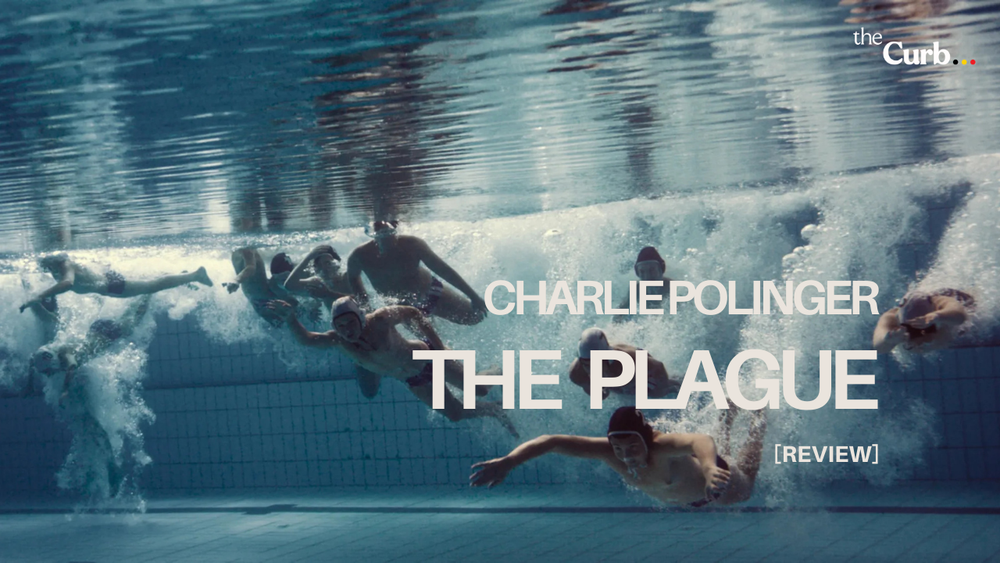
It's 2007 and an Olympic sized swimming pool seems peaceful until the bodies of boys break the surface like depth charges. The boys are part of the second session of the Tom Lerner Water Polo camp. They’re testing their newfound notions of maturing sexuality by exhibiting an immaturity that frustrates Coach Wags (Joel Edgerton). Dick pics drawn on the coach’s board, catch phrases yelped, and pale versions of teenaged rebellion against authority seem harmless enough. However, harm is not visible to the Coach the way it is to the other boys. The depth of the competition for ascendency within the group is misunderstood by adults who have perhaps forgotten the psychological and psychosocial damage extended hazing.
Ben (Everett Blunck) has newly arrived in the area. His mother moved them after leaving his dad for another man. Ben’s earnest, if a little anxious about being in a new place without friends. He doesn’t know “the rules” which makes him easy pickings for Jake (Kayo Martin) the cynical and cruel “leader” of the group. Ben’s pronunciation of a single word, “Stop,” earns him the name Soppy. Even when ostensibly invited to be a part of the group, Jake ensures that Ben knows it’s conditional. The presence of Eli (Kenny Rasmussen), a slightly overweight loner, sends the group scattering.
Eli has “the plague” – an illness which manifests through skin ailments and, according to Jake, eventual mental incapacity. Jake’s been through the first session at the camp and is au fait with the symptoms and transmission of the plague (possibly because he is the progenitor of the idea). Ben tries to understand the rules and does his best to follow the group, but he’s aware that he’s outside of it. He doesn’t know the in-jokes, he’s nervously anxious to please, and yet, he also seems to have a core sense of his own beliefs that make him seem weird to Jake’s circle. He also quietly gets to know Eli, who is indeed a particular kid. Eli’s interests include magic tricks, movie quotes, and has a self-sufficiency peculiar to those who are used to being rejected from groups. Eli is a target who puts up no resistance, nor does he change his slightly oddball behaviour; for Jake he’s perfect as an example of what the plague can cause.
Eventually, Ben and Jake will reach a point where the former “undermines” the latter by trying to leave the camp after the bullying begins to hit fever point. Ben calls his mother from a nearby diner and asks to be picked up. His mother instead calls the coach who after giving some dispiriting, but well-intentioned, advice figures out who is responsible for the bullying (it’s not as Jake hides his general disdain for the coach either). Although Ben was at pains not to reveal who is responsible, coach calls a meeting with Jake. That meeting is the point where Jake’s attention falls squarely on Ben, who, unlike Eli, is at pains to either rectify the situation or fight it. Ben’s insecurity and anxiety means that he starts to manifest symptoms of “the plague” – and although he believed it was all made up before, that pointed bone begins to overwhelm Ben’s logic.
Charlie Polinger’s very first shot alerts the audience to a sense of danger in what should be a neutral space. The boys aren’t simply like depth charges, they are destruction waiting to be unleashed. The strident score and polished cinematography render the water polo camp as a confusing and threatening place. The sense of foreboding builds as the codified practices of early masculinity become malignant. Potential allies such as Elliott Heffernan’s Tic Tac rescind their offer of friendship. Ben crosses lines and causes harm. Shame and fear rule and the deindividuation which will shape those most anxious about alterity is weaponised.
The Plague is an all too real and recognisable nightmare scenario and Poligner carefully navigates the intensity of emotion that drives the confused and hormonal boys to simultaneously imagine themselves adults and to play dangerous games. The Plague earns its place in the pantheon of nerve-wracking coming of age stories, declaring itself a classic.
Director: Charlie Polinger
Cast: Everett Blunck, Joel Edgerton, Kayo Martin
Writer: Charlie Polinger
Producers: Derek Dauchy, Joel Edgerton, Roy Lee, Lucy McKendrick, Vindjya Sagar, Steven Schneider, Lizzie Shapiro
Composer: Johan Lenox
Cinematographer: Steven Breckon
Editors: Henry Hayes, Simon Njoo