
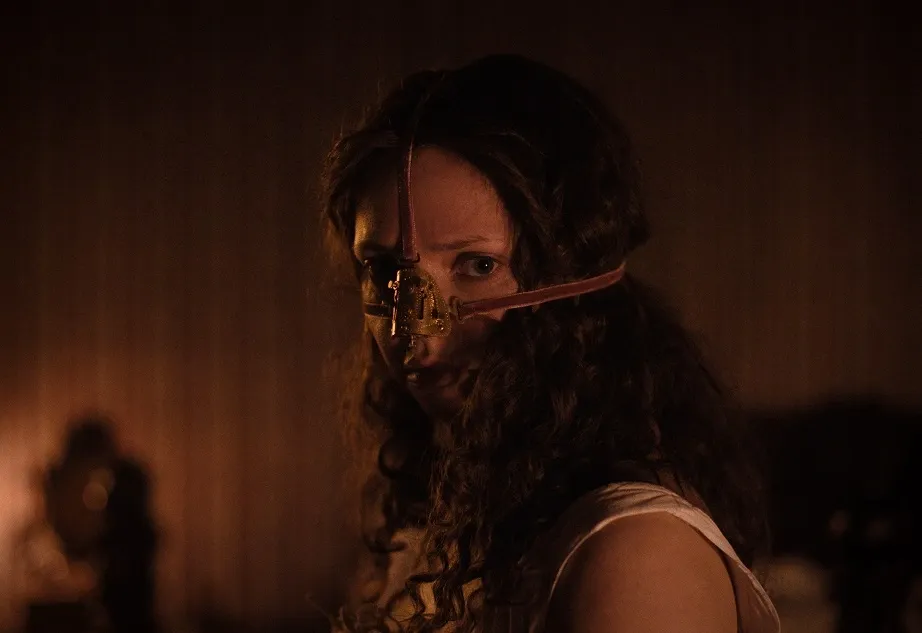
This is the feature film debut of writer and director Emilie Blichfeldt—and what a stellar debut it is. Taking inspiration from the grim origins of Cinderella, The Ugly Stepsister spins a haunting, heartbreaking fairytale told through the eyes of someone we’ve always been told to despise. But instead of a vain antagonist, Blichfeldt’s version of the stepsister, Elvira, is a fragile, painfully human figure—desperate to be loved in a world where love must be earned through beauty, obedience, and sacrifice. What unfolds is a visceral, unflinching feminist horror story cloaked in dreamlike aesthetics and grounded in a sharp critique of societal expectations placed on women.
From the moment Elvira (played beautifully by Lea Myren) arrives with her mother and younger sister at the home of her soon-to-be stepfather and stepsister, Agnes, it’s clear this isn’t a sugary fairytale. The death of Elvira’s new stepfather shortly after the wedding pushes the family into economic desperation, and when word spreads that the Prince is holding a ball to find a bride, Elvira and her mother seize the opportunity. What starts as innocent hope curdles into something deeply disturbing, as her mother encourages—and eventually forces—Elvira through gruesome cosmetic procedures in pursuit of the prince’s favor.
Lea Myren’s performance is the aching, beating heart of the film. There’s a quiet innocence to Elvira at first, but Myren carefully reveals the cracks forming beneath her soft gaze. As the film moves forward, she shifts from timid to tormented, her descent into obsession and pain always grounded in emotional truth. Even when Elvira begins to unravel, Myren keeps her heartbreakingly sympathetic. She doesn’t become a monster—she becomes someone trying desperately not to be discarded in a world that only values beauty.
Blichfeldt’s direction balances surrealism with raw, emotional honesty. At times, the film evokes the hazy atmosphere of a lucid dream—or a nightmare, depending on the scene. Soft lighting, ethereal music, and lavish costumes lull you into a sense of magical nostalgia, only to be violently disrupted by bursts of body horror that are as grotesque as they are fascinating. There’s a real sense of duality here—the sparkle of the fairytale collides with the blood and bruises it takes to “earn” your place in it. It’s both stunning and stomach-churning.
What makes The Ugly Stepsister so effective isn’t just the horror—it’s the why behind it. The film never lets you forget that beneath every disturbing moment lies a deeper cultural rot: a world that tells women they are only as valuable as their looks. In one unforgettable scene, a room full of women line up like livestock, silently battling each other for attention. It's a vision that feels medieval and yet, eerily modern. This is a film about the commodification of beauty, the tragedy of comparison, and how societal ideals pit women against each other in cruel, dehumanizing ways.
Agnes, the stepsister, is also handled with surprising nuance. She isn’t the typical cruel beauty of fairytale lore—she’s just another girl shaped by the same impossible expectations. While Elvira dances like a dream, is kind, and remains “pure,” it’s Agnes who effortlessly draws attention. Not because she’s more worthy, but because she fits into the mold better. The film never blames either girl—it indicts the system they’ve been forced into.
If there’s a flaw, it’s that the film takes a little time to fully find its rhythm. The opening stretch is atmospheric but slow, and there’s a mid-film sequence that feels like it’s building toward something bigger than what eventually follows. Still, the payoff is emotionally rich and thematically satisfying, pushing the fairytale into darker and more surreal territory as it nears its end.
Technically, The Ugly Stepsister is a marvel. The production design transports you to another era, while the music by John Erik Kaada enhances the film’s eerie fairytale mood. And then there’s the body horror—achieved through stomach-turning practical effects that never feel gratuitous but instead underscore the toll this world takes on its women.
Emilie Blichfeldt’s debut is not just impressive—it’s unforgettable. She builds a world that feels both hauntingly surreal and painfully grounded, where fairy tale fantasy collides with brutal reality. The Ugly Stepsister is a fearless reflection on identity, obsession, and the cost of being seen. It’s a film that reclaims a silenced voice and dares to confront the systems that shape—and shatter—women. Visceral, unrelenting, and razor-sharp, it doesn’t ask for your sympathy. It demands your attention. And it earns every second of it. My favorite horror film of the year so far.
Director: Emilie Blichfeldt
Cast: Lea Myren, Thea Sofie Loch Næss, Ane Dahl Torp
Writer: Emilie Blichfeldt
Producers: Maria Ekerhovd, Axel Helgeland, Christian Torpe, Jesper Morthorst
Cinematography: Marcel Zyskind
Editor: Olivia Neergaard-Holm
Music: John Erik Kaada
Screening or Streaming Availability:
