
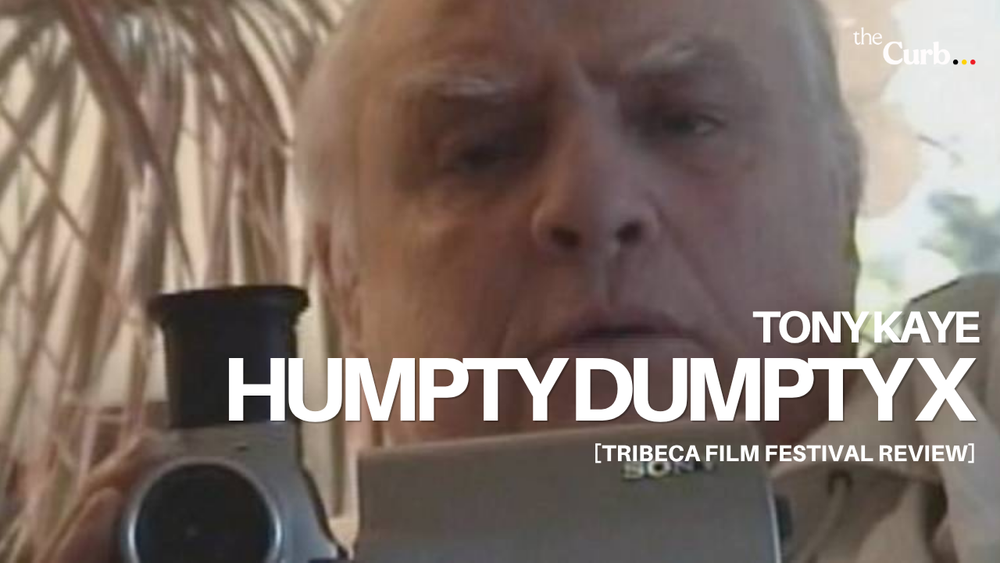
Feted British commercial director Tony Kaye went to Hollywood to make a monumental piece of art and instead found himself in a maddening spiral of delusion as he began to realise that studios and producers weren’t going to wait for a first-time director to be one-hundred-percent happy with the reality of show “business.” Tony Kaye turned his camera on himself after New Line Cinema decided to show a cut of American History X at TIFF that he didn’t approve of. Humpty Dumpty X is the result of the footage captured during his protracted battles with the DGA, New Line Cinema, and the inevitable blowback on his feature directing career.
Beginning with two of Tony’s commercials which helped to garner him the title of the most awarded director and cinematographer of television commercials in the history of British advertising. Both commercials as seen through a modern eye are incredibly bombastic; the one for Dunlop tyres being a Velvet Underground soundtracked run through an even more surreal and fetishistic Mad Max inspired landscape. The other, an ad for Volvo is almost an exercise in cognitive dissonance as a frontline war photographer talks about her need to capture reality and the moment and later chasing a plane down in her Volvo taking shots of contraband. Sure, Volvo will always have a reputation for solid and secure cars, and Tony was bucking the idea that they are staid and unadventurous, but do people also want to equate them with human misery?
It was those kinds of awarded risks that made Tony feel like he was able to take on anything and do so precisely with his artistic vision. Hollywood thought differently and the Soho lad who had previously always said what was on his mind got a lesson in humility –sometimes delivered by his hero Marlon Brando.
Arriving in Hollywood seemed to be the apex of what Tony always wanted. He doesn’t mention it in the documentary, but in reality he was a director for hire after two more famous directors (Dennis Hopper and Larry Clark) turned the project down. American History X went from an indie drama to a wide release not because Tony Kaye’s name was sitting on a marquee, but rather the addition to the cast of Edward Norton playing alongside Edward Furlong as a reformed Neo-Nazi who tries to keep his Venice Beach family from falling apart after he is released from prison.
The issues began after Tony delivered his positively tested 95-minute film to the studio and then found out they had “bowed to pressure” from Norton to be allowed to do significant re-edits that added what Kaye saw as distracting bloat to the film. Negotiations didn’t go Tony’s way despite New Line’s Michael de Luca and producer John Morrissey giving him as much leeway as they could. Tony wanted to re-cut the film and add in voice-overs (one written by an award-winning author), yet he didn’t deliver on any timeframe that would be reasonable for distribution. Tony’s next goal was to Alan Smithee the film and remove his name. Something, he himself had made impossible due to DGA rules citing that the removal of a director’s name came with the caveat that the director could never speak about the production. Fine, he decided, he’d use the pseudonym Humpty Dumpty.
Tony Kaye’s documentary is a vivid portrait of a man so over his head that he’s become more than a little mad. In present day intercuts Kaye admits that he might have gone a bit too far, gone a bit too hard, and gone a bit insane. The footage at the time shows a charmingly and disarmingly naïve man thinking he’s going to David the Hollywood Studio Goliath through sheer force of will. As the video diary began around the time of the TIFF premiere there isn’t any actual footage from the film and certainly no comment made by Edward Norton.
However, what there is includes sage and slightly be/amused advice from fellow British director Mike Figgis telling Tony that you can’t air your dirty laundry against the studios and the way to succeed is to say nothing and smile when you’re being stabbed in the back. Even better is the relationship Tony develops with Marlon Brando who reminds him about contracts and how Hollywood works in a gentle and eloquent manner. “You don’t have edit permissions in your contract,” the Hollywood giant reiterates. Brando says he dealt with bad directors and the like throughout his career ruining his artistic intention and the only way to deal with it is to move on. If for no other reason (and there are plenty of reasons) spending time with a happy mid-1990s Marlon Brando giving well-meaning and entirely sound advice to a man who is essentially ‘nobody’ in the scheme of things, is worth engaging with Humpty Dumpty X.
Humpty Dumpty X is the kind of documentary that at first seems to exist for ironic enjoyment, but as it goes on it becomes entirely engrossing. Tony Kaye didn’t arrive in Hollywood and become the next Orson Welles or Cecil B DeMille – in fact he left it broke, with a damaged reputation, and in the middle of a divorce and was still possessed with the mania of artistic control leading him to turn down a million dollars for a single ad because he didn’t want the company paying for it to add a line.
Tony Kaye fought the system and lost, but he rallied and returned to storytelling with music videos (Grammy winning) and documentaries (one Academy Award longlisted). You have to admire his chutzpah even while cringing through his delusion driven disillusionment. Humpty Dumpty X proves you can have a great fall and put the pieces back together again all in the name of art.
Director: Tony Kaye
Writer: Tony Kaye
Participants: Tony Kaye, Mike Figgis, Marlon Brando, Michael De Luca, Piers Handling