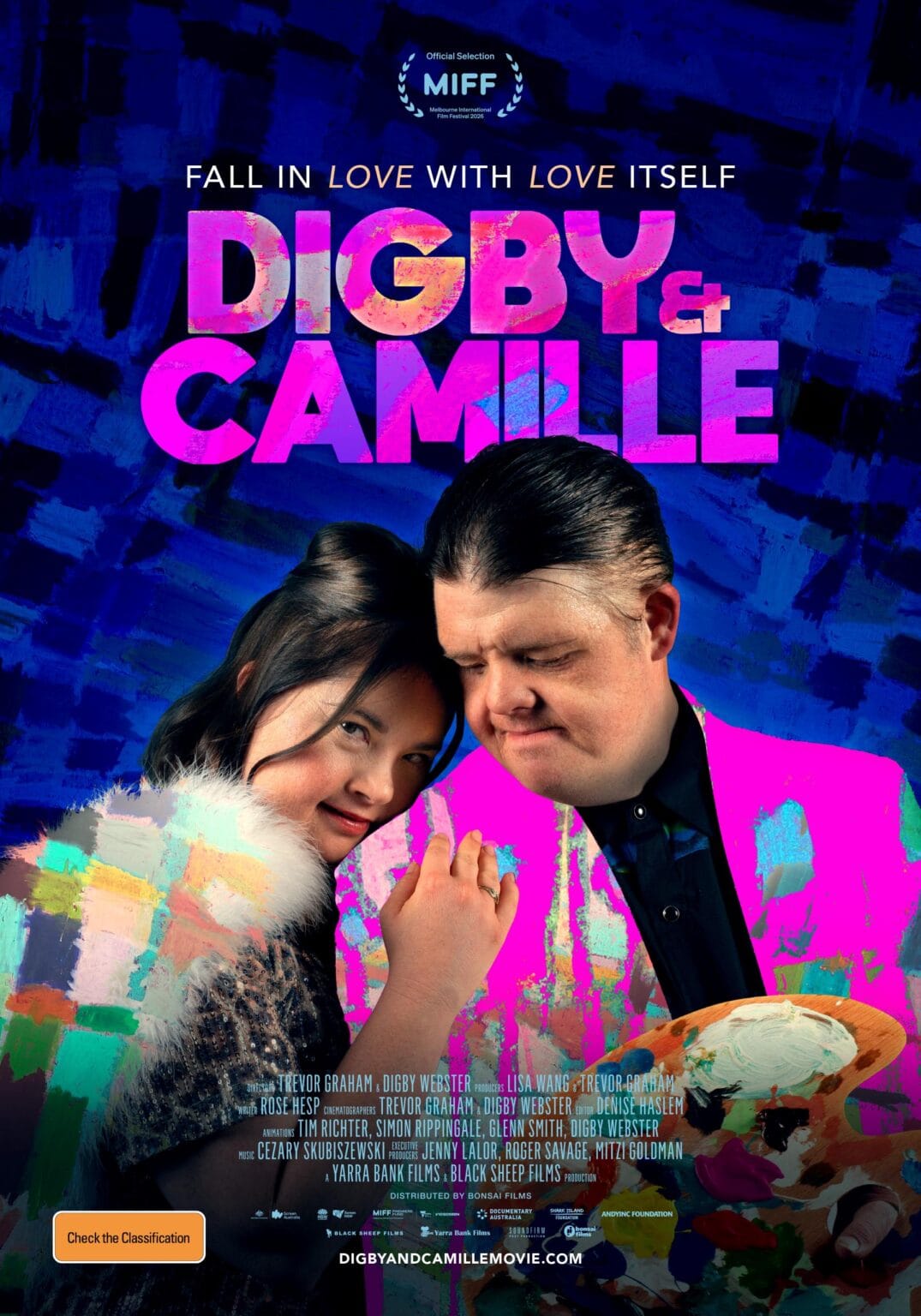
One of the most charming and delightful films to screen at the 2026 Melbourne International Film Festival is the community-created documentary Digby & Camille. Seasoned documentarian Trevor Graham pairs up with acclaimed artist Digby Webster to craft a beautiful film about love, creativity, and the support we give each other along the way.
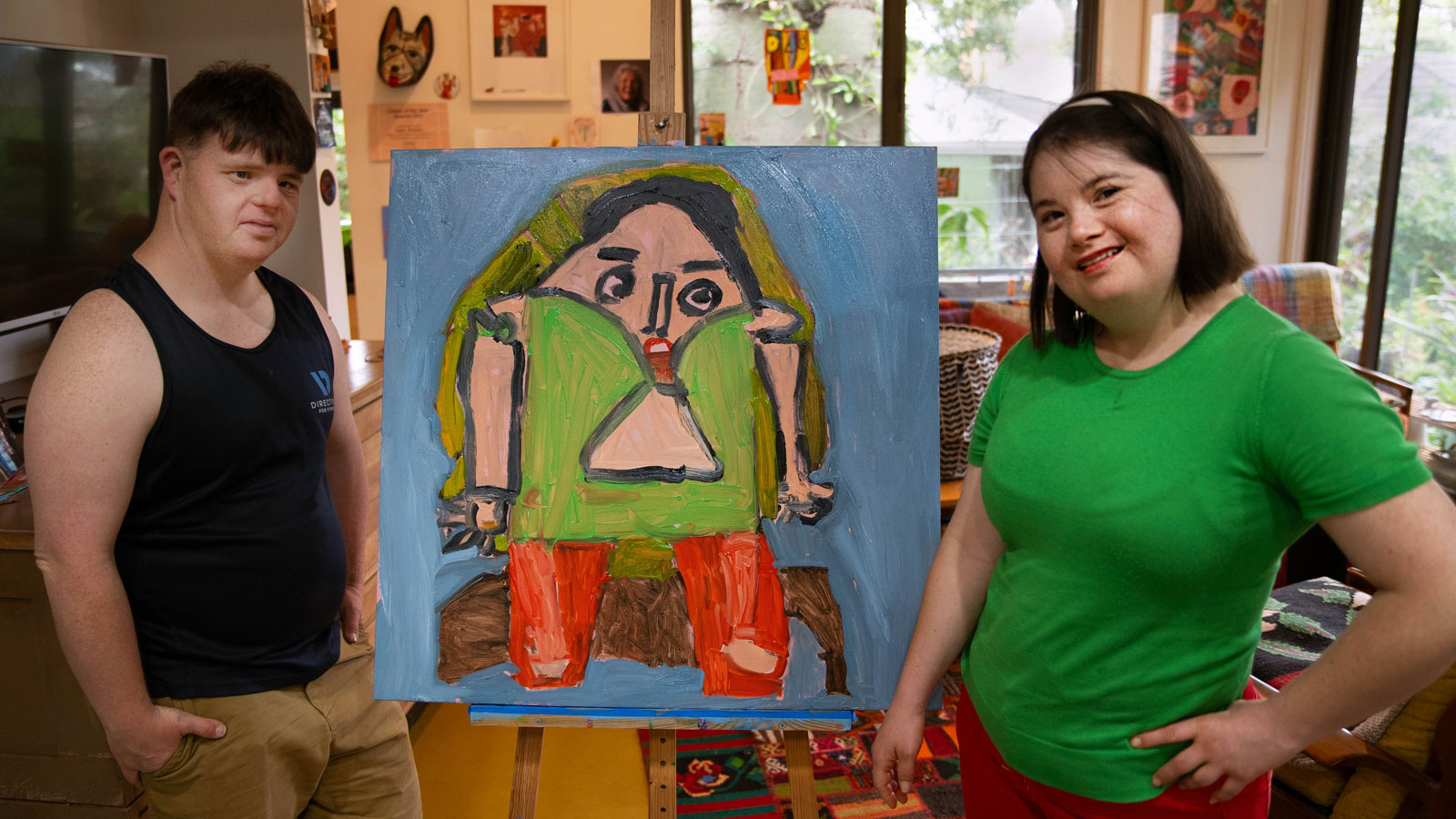
Digby& Camille introduces us to Digby and his girlfriend Camille Collins. He's a twice nominated Archibald prize artist, she's a chef in the making. Both live with Down syndrome and have the support of their parents. Throughout the film we see both Digby and Camille flexing their creative muscles, with Digby's expressive art presenting the joyous personality of Camille as she cooks up another dish.
I caught up with Trevor and Digby ahead of the films screening at the Melbourne International Film Festival this August to talk about how the film came about, what it means to make a film like this, and also about Digby's animation which features extensively throughout the film.
Tickets are available via MIFF here:

This interview has been edited for clarity purposes.
Congratulations on the beautiful film. I really appreciate the insight that we get into your life, Digby, with Camille. Can you talk about how you met Trevor and decided to make this film?
Digby Webster: The first time I met Trevor was through a mutual friend, and her name is Tracy Lee Stewart; she's me and my partner’s friend. And then we heard in the grapevine that Tracy and her partner were having a little party in their old house and Trevor came to that. So that's how I met Trevor and his wife through that mutual friend in common.
Trevor Graham: Before Digby and I met, I went to see one of his exhibitions in in Sydney, as an introduction to his artwork, and I liked what I saw at the exhibition. I think I first got to meet you at the art gallery with your mum and dad.
DW: Yeah, yeah, I think so.
TG: And that's when I said to you, ‘Tracy Lee has been suggesting I should make a film about you and Camille.’ I’d told Tracy Lee I was interested in a love story. In Chef Antonio's Recipes for Revolution there are two love stories in that, but they're sort of secondary to the main story. After making that film, I thought I'd really like to make a love story in the same community, but one where just the love story is the focus of the film. I was talking to Tracy Lee about it, and she's very well connected. She said ‘you should think about Digby and Camille.’ So that that's sort of how it started. The first time I met Camille is at the start of the film. It just took off from there, really.
Digby, you're co-director on this as well. What was the process of you coming on as co-director?
DW: Well, I thought, ‘oh, Trevor needs some help with the film.’ He approached me saying he was going to make a film about me and my girlfriend and he asked me ‘can you be co-director?’ I said, ‘of course, that'd be lovely.’ So he gave me a little camera on an iPhone carrying thing, and I kept carrying it everywhere I go with my partner. I filmed every single thing that me and my girl were doing by ourselves. He filmed me at home with my parents and her. I gave the camera to her to film her and her mum.
TG: Then of course, Digby's involved as part of the animation team as well. So, there's a sort of directing element through his artwork, for instance.
I've seen your short film Digby, Blockhead and Sparkles and the Flood of Tears, which is really beautiful.
DW: There was a young lady who wanted to make that happen. Her name is Rosie. I know her from Newtown Primary School. I went to school with her and her brother, and she said, ‘Oh, I'm doing an animation film. Digs, can you be involved with this and make your artwork into a short film?’ And she did, and everything went really smoothly from there.
TG: What's really interesting, Andrew, about his animation and the doco Digby and Camille is that it's sort of grassroots. Rosie went to school with Digby, and that resulted in Blockhead and Sparkles, and through Digby's connection with our mutual friend Tracey Lee, that's how this doco came about. These connections have made both of those projects happen, and they're very grassroots.
I think that also leans into the real personal nature of the story, and we see ups and we see downs. We're getting to experience you and Camille’s lives. Digby, there's also some not great moments for you, like where your mum's having a conversation about you being on the phone at work.
DW: Oh that’s very annoying for me. My mum is very deserving herself. Every time I go somewhere, she'll be tracking me, calling me, wanting to know how I'm going, all that stuff.
TG: I could have made a film just about the phone use. I have to say, it was like a constant battle going on about phone use from the parents on both sides, and I mean, they're a young couple in love, and they like to talk all the time, and that's what you see.
What's it like putting those kinds of that side of your life on screen as well, Digby? We're getting to see the good side, but we also see the less positive side
DW: Well, for me, it's very nice to see everything goes really nice on the big screen because every scene would cover film me and my girl, my area in Annandale or her area in Gymea. If you see the film about her life and then see the film about my life, it's like the two different worlds collided. I thought it'll work really well.
TG: Sometimes I started to think, ‘oh, am I an intruder here?’ when I was filming.
DW: He's a shadow, by the way.
TG: Sometimes I thought I was going a bit too intimate. I had to think about that a lot. I don't think I came to any real conclusion about it. Then it was up to Digby and Camille and everyone else when they saw the rough cut to sort of say, ‘Well, look, maybe that's going too far or maybe it's not.’ But there were no comments like that. They just they just thought it was wonderful and accurate and true.
I think that's what you get a sense of that this is a real life experience that you're watching. It's a love story and there's lots of humour in it, but there's lots of moments where you get to experience two people being intimate with each other and being sort of in conflict at times, and that's its real value and power. It's not a documentary that's full of gloss. It's a documentary that's got lots of heart and humour and intimate moments.
You were saying you had that feeling of intrusion. I never felt that at all as a viewer.
TG: Well, that's great. What you see is probably the most intimate stuff in the in the film, in terms of interactions between Digby and Camille, but also between Digby and his mum and dad, for instance. That undoubtedly helped because there were things that Digby went off and filmed himself with Camille and with his mum and dad, which are in the film. And I think having Digby's camera filming his own life adds another layer of authenticity to the film. It provides a dynamic, if you like, between what he shot and what I shot, and I think it sort of just paid off in the totality of the you know what you see.
Look, it was right from the start. It was planned that if we're going to make this film, it needs to be a co-directing job. It was Tracy Lee who suggested to me, ‘if you're going to do that, why don't you get Digby to film some of his own life?’ I thought, yep, that's a great idea. Tracy Lee was our consultant on the film. She's an advocate, an activist, and an ally, for people with disabilities.
We're also able to see how Digby's creative style works as well, and the mindset that he has in building his paintings. We don't often get to see an artist process like this on screen, especially somebody as celebrated as Digby is.
TG: I felt like it was important to show aspects of both of their careers, but obviously we do favour Digby a bit more because, as he says, he's got a degree of fame, and also he creates really interesting work. He's big, talented artist in in his own right, and I think that's what the film recognises. I think that's what Blockhead and Sparkle recognises as well. The more recognition he gains for his work, the better, from my point of view, so the film had to deal with that too.
Digby, you're an artist, a painter, an actor, and you've created the animation, and now you've made a documentary together. How has that changed you as a creative person?
DW: Yeah, that's true. I love to be an artist now. I’m very happy to be an artist because of the people around me like myself. I did a painting of Trevor for the Archibald prize. I did a portrait of another friend for the 2020 Archibald prize. I’ve been not once but twice nominated. That's where I painted and drawing all my life.
TG: Digby's already got a well-established career, but the film just puts it out there more, potentially to a national audience. I think Digby's more well known in Sydney, particularly in the inner city areas, and to do with the inner west, the Art Gallery of New South Wales, but the film gives him an opportunity to have a more national profile, and that of course is one of the other intentions of making sure that his work is reasonably well covered in the film.
You're screening at MIFF. What are you looking forward to with screening at the festival?
DW: Well, for me, I can't wait to see them watch it at first and see them react to the whole film from start to finish.
TG: Watching it with a fresh audience will be really interesting. It always is because you get to experience how other people see the scenes that have been constructed. Do they all laugh at the same moment? Do they all sigh at the same moment? Those sorts of things are really interesting. Do they have the same responses that I do when I watch the film? We’ll just soak all that up. It's always a learning experience. You always learn something as a director sitting in with an audience when they're watching your film. Beyond MIFF, it's going to CinefestOz in WA. We hope to have it hit as many festival screens as possible, then it's going to get a national release next year.
Fantastic! Well, I know the audience is going to respond to it just like I did. I thought it was absolutely beautiful, and this wonderful film about love and creativity, which I so grateful for. We need more stories about love.
TG: I really value your addition of creativity. I think that's great. I love that angle because I've been obviously pushing it as a love story. Our byline for our poster is ‘fall in love with love itself’, but I think your angle of adding love and creativity is really great.