
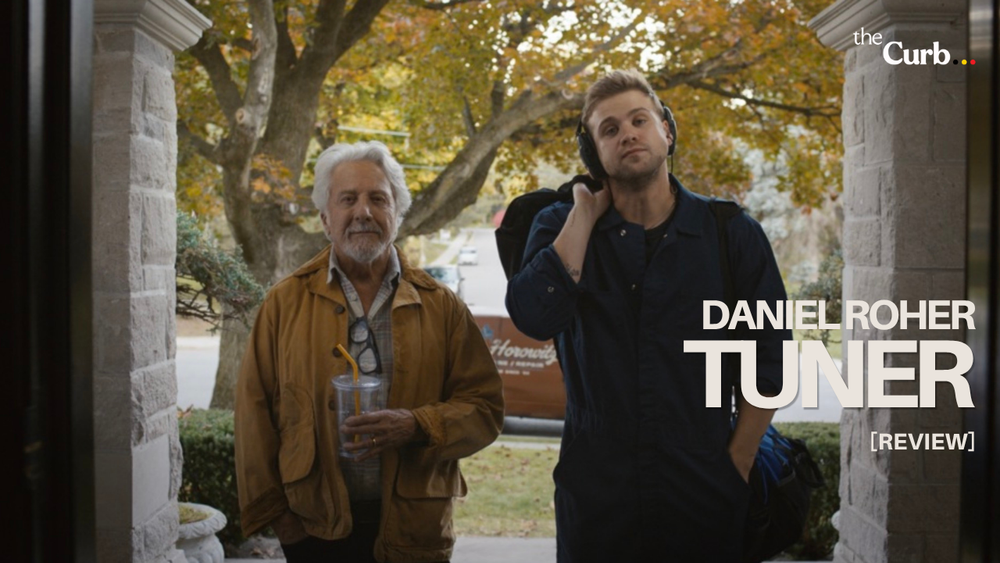
“Play for me.” Harry Horowitz (Dustin Hoffman) has probably asked his apprentice and son figure, Niki White (Leo Woodall) more times than either can count. Harry was once a fireball on the ivories, but his reputation as a music man came from his ability to harmonically tune a piano. That delicate skill mostly falls to Niki to perform as Harry is reliant on hearing aids (often misplaced) and he’s also forgetting to give a fuck about the rich people who call the duo to pay attention to an instrument they rarely do beyond its purpose as a status symbol and conferrer of cultural cache. When a client asks them to fix a leaking toilet neither Niki nor Harry can hide how tone deaf they think the woman is. As she keeps offering to give them more money to do the plumbing Harry says it’s $500 for the toilet, although he has absolutely no intention of helping her. He also says more than loudly enough to overhear that her dog is one of the ugliest he’s ever seen.
Harry’s a charm machine in the right circumstances but he’s also at the age that life is more about looking backwards than forward. Although he’s still concerned with mercury levels in canned tuna and avoiding “inflammation” as long as it doesn’t interrupt his ability to eat cheeseburgers, have salt, and devour donuts. He adores Niki and despite his constant chatter and tendency to embarrass him, it’s clear Niki feels the same. Niki, the son of one of Harry’s deceased friends, was once a prodigy who played piano better than anyone he’d ever heard – and his other friends include Herbie Hancock. Niki developed the rare hearing condition hyperacusis which Niki describes as “being allergic to sound.” He wears earplugs and when outside he dons industrial grade noise-cancelling headphones. Sounds that reach certain decibel levels can physically incapacitate him causing him to lose his balance and feel acute pain. Whatever future he imagined for himself as a pianist and composer abruptly ended and made askew his relationship with his perception of senses. Perfect pitch and a seemingly eidetic memory are two of the skills Niki has; the ability to socialise and share in a world larger than that of Harry and his wonderful wife Marla’s (Tovah Feldshuh) are skills Niki doesn’t seem to be actively cultivating.
Niki finds he has another skill he’d never considered until Harry, in a moment of confusion, locked his hearing aids in a safe that he’d changed the combination of and can’t recall. Harry wants him to smash it open despite the fact that there are a couple of inches of steel keeping his hearing aids safe. Instead, Niki takes the safe home and after watching a few YouTube videos becomes a safe cracker using his highly sensitive hearing.
Niki takes the truck and does a day solo while Harry is at a medical appointment (although with a bobble-head Harry on the dashboard, Niki’s never really without Harry). His first appointment at a house where the owner is rich enough to hire Billy Joel for a party, and for it not to be his only residence. A crew is setting up extra security and Niki can’t work with mechanical noise around him. He reluctantly agrees to come back later that night to tune the piano the owner is pissed about going out of tune despite no-one even touching it in ages.
His next client is a college conservatory of music where he gets an equally annoyed reaction from Ruthie (Havana Rose Liu) a composition major trying to work on her graduating piece. Despite squabbling and a slight case of one-upmanship between the pair, there is some recognition that they share an intimate relationship with music, if not particularly patient nor inviting temperaments.
Back at the “rich asshole’s” house that same night trying to tune the piano for the “Piano Man” the next morning, Niki hears a persistent and annoyingly pitched sound. It turns out to be the security specialists who were working earlier in the day trying to saw through a safe. The boss, Uri (Lior Raz) does his best to intimidate Niki via calling him a racist for assuming people with Eastern European accents are instantly criminals. The truth is that Niki doesn’t care if they are robbing the place or not, he simply wants to do his job and go home. As it will speed up the process he cracks the safe for Uri who offers him better money than the “tuning thing” if he ever wants to work with him.
A sudden downturn in Harry’s health lands him in hospital and in American Healthcare Debt (tens of thousands of dollars). Niki finds himself at a series of crossroads. The first is calling Uri and scoping out what he wants him to do for money. The second is a blossoming relationship with Ruthie that truly begins when she calls asking for help to save her heirloom piano from water damage. Like Niki, Ruthie seems to be without her family and her attachment to music came via her grandmother who taught her to play piano and left it for her. Soon Niki is living a triple life: running Harry’s business, learning to love Ruthie and her proximity to music, and stealing small but profitable goods from the safes of people who own so much they’ll unlikely even notice a Rolex or some cash taken.
At first a life-of-(soft)crime seems sustainable, if sometimes tricky. Uri and his friend Yoni (Gil Cohen) and hapless nephew Benny (Nissan Sakira) don’t appear to be particularly threatening and keep the scores low risk. Niki has money to pay hospital bills and even take a pearl watch for Ruthie as a gift (which she finds overwhelming and a sign of Niki’s attentiveness).
Uri, of course, is not content with consistent small robberies and has something much larger planned that Niki rightly baulks at. Uri’s geniality towards Niki changes to outright threats and torture. In the space of a week or two Niki is facing crisis after crisis and losses he doesn’t have time to process. Anxiety, stress, and isolation leads to resentment and recriminations between Niki and Ruthie, and the far less Robin Hood inspired commitments Uri insists upon. The film becomes unbearably tense with dual ‘everything on the line’ expectation of perfect performances. The pressure cooker of Ruthie’s graduation performance yields transfixing results (screen composer Marius De Vries delivering his most accomplished film music to date), and Niki, at least, doesn’t die.
Daniel Roher writing with Robert Ramsey keeps the film constantly engaging by rarely letting any of their characters be defined by one characteristic. Leo Woodall’s Niki isn’t perceived as an outsider because of his condition. He lives in New York, one of the loudest and most energetic cities in the world. Niki risks his health every day to be around Harry and Marla and to have haptic and professional access to an instrument that is a reminder of loss but also of love. Niki isn’t a saint; he displays a kind of condescension and diffident distance with many people he encounters which keeps him at a distance from people who aren’t warm and crotchety octogenarians. Havana Rose Liu’s Ruthie is immensely driven to be excellent and to have an extraordinary career as a composer to the point that she has no-one outside her conservatorium; she is funny and a genuinely sensitive and observant person who can also be unfairly demanding and self-absorbed. Even Dustin Hoffman’s Harry Horowitz, the tuner known to the jazz, funk, and New York music scene as the always fresh “tuna fish” energetic and devil-may-care as he is, is also an argumentative and stubborn pain in the butt who only shuts up when he’s listening for a note. Marla perhaps is the only character who is a little underserved, but Tovah Feldshuh’s performance sparkles with an energy and wisdom that tamps down some of the clichés Roher’s characterisation of a woman of a certain age constantly having to keep check on her husband’s cholesterol, his recklessness, and the finances.
The highly enjoyable and entertaining Tuner upends a lot of expectations and zigs where many other films would zag thus keeping the momentum from sagging. It manages to be quite pointedly critical of the extremely wealthy without patently being didactic. Conspicuous and inconspicuous consumption is what Uri and his partners deal with consistently when offering high-end security to the rich. Harry and Niki tend to grand pianos tuning them only for the beautiful instruments to be high-end furniture. Even Ruthie’s apartment in a gentrified part of Bushwick is an absolute fantasy for many New Yorkers, let alone a student with the freedom to study one of the arts. The cluttered, joyful, and abundantly lived life of Harry and Marla, the former who is almost ninety and still working and can’t afford hospital care, is explored by Roher for the happiness they’ve experienced but is not heavy-handedly used as an object lesson on the pressure facing the elderly with retirement income insecurity and the failure of essential healthcare in the States.
Still, Tuner is partly about a hesitant thief who isn’t overly troubled by conscience while redistributing wealth without violence or measurable harm. Canadian Daniel Roher’s background in documentary, most notably the 2022 Academy Award winning Navalny, serves him well for creating the ethical greys Niki learns to live with because he sees a clear (and personal) greater good. For the talented artist Roher’s documentary Once Were Brothers: Robbie Robertson and The Band gifted him insight into committing to a life to music and the passion, doubt, and the tumultuous relationships the creative process can engender.
Although the crime thriller and the dedication to musical endeavour (also communicated as romance) are the forte sections of Tuner the dolcissimo section of devotion to the people who nurture and heal is the quiet melody stirring the universal emotional strings that allow the audience to laugh, mourn, contemplate and relate to the things we do for love. Throughout the loud and quiet it’s Leo Woodall’s dexterous performance as the profoundly pained protagonist who learns to balance isolated self-reliance, dangerous over-confidence, shared vulnerability, and the value of embodied emotion, that strikes the perfect chord.
Director: Daniel Roher
Screenplay: Daniel Roher, Robert Ramsey
Cast: Leo Woodall, Dustin Hoffman, Havana Rose Liu, Tovah Feldshuh
Cinematography: Lowell A. Meyer
Editing: Greg O’Bryant
Music: Marius De Vries, Will Bates