
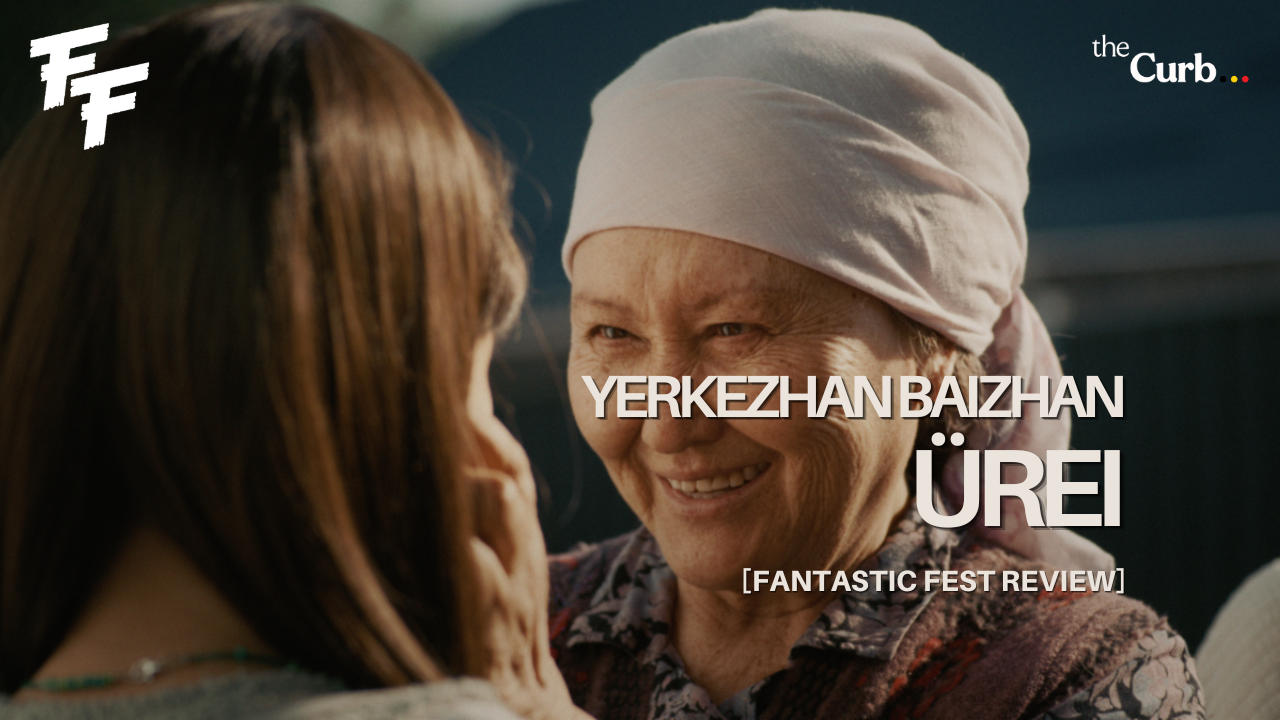
There’s something about Ürei that gets under your skin without constantly reminding you that you’re watching a horror movie. Its horror comes quietly, slowly building the feeling that something is deeply wrong before allowing that tension to fully surface. What initially seems like a straightforward story about a troubled teenage girl being sent away to live with her grandmother gradually becomes something much darker and more emotionally layered.
Kalima (Akerke Kozaiyr) is sent to stay with her grandmother, Amina (Tynyshgul Sultanberdieva), after her parents become fed up with her behavior. She’s been drinking, getting into trouble, and generally becoming more difficult for her parents to handle. Sending her away to the countryside is meant to straighten her out, but it quickly becomes apparent that Kalima has entered a situation far more unsettling than the one she left behind.
At first, the strange behavior surrounding Amina is subtle. She cries out during the night, dismisses Kalima’s concerns, and begins behaving in ways that are increasingly difficult to explain. There’s an unmistakable feeling that something is buried beneath the surface, and the film wisely takes its time allowing those pieces to come together.
One of the strongest aspects of Ürei is the way it refuses to make Amina a straightforward horror villain. There is clearly something frightening happening to her, but the film is far more interested in understanding where that darkness comes from. As fragments of her past begin to emerge, the story becomes less about an elderly woman losing control and more about decades of trauma, grief, guilt, and pain that have never truly disappeared.
That makes the horror considerably more effective.
The scenes involving Kalima can be genuinely uncomfortable to watch, but they never feel like they exist solely for shock value. There’s an emotional purpose behind the cruelty, and the film uses those moments to explore how trauma can move through generations. The pain experienced by one person doesn’t necessarily end with them. It can shape the people around them, influence the next generation, and eventually manifest in ways that nobody fully understands.
The mystery surrounding Amina is another element that works particularly well. Rather than explaining everything immediately, Ürei leaves small pieces scattered throughout the story and allows the audience to gradually connect them. Her strange behavior, fragmented memories, and unsettling comments slowly begin to form a much larger picture. The result is a mystery that becomes just as important as the horror itself.
There’s also a strong sense of isolation throughout the film. The remote rural setting should feel open and peaceful, yet somehow becomes increasingly claustrophobic. Kalima is separated from her parents, removed from everything familiar, and left alone with someone whose behavior she can no longer predict. That uncertainty creates a constant feeling of unease, even in scenes where very little is happening on the surface.
The atmosphere is particularly effective. Ürei has a cold, almost dreamlike quality, with moments of quiet beauty sitting alongside something much more sinister. The score by Abai Akbaev adds another layer to that uneasiness, often making seemingly innocent moments feel subtly wrong. That contrast between calm and dread gives the film much of its personality.
The slower pacing and deliberate storytelling may not work for everyone. There are stretches where the film takes its time reaching its next major development, and some viewers may find themselves wanting more momentum. However, the patience ultimately gives the emotional side of the story room to develop alongside the horror, making the later revelations feel more meaningful.
What makes Ürei stand out is that beneath its unsettling imagery and disturbing moments is a genuinely thoughtful story about family, grief, and generational trauma. It doesn’t offer easy answers or reduce its characters to simple victims and villains. Instead, it presents a cycle of pain that has been allowed to continue for far too long.
Ürei is disturbing, sad, and at times genuinely difficult to watch, but it’s also a surprisingly compelling piece of horror. The film slowly reveals what is hiding beneath its surface and leaves plenty to sit with once the credits roll. It may not be a perfect film, but there’s a lot to admire in the way Yerkezhan Baizhan allows its horror to grow out of something deeply human.
Director: Yerkezhan Baizhan
Cast: Tynyshgul Sultanberdieva, Akerke Kozaiyr, Asset Eszhan
Writer: Yerkezhan Baizhan
Producers: Rustem Omarov, Kuat Sadykov, Timur Smagulov, Igor Tsay
Composer: Abai Akbaev
Cinematographer: Kairat Temirgali
Editor: Yerkin Sagindykov