
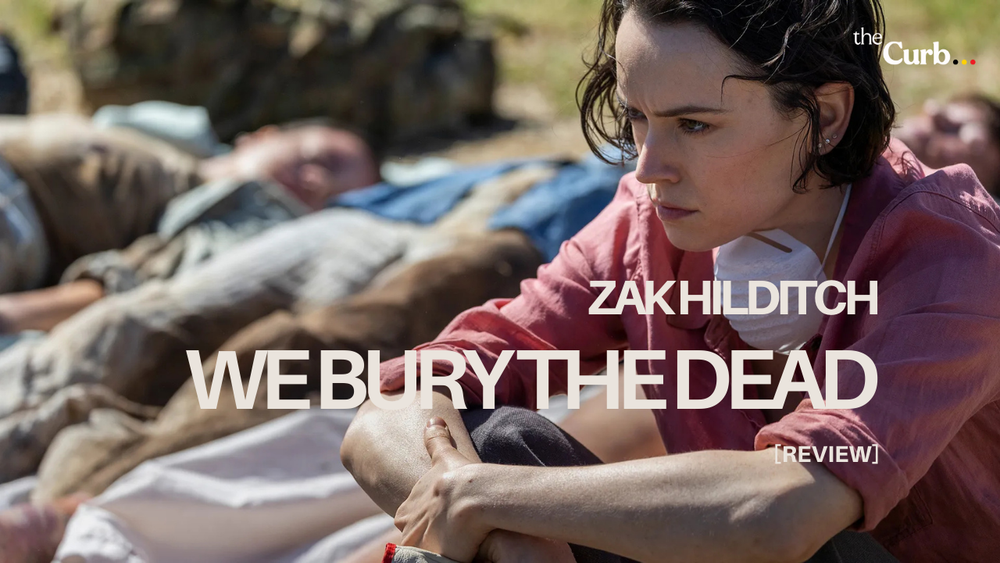
There are zombie films that thrill you, and then there are those that haunt you — not with snarling teeth or sudden jump scares, but with quiet questions about love, grief, and the echoes we leave behind. We Bury the Dead, directed by Zak Hilditch, nestles firmly into the latter. It’s not here to pump your adrenaline; it’s here to quietly splinter your heart, one still, lingering frame at a time.
Set against the scorched and eerie backdrop of post-catastrophe Tasmania, this film walks the fragile line between horror and meditation. The dead are rising — not in packs or with hunger in their eyes, but as vacant, ghostly versions of themselves. There’s something far more unsettling about their silence than any scream. They don’t run, they don’t speak, and sometimes they don’t even move. They simply exist, and in that existence lies a mirror — to the pain we carry, the apologies we never gave, and the love we didn’t quite know how to hold on to.
Daisy Ridley leads the film as Ava Newman, and she gives a performance that feels both brittle and blazing. Ava’s grief isn’t performative — it’s lived-in, hollowed out, bone-deep. She joins a military-led "Body Retrieval Unit" not for duty, not even for survival, but for love. For guilt. For something unfinished. Her husband is presumed dead after a U.S. weapons experiment devastates Tasmania, wiping out nearly everyone. But Ava is chasing the faintest possibility that he’s out there somewhere — not gone, not yet — and so she buries strangers by day and searches for ghosts by night.
This isn’t your typical zombie film. Hilditch has no interest in the bombastic. Instead, he gives us a slow burn — a film that is quiet, restrained, and devastating. There’s a lyrical quality to how the story unfolds, with vast silences, scorched earth, and crumbling buildings serving as a canvas for Ava’s unraveling. You’re not just watching her journey; you’re feeling it — in the tremble of her breath, in the way she doesn’t flinch anymore when the dead twitch, in the way both poisons and sustains her.
What’s fascinating — and frankly, what makes this film feel so fresh in an oversaturated genre — is how the undead are treated. They're not threats so much as symbols. They’re not “monsters” but mysteries. Some stand still. Some walk in circles. Some seem to remember. And others… don’t. That ambiguity keeps you on edge — not out of fear, but out of emotional vulnerability. Every corpse Ava stumbles upon could be him. And every one that doesn't twists the knife a little deeper.
The film introduces Clay (Brenton Thwaites), a quiet fellow volunteer who becomes Ava’s reluctant companion as she breaks protocol and heads south into fire-swept territory. Their partnership is tender and cautious, never romantic, always human. Along the way, they encounter a soldier, Riley (Mark Coles Smith), and the tension that blooms in that interaction — between empathy and power, between help and harm — becomes one of the most searing scenes in the film.
But it’s always Ava who anchors everything. Ridley gives her such emotional texture — she is stubborn, raw, soft-spoken, and deeply haunted. There’s a moment where she just sits, staring into nothing, teeth grinding in the background from an unseen undead nearby. The sound is unbearable. But she doesn’t move. She’s not afraid. She’s exhausted. And in that stillness, the film says so much about the weight women carry, the burdens of regret, and the cost of unfinished love.
What makes We Bury the Dead so arresting is its refusal to sensationalize. The horror here is not teeth or blood. It’s the ache of memory. It’s the way people leave, and how we chase after them in the ruins. The film doesn’t just explore grief — it embodies it. Grief here is a place, a landscape, a journey. The dead rise because something in them couldn’t let go. And Ava walks straight into the fire because neither can she.
By the third act, the emotional arc becomes even more intimate. The story behind Ava and her husband’s last moments together begins to peel back. You start to understand why she couldn’t let go. And perhaps more painfully, why she still can’t, even when every sign is screaming at her to stop. There’s a tragic beauty in that kind of devotion — in loving someone so fiercely that even death feels negotiable.
And yet, the film doesn’t romanticize her choices. Some of them are frustrating, even reckless. But they feel real. Because grief makes us do wild things. It rewrites our logic. It feeds our denial. And sometimes, it becomes our only compass in a world that no longer makes sense.
We Bury the Dead is a slow, sorrowful, stunning film. It’s not flashy. It’s not trying to reinvent the wheel. But what it does — and what it does so well — is sit with you. Long after the credits roll, you’ll find yourself thinking about Ava. About the people you’ve lost. The things you never got to say. The parts of you that still ache in their absence.
This isn’t a zombie movie. It’s a love letter written too late. A lullaby for the unloved dead. And maybe, just maybe, a gentle reminder that sometimes the scariest thing isn’t the end — it’s what we leave behind.
Director: Zak Hilditch
Cast: Daisy Ridley, Mark Coles Smith, Brenton Thwaites
Writer: Zak Hilditch
Producers: Kelvin Munro, Grant Sputore, Ross Dinerstein, Joshua Harris, Mark Fasano, Ari Novak
Cinematography: Steve Annis
Editor: Merlin Eden
Music: Clark