
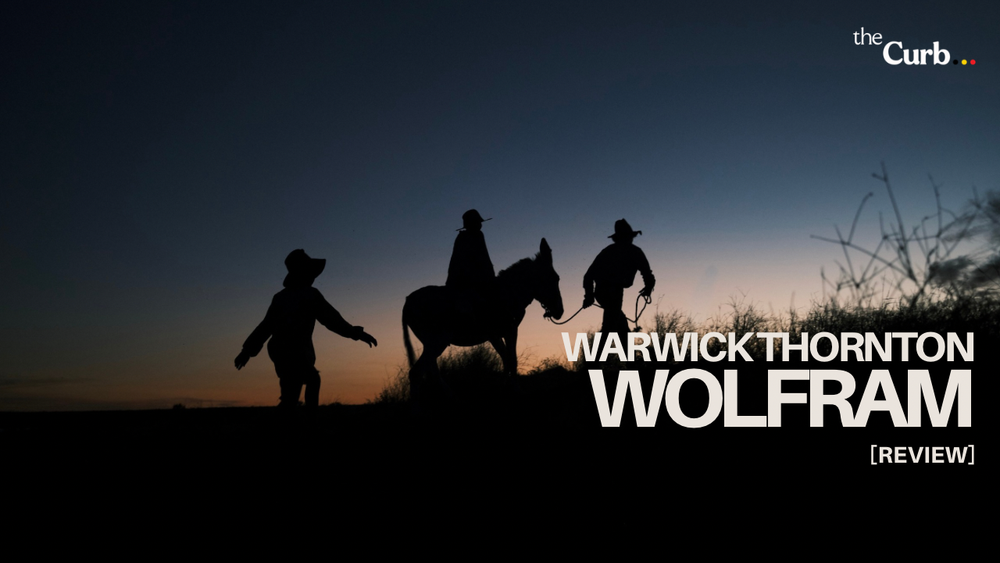
Warwick Thornton said that Wolfram acts as an antidote to its stunning forebear Sweet Country – a film that cost the director and his cast and crew a great deal emotionally to make. With the scars of colonialism and the still resounding lack of Indigenous Australian stories by Indigenous Australians, even an antidote to the brutality of Sweet Country will be an experience that is harsh before it can be hopeful. Wolfram is a story of survival, and the protagonists surviving are children; children who were taken for their mother and made to work. Such was, and is, the case for Philomac in Sweet Country and remains so in Wolfram, with the character now being played by the truly excellent Pedrea Jackson.
Philomac is now eighteen and lives with Mick Kennedy (Thomas M. Wright) who is as run down and broken as his property appears. When the opportunity to reconnect with his aboriginal heritage arrives in the form of two very young siblings who were working in a wolfram mine, Philomac makes a decision that puts him into the crosshairs of the worst kind of men.
The outpost town that is Henry has changed little, but enough to note that there is no new constabulary open across from Nell’s (Anni Finsterer) saloon. It’s the early 1930s and those seeking their fortunes now mine tungsten (wolfram). It’s in these dangerous holes that Billy (Matt Nable) pushes two children aged six and nine to mine the metal. The siblings aren’t the only aboriginal children working with picks and dynamite – it’s work that requires small bodies and light weights. Where the children come from doesn’t seem to matter greatly as no one is keeping an eye on them except those who can profit from them. For Pansy (Deborah Mailman) the location of her children is paramount as they were stolen from her by Billy who is abusive ex-partner. Her new partner, Chinese immigrant Zhang (Jason Chong), plans their relocation to Queensland to mine for gold, but Pansy remains desperate to locate her kids – leaving cuttings of her hair with coloured berries and seeds as beads wrapped in it as signposts for her children to follow.
Nine-year-old Max (Hazel May Jackson) is stolen by Casey Martin (Erroll Shand) and Frank (Joe Bird), two lawless, cruel, and viciously racist men who have come to stake their claim. Taking Max is like taking Billy’s food or rifles to them, the child is a tool for their use. Max’s sibling Kid (Eli Hart) is left completely alone as fate strikes Billy down at the same time as Max is taken. The siblings’ winding path finds them reunited at Mick’s property and in the care of Philomac. When they decide to leave after experiencing the callousness and vile behaviour which condemned one of Philomac’s father figures to a terrible death at the hands of Casey and Frank, they find themselves hunted.
Warwick Thornton and screenwriter David Tranter (who collaborated with Steven McGregor) take from their familial experiences in central Australia with Thornton’s Kaytetye heritage and Tranter’s Anmatyerre and Chinese heritage. Both men’s grandmothers worked in the wolfram mines in the region. For Thornton Wolfram is a testament to the strength of the Indigenous communities for whom the “boss” whitefellas disconnected them from their Country and families. The multiple deaths that they have to survive are more than physical. Childhood isn’t a precious time for the dispossessed and for Philomac, manhood and ceremony have also been taken from him. Leaving means abandoning Country and the ancestors. Yet, for the three it is the only way they can be safe.
Because Wolfram is essentially about children Thornton injects a lighter tone into the film than is found in Sweet Country, but even with the softer touch around Max and Kid violence remains a constant. Erroll Shand’s Casey Martin seethes with contempt and entitlement, another man who was taught human life is disposable by WWI. Joe Bird’s Frank is Casey’s protégée, a young man for whom hatred is fuel. They fear nothing once they’re armed with booze and rifles.
Wolfram is, naturally, incredibly shot by Thornton. There is no faulting Thornton’s eye as a cinematographer especially when he is capturing the desert. But the film is unnaturally disjointed in places which mostly comes from Thornton’s decision to divide it up into four chapters. The chapters aren’t distinct, nor are they identifiably necessary which makes the narrative appear to be artificially cordoned. As in Sweet Country Thronton uses non-sequential inserts to illustrate characters’ past and future. In Wolfram there is a sense that that the inserts work against the chapters and the flow of the film.
Despite some rocky narrative choices Wolfram is a deeply embodied work. Deborah Mailman’s near silent performance speaks multitudes, and the child actors are irresistible. Pedrea Jackson’s commitment to making Philomac a young man suspended between two worlds is the grace note in a work filled with accomplished performances. Thomas M. Wright plays Mick Kennedy as a man who also can’t move forward and has retreated into paranoia, alcoholism and dependence on his illegitimate son who must call him “boss”. Secondary characters, especially Ferdinand Hoang as the Chinese miner Shi add to the rich cultural history of Wolfram.
Wolfram suffers in comparison to Sweet Country because it is difficult to recapture what made that film an exemplar in Australian movies of the twenty-first century. Wolfram is good but it is following great. Perhaps the best way to view Wolfram is as another story that needs to be told about Australia’s history because there are so many tales that have been taken away from the tellers. “We’re playing catch up,” Thornton said of Wolfram and Indigenous cinema in Australia. Wolfram might be imperfect, but it is impactful and provides a window into the past through the consummate eye of one of Australia’s best, and most essential, storytellers.
Director: Warwick Thornton
Cast: Deborah Mailman, Pedrea Jackson, Thomas M. Wright
Writers: David McGregor, Steven McGregor, David Tranter
Producers: David Jowsey, Greer Simpkin
Cinematographer: Warwick Thornton
Editor: Nick Meyers