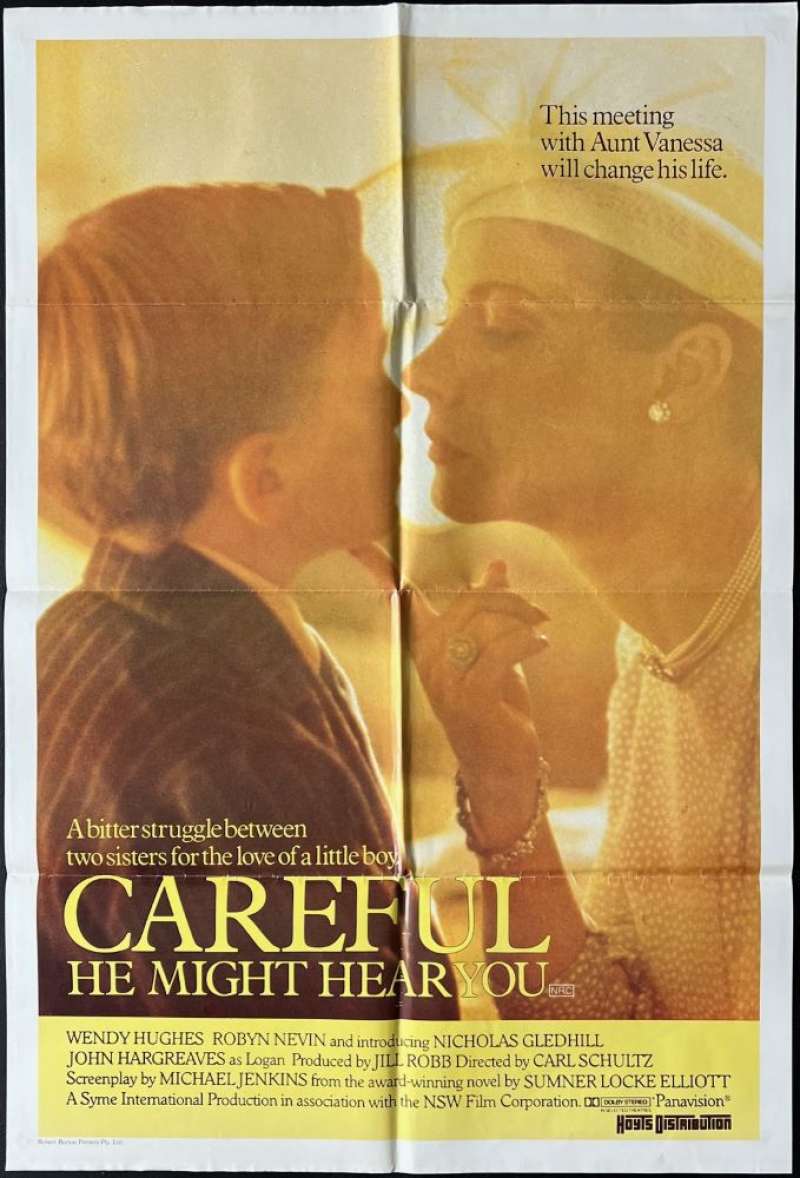
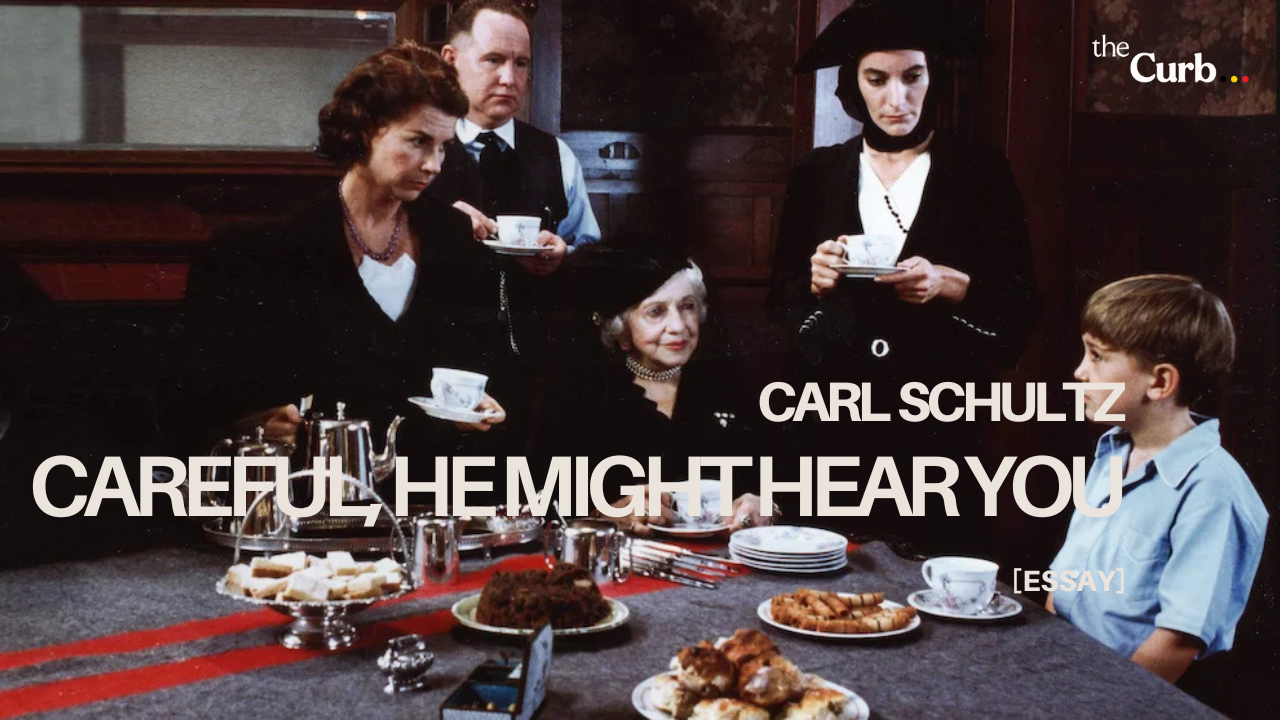
In 1983 Hungarian-Australian director Carl Schultz adapted Sumner Locke Elliott’s award-winning novel Careful, He Might Hear You into a film Australia itself has largely forgotten. Set in Depression-era Sydney, it tells the story of a small boy named PS, for PostScript, caught between two sisters who love him in ways that both damage and ultimately set him free.
The film is lushly photographed by John Seale, whose camera turns memory itself into a family album with sticky sleeves. The beauty in this film goes beyond nostalgia. Seale creates a feeling of mourning in advance. Even while watching the film, we feel something already disappearing. What makes the film extraordinary in 2026 is not simply its beauty or nostalgia. It is the human permission it grants itself.
Critically acclaimed internationally at the time, Careful, He Might Hear You asks dangerous emotional questions beneath its extraordinary beauty. Director Carl Schultz trusts audiences with discomfort. Longing becomes inappropriate. Masculinity becomes broken and tender at once. Women become contradictory, controlling, loving, manipulative and wounded simultaneously. The film does not force human beings into ideological positions. Watching it again reminded me of that and, honestly, it felt good.
We live in stressful times. Why would a migrant like me not look to the past too? But I think what I found in Schultz’s melodrama as a migrant is different to what I normally read about this ‘golden age’ of Australian film. Careful has one line that repeats in my mind today:
“Find out who you are, PS, and you’ll know how to love someone else.”
Wendy Hughes’ character Vanessa in Careful, He Might Hear You says this quietly to her nephew PS–a child trying to understand who he is within a family full of contradictions and fraught emotions. Watching the film again in 2026, her words also feel directed at Australia.
My family arrived in Australia in 1974, just after the formal dismantling of the White Australia Policy. I am Chinese, Indian and UK-born, which means I grew up carrying several competing histories inside me. Britain lives inside my family story. Asia lives there too. So does migration itself. I understand Australia partly through Asia and partly through the residue of Britishness that still shapes the country psychologically.
Despite Australia’s racist history, and despite the exclusions deeply embedded within its institutions, laws and cinema, I still came to love this country. Many migrants of my generation did. That is the contradiction political language often struggles to explain when they imagine multicultural Australia as a dramatic assimilation instead of an accent you pick up when travelling. That was not the Australia many of us entered. We arrived during a period when white Australia itself was already questioning who it was becoming and the values it had inherited. Yes, there was always racism especially when we were not visible on screen. Yet we found ways to love these films anyway. I met many migrants during that period who felt the same. We joined the creative community because it welcomed us.
We migrated into an Australian culture whose uncertainty about its own white identity did not demand total surrender of ours. We discovered a country arguing with itself artistically and psychologically, and we were often in the room while that conversation unfolded. Across much of Asia, silence, shame and ambiguity are simply another form of literacy if you know how to listen for them. Even with an all white cast, we recognised those conversations in Careful. They said, we are not really that different from each other.
We were not simply assimilating so much as adjusting. We were entering a genuine conversation where questioning identity was experienced as an opportunity. Even without literal representation, we saw longing, awkwardness, shame, aspiration, broken masculinity, grief, class anxiety and loss when beautifully expressed.
Careful recognises white nostalgia and complicates it. Part of what gives the film’s performances their depth is the way desire, shame, masculinity, grief and dependency move indirectly through the film, awkwardly, sometimes inappropriately, but often with greater honesty than our culture allows today.
At the centre of the film is PS, the boy who has never known his mother, referred to only as “Dear One”, an absence haunting every room he enters. His father Logan, played with heartbreaking complexity by John Hargreaves, is loving, funny, gorgeous, weak, emotionally shattered and decent all at once. Amnesia over the fact that Australian masculinity always held both decency and idiocy looms large over society today.
Hargreaves became one of the great excavators of white Australian masculinity precisely because he approached it with emotional openness rather than ideological certainty. Alongside Jack Thompson, Bryan Brown and Chris Haywood, he belonged to a generation of actors exploring white Australian manhood as something wounded, performative, ashamed, tender and often deeply lonely, against which Yolngu actor David Gulpilil’s silent, graceful screen presence gained even greater force. For new migrants in the darkened cinema, Gulpilil was the brother holding open the door to our shared imagination.
The entire film is about a family struggling to inhabit identities that do not fit comfortably together during the Great Depression. PS searches for his name. His father Logan cannot stabilise fatherhood or masculinity inside his own life. His aunt Vanessa performs a brittle colonial sophistication that has trapped her deepest desires, while Lila and George construct dignity through working-class steadiness. Everyone in the film is trapped between aspiration, shame, class, longing and love. Nobody fully knows who they are. That is precisely what made these films emotionally recognisable to many migrants. White Australia itself was unstable and unfinished. Rather than collapse, filmmakers opened an emotional space.
The two women pulling PS apart also represent two competing ideas of Australian identity. Wendy Hughes’ Vanessa, in one of the greatest performances Australian cinema has produced, carries colonial glamour in her body. London lives inside her gestures. She is beautiful, intelligent and emotionally dangerous beneath her expensive veneer. Opposite her stands Lila, played by Robyn Nevin, grounded, suburban and emotionally practical but, also willing to pretend her love is selfless.
Both worlds are white, yes, but the grief moving through the film feels recognisable far beyond whiteness itself. Films like Careful are also an emotional map of the psychological terrain we must all face if we want to discover who we really are or – as the character Vanessa says to PS: “Find out who you are, PS, and you’ll know how to love someone else.” I’m not saying that’s easy, but she’s got a point.
The 1970s and 1980s were full of uncertainty and experimentation. Our British inheritance was loosening and we were trying to imagine ourselves differently. In Film, theatre, photography, literature, fashion and visual art, migrants were part of that conversation. It was the era of Australian New Wave cinema, of fashion designer Jenny Kee, of queer artist/photographer William Yang and a new queer artistic presence during the trauma of the AIDS years.
As a young art student in Perth during the mid-1980s, I skipped typography class to attend a Jenny Kee fashion event. I remember nervously asking her about becoming an artist myself. She looked at me very seriously and said: “Carl, you have to work so hard, like so hard, and really love what you do.” I have never forgotten it. Kee and Yang mattered enormously to many of us. Not because Australia had solved racism or homophobia. It absolutely had not. Asian representation in earlier Australian cinema was often marginal, stereotyped or deeply compromised, as scholars such as Olivia Khoo and others have carefully documented. The AIDS era was brutal and existed alongside broader racism throughout Australian society.
I found it very difficult as a young migrant thrust into this country but, despite all this, Australian films in this era carried a strange openness. For me, that openness was not a free ticket into the Australian Story so much as a door left welcomingly ajar. It didn’t push assimilation as much as welcome me to try on new clothes and have a play around.
Migrants did not merely absorb a finished Australian identity. We joined the national question: who are we becoming? We engaged with that question through artforms that held camp, complexity and camaraderie together across a decade of powerful memory-making. That is partly why this older Australian artistic culture feels unexpectedly new to me again. Our country has a history with enough openness to examine itself honestly. To question our sacred myths and acknowledge when our melodrama has a cathartic purpose.
Australia once produced films, artists, actors and photographers willing to examine this country’s shadows beneath its extraordinary physical beauty. The tragedy is not that these works were unfinished. The tragedy is that we stopped the conversation. Something drained away. The language we use today to explore diversity no longer allows for that older emotional awkwardness and self-questioning that attracted me to Australian artistic life. Even when anxious about our identity, our films showed us how to be more open and generous.
Yet that uncertainty and fear can also create the same self-knowledge that Hughes’ character demonstrates when she tells PS that in order to love others-we need to know ourselves. That search for love is a national question that we seem too embarrassed to ask today and, that makes me a little sad.
At the end of this film, PS finally discovers his real name. Throughout the story he has been called only by initials, his mother’s final postscript to other people’s desires, grief and expectations. When PS finally hears his own name, he runs through the streets unashamedly shouting it aloud. That joyful ending feels like a postscript to me for all the endless anxieties Australia puts itself through when asking who it is.
It gives me hope that we’ll figure it out.
Director: Carl Schultz
Cast: Wendy Hughes, Nicholas Gledhill, Robyn Nevin
Writer: Michael Jenkins, based on the novel by Sumner Locke Elliott
Producer: Jill Robb
Composer: Ray Cook
Cinematographer: John Seal
Editor: Richard Francis-Bruce
Screening or Streaming Availability from JustWatch: