
Welcome to the fourth instalment of the Noughts Report. Each entry revisits a year in film from the 2000s, highlighting movies big and small and the careers and genres and trends that ignited or flamed out along the way. This attempted kaleidoscope is 100% subjective and AI-free, so if I bag or barely mention a film you love, or orate at length or heap praise upon a film you loathe, I apologise.
Read Part 1: 2001, Part 2: 2002, and Part 3: 2003.
In the wake of Christopher Nolan’s The Odyssey, I’ll kick off this look back at 2004 with Wolfgang Peterson’s Ancient epic Troy. I also hope that mentioning Christopher Nolan (twice now) will boost traffic for this article, because the titles After the Sunset and Wimbledon certainly won’t.
I suspect the studio honchos who greenlit this mammoth production envisioned the movie—with its fabled romance between Paris and Helen and the culminating disaster of the Fall of Troy—achieving the cultural and commercial success of Titanic and Gladiator. Little did they envision it would have the land-based excitement of Titanic and heavy swoon factor of Gladiator. I jest, but the product—and it feels very much like corporate product—pales in comparison to those successes.
The weakest link casting-wise is Orlando Bloom, undeniably dreamy to his demographic but offering little beyond being the dreamy face that seduced the face that launched a thousand ships. With some local pride, I can say the Australian contingent comes out strongest, with Eric Bana nailing the assignment as Hector—his duel with Brad Pitt’s bronzed Achilles is a highlight—and Rose Byrne making an impression in her first international role, discounting her presence as background ornamentation in Star Wars Episode II.
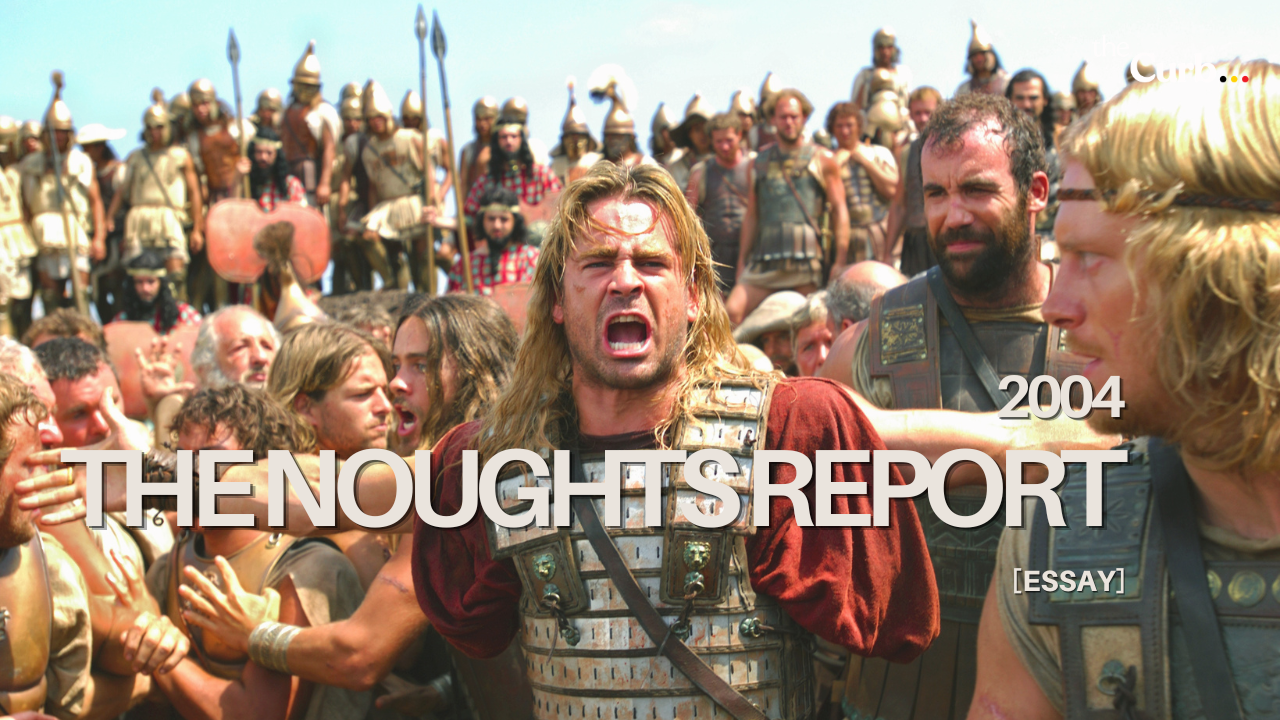
Troy wasn’t the only Ancient epic of 2004; Oliver Stone’s Alexander was also released, but did not conquer. I find this film, imperfect as it is, fascinating. Where Troy is very much product, Stone’s passion for and fascination with Alexander the Great permeates the film, as evident as his passion for Jim Morrison or fascination with Richard Nixon, other subjects he previously wrestled to screens. Stone’s clearly trying to stuff every seam with insight, detail, symbolism, while meeting the commercial imperatives of the costly production. That Stone failed was somewhat expected; that this director-madman gave it his all—and indeed continued tinkering and releasing multiple versions on home media over time—was also not unexpected.
Covering a smaller stretch of Alexander’s life may have enabled the film, like Lawrence of Arabia, to balance the epic and the intimate. As it stands, there’s so much epic to cover that the intimate suffers. From this decade, Gangs of New York is a comparable passion project, another enterprise long-chewed-over by its director to the point that, like chewing gum, some of the joy and flavour has gone.
Mel Gibson’s The Passion of the Christ, in contrast to Alexander, focuses intently and intensely on a narrow period in the life of Christ, the crucifixion, perhaps at the expense of some of the larger context and rich background that make the crucifixion meaningful. For the faithful who bring that built-in context to the film, this is powerful stuff and—as the currently-in-production sequel attests—still exerts some hold, despite accusations of anti-Semitism against both film and filmmaker. Like Gibson’s other historical epics—Braveheart, Apocalypto, Hacksaw Ridge—it’s muscular, striking filmmaking.
Another period epic, King Arthur, opens with a title card proclaiming “Historians agree that the classical 15th century tale of King Arthur and his knights rose from a real hero who lived a thousand years earlier in a period often called the Dark Ages. Recently discovered archaeological evidence sheds light on his true identity”.
These historians are never named—Stone, in contrast, worked with a credited historian in Robin Lane Fox—and the film that follows has no seeming basis in fact whatsoever; producer Jerry Bruckheimer, Gladiator scribe David Franzoni, and director Antoine Fucqua—most recently of Michael, a film that chooses to print the legend—do pretty much what they want, including making Guinevere a spunky bow & arrow-wielding Pict warrior with exposed midriff played by Keira Knightley. I have a soft spot for this nonsense, but there are better films drawing from Arthurian lore before and since.
I also have a soft spot for The Alamo, John Lee Hancock’s film depicting the siege of the titular Texan fortress. My appreciation of this somewhat maligned movie is largely vibes-based, liking its various component parts: I love the execution of the siege; I love seeing Billy Bob Thornton as Davy Crockett and Jason Patric as Jim Bowie and Patrick Wilson as William Travis, all bouncing off each other; I love how Dean Semler shoots Westerns, giving them a warm glow but also verisimilitude (see also Dances with Wolves, Young Guns); and so on.
It’s noteworthy that Troy, King Arthur, and The Alamo all strip romantic elements—and in Troy and King Arthur’s cases, magic and supernatural elements—from their stories; moreover, all cast, to various degrees, their heroes as flawed, self-serving, craven, with feet of clay. This feels indicative—even with Hollywood gravitating towards superheroes and high fantasy—of the dent that traditional heroism had taken in the American psyche during this era.
Critical & commercial success and cultural longevity on film can be a Darwinian struggle for survival of the celluloid fittest, but it’s also a rigged system that privileges some releases over others. Of these titles, The Alamo was the only outright flop—The Passion made a mint: Troy made a mint, albeit cost a mint; Alexander and King Arthur made more than their budgets, albeit costing a mint—but still enjoys an afterlife on Disney+ and, no doubt, in San Antonio gift shops.
Looking at the broad sweep of films released in 2004, there are other titles that I’m convinced—though happy to be persuaded otherwise—have next-to-zero posthumous life, despite most featuring stars of some profile. For example, between the one-two punches of Lost in Translation/Girl with a Pearl Earring and The Black Dahlia/Match Point, Scarlett Johansson appeared in A Love Song for Bobby Long opposite a forlorn John Travolta and Oscar Wilde adaptation A Good Woman opposite Helen Hunt. Pierce Brosnan, chillaxing post-007, starred in breezy rom-com Laws of Attraction alongside Julianne Moore and abovementioned breezy caper After the Sunset under the vile, sleazy gaze of Brett Ratner. All titles, to the best of my gauge, largely forgotten.
Red Dust and In My Country enlist a handful of global stars—Hilary Swank, Chiwetel Ejiofor, Juliette Binoche, Samuel L Jackson, Brendan Gleeson—to grapple with the Truth and Reconciliation process in South Africa after the dismantling of Apartheid. The former was Tom Hooper’s debut—his future excesses kept in check—and the latter helmed by veteran John Boorman. Both titles, to the best of my gauge, largely forgotten.
Academy recognition is one means of carving out some posterity, and a couple of these releases probably mustered some lukewarm Oscar heat but missed out on that sanctification. Ditto The Assassination of Richard Nixon, a sweaty Taxi Driver-esque character study in which Sean Penn plays a dweeb who becomes fixated on assassinating Nixon—whatever you’ve just imagined, that’s pretty must the film. Penn has Australian support in 21 Grams co-star Naomi Watts and Jack Thompson, the latter enjoyably essaying one of his portly men of influence. Ditto DeLovely, from powerhouse producer, occasional director, and non-Sylvester Stallone Christmas card recipient Irwin Winkler, which sees Kevin Kline play Cole Porter and focuses on his convenient but deeply loving marriage to Ashley Judd’s socialite Linda Lee, scored to a soundtrack of Porter’s bangers. Again, the movie’s pretty much what’s on the box.
Also largely forgotten: chiller Godsend headlined by a jobbing Robert De Niro; breezy and unmemorable Elmore Leonard adaptation The Big Bounce; post-Pirates Johnny Depp going dissolute in period drama The Libertine; the underwhelming Robin Williams-led thriller Final Cut; Suspect Zero, E. Elias Merhige’s drab follow-up to the colourful Shadow of the Vampire; and Two Brothers, which sees Jean-Jacques Annaud return to the milieu of The Bear with a tale of two tigers, with Guy Peace in tow.
In my 2003 entry, I suggested it’s probably best for Australia’s filmic repute that there are no longer half a dozen daggy, brightly-lit, low-budget comedies released annually (though perhaps our national cinema has swung too far in the opposite direction of artful self-laceration). However, the selection of daggy, brightly-lit, low-budget comedies from 2004 is a better bench.
Mileages vary, sometimes wildly, when the name “Paul Hogan” is uttered; the concept of Strange Bedfellows, which sees Hogan and best friend Michael Caton pretending to be gay for tax rebates, would send some apoplectic. Much of the humour in Strange Bedfellows stems from the comedy of incongruity inherent in Hogan and Caton—two iconic Australian comedy stars and heteronormative “blokes”—learning to mince effeminately, watching clips of Rock Hudson and Peter Allen, and going clubbing on Oxford Street in Sydney. It’s to the filmmakers’ credit that it mostly works, without veering into gay panic or condescension.
Director Dean Murphy would work with Hogan again later in the decade, and Strange Bedfellows would be remade by Adam Sandler as I Now Pronounce You Chuck and Larry, with Australian connections in regular import star Richard Chamberlain (The Last Wave, The Thorn Birds) and aforementioned export DP Dean Semler, who it’s worth noting has shot seven (!) Sandler-starring or affiliated films. In his defence, they were probably more relaxing than shooting Super Mario Bros, Last Action Hero, and Waterworld.
According to Wikipedia, “bromance” didn’t enter the cultural lexicon until 2005, but there’s a bromantic strain to Thunderstruck, which sees four childhood pals—including Damon Gameau and Stephen Curry—reunited to fulfill their promise to bury their deceased friend at Bon Scott’s grave in Fremantle. It’s a fun little flick with a certified soundtrack and good chemistry between the leads. Chemistry also carries Under the Radar, which mixes gritty thriller elements and danger—heightened perhaps by the casting of future Wolf Creek and Dying Breed star Nathan Phillips—with comedic hijinks as a surfer on community service, his two disabled wards, and a hitchhiker stumble upon criminal activity.
Also surf-centric is Bondi Tsunami, promoted as “An original music video motion picture experience”, which follows four Japanese travellers on the road from Bondi to Surfer’s Paradise. The movie—part music video compilation, part travelogue, with vignettes and enigmatic narration thrown in—has a very particular flavour and is a very acquired taste, but credit to its one-woman-band director, writer, cinematographer, composer, and costume designer Rachael Lucas. Not even Peter Weir can lay claim to helming Australia’s first and only Japanese-language, surfing-centric, feature length road movie music video.
Other local releases included Peaches, Oyster Farmer, Tom White, The Human Touch, and Somersault, the latter widely acclaimed and boosting Abbie Cornish and Sam Worthington’s star signals.
Among the most lucrative Australian exports of that year were director James Wan and writer Leigh Whannell, whose grisly Saw would launch a franchise of diminishing returns, escalating mayhem, and Ouroboros plotting. Other genre releases of the year included psychological thriller Taking Lives, Stephen King adaptations Riding the Bullet and Secret Window, remakes The Toolbox Murders and The Grudge (US), sequels Seed of Chucky and Resident Evil: Apocalypse, Stephen Sommers’ hyperactive Universal monster mash Van Helsing, prequel Exorcist: The Beginning—which originated with John Frankenheimer before his passing, was inherited and steered by super normie Paul Schrader, and significantly reshot by Renny Harlin—and Russian vampire movie Nightwatch, which was a big deal in 2004 but now feels like a blip.
Building on the success of 28 Days Later and Resident Evil in 2002, and nerd cachet if not success of Undead in 2003, Shaun of the Dead and remake Dawn of the Dead provided comedic and action-horror takes on the zombie genre, as well as introducing dynamic new directors and visual stylists—Edgar Wright and Zack Snyder—with very different temperaments and legacies.
I’ve held off talking superhero movies until this point, withholding the coin of the realm. Suffice to say, there were new superhero releases, including Pixar’s original and delightful The Incredibles. Also delightful was Spider-Man 2; what this sequel loses in freshness, it makes up for in assuredness. Hellboy, like Batman Begins one year later, is a great example of a filmmaker (Guillermo Del Toro) ticking all the popcorn cinema boxes—an audience avatar, romantic interest, recurring action beats, bureaucrat haranguing the hero, gags with cute animals—while smuggling his own fetishes and preoccupations into the mainstream.
I like both The Punisher and Blade: Trinity more than most, but on Catwoman toe the party line, which is that it’s very bad. I take issue, however, with lambasters who jeer Sharon Stone as bad and unintentionally camp in this and 2006’s Basic Instinct 2; she’s great in both and as attuned to those assignments as Bette Davis and Joan Crawford in Whatever Happened to Baby Jane.
There was no Fast and Furious entry this year, but there was Torque. There was no Lord of the Rings, but Joe Johnston’s Hidalgo road-tested Viggo Mortensen as standalone action hero, with mixed results. There was a new Potter instalment in Harry Potter and the Prisoner of Azkaban. I can’t really dispute the view that the talented Alfonso Cuaron’s entry is the best of the series, but I’ll continue to doff my cap in Christopher Columbus’s direction for assembling all the pieces for others to play with. However, I had more fun with Lemony Snicket’s A Series of Unfortunate Events—among the first and best of the Potter imitators—and was more transported by Miyazaki’s Howl’s Moving Castle. Also hailing from Japan was Godzilla: Final Wars. Spoiler: it was not Godzilla’s final war.
An offshoot of the skyrocketing currency of superhero and fantasy franchises was event movies increasingly gravitating towards nerdy sci-fi material. I Robot fits into a genealogy of Will Smith-starring science-fiction actioners of the 1990s (Independence Day, Men in Black); ditto for Alien vs. Predator, drawing from two popular film series and comic book source material. But how else explain The Chronicles of Riddick, David Twohy’s space opera built around Vin Diesel’s anti-hero character from creature feature Pitch Black?
While I don’t share Vin Diesel’s biased view that Riddick is one of the great screen characters, I nonetheless love that this movie exists, despite its flaws and overreach—there’s much more left-handed personality here than the assembly-line likes of I Robot and AVP—and I love that Diesel and Twohy keep wanting to make more of these, though I’d rather see Twohy creating other nifty premises and squeezing juice from them, his gift as a writer-director.
Pulp throwback Sky Captain and the World of Tomorrow, much-hyped by geek media like Ain’t It Cool News and synonymous in my mind with that outlet and era, is another deeply nerdy endeavour, in execution as well as storytelling and aesthetic. The film, not to put too fine a point on it, is very boring. Even The Day After Tomorrow and National Treasure, both engaging, lean nerdy in their scientific and historical trappings.
Side bar: I was a daily reader of Ain’t It Cool News for much of the 2000s, and while I still appreciate a number of the critical voices honed on that site—among them Drew McWeeny and C. Robert Cargill—I look back at that era and its parasitic effects—on filmmaking, film journalism, film criticism, print media, audiences, fandoms—with much embarrassment and frustration. For every gain against the Hollywood machinery, AICN would succumb to the system twofold or warp it for worse, and for every fandom it empowered, it would in turn entitle and infantilise and curdle others. For a deep dive into AICN history, listen to podcast series Downlowd: The Rise and Fall of Harry Knowles and Ain't It Cool News.
At that year’s Academy Awards, boxing drama Million Dollar Baby snared Best Picture, a second Best Director gong for Clint Eastwood, and a second Best Actress gong for Hilary Swank, putting this actress—undeniably brilliant here and in Boys Don’t Cry, never quite connecting as effectively elsewhere—in a very select pantheon alongside Vivien Leigh, Olivia De Havilland, Bette David, Ingrid Bergman, Elizabeth Taylor, Glenda Jackson, Jane Fonda, Meryl Streep, Sally Field, Jodie Foster, and Emma Stone. Martin Scorsese—nominated for his second collaboration with Leonardo DiCaprio, the Howard Hughes biopic The Aviator—continued his streak of losing Best Director to actor-directors (see also Ordinary People, Dances with Wolves).
Both Million Dollar Baby and The Aviator are excellent films. The former tackles its central mentor/mentee relationship between Eastwood’s coach and Swank’s athlete and the tragic direction it takes with Eastwood’s signature unobtrusiveness and clarity. The latter sees Scorsese tapping into Vincente Minnelli mode as engineer of polished studio entertainment, recreating Old Hollywood glamour and Hughes’s aerial hijinks—and, most impressively, one of his biggest calamities—while affording DiCaprio opportunity to strain for his art, as he’s wont to do.
An Oscar winner of yore was remade, or at least its source novel by Jules Verne re-adapted: Around the World in 80 Days, featuring Steve Coogan and Jackie Chan as mismatched travel companions. The remake did not bother the Academy. 2004 also saw remakes of The Flight of the Phoenix—the best film that action journeyman John Moore has made—and The Manchurian Candidate, not one of Jonathan Demme’s best but not as deadly a misfire as Charade remake The Truth About Charlie. Steven Soderbergh broke the toy, at least for a couple of years, with his eccentric sequel-to-remake Ocean’s Twelve, and the Coen Brothers remade The Ladykillers, leading to proclamations of their artistic demise that would prove unfounded.
The troubled Peter Sellers, star of the original Ladykillers, was the subject of biopic The Life and Death of Peter Sellers, which like The Ladykillers and unlike Sellers wasn’t very funny, despite Geoffrey Rush’s best efforts and some novel visual and storytelling devices from Stephen Hopkins, a jobbing mainstream director throughout the 90s (Predator 2, Blown Away, Ghost & the Darkness, Lost in Space). Between Rush’s Sellers and Cate Blanchett’s Katherine Hepburn in The Aviator, it was a banner year for Australians conjuring bygone stars onscreen.
I have a big soft spot for several of the year’s comedic releases: Dodgeball, Anchorman: The Legend of Ron Burgundy, Starsky & Hutch. Ben Stiller appears in all three, albeit only cameoing in Anchorman, as well as sequel Meet the Fockers, making him the hardest-working comedy star of 2004; Vince Vaughan, slacking, only appeared in three of those, but was enjoying a post-Old School comedy reinvention.
There was new Sandler in 50 First Dates, re-teaming with Wedding Singer co-star Drew Barrymore; new Wayans Bros in White Chicks, hailed by Albert Brooks as the movie of the year; actual white chicks Cameron Diaz, Christina Applegate, and Selma Blair in The Sweetest Thing; new Broken Lizard in Club Dread, featuring Bill Paxton as the memorably monikered Coconut Pete; unexpected franchise-starter Harold and Kumar go to White Castle; the unexpectedly quite good Eurotrip and The Girl Next Door; and satire Saved. Garfield also made his film debut, not written by the Coen Brothers.
Humour made the medicine go down in Morgan Spurlock’s Super-Size Me and Michael Moore’s Fahrenheit 911—documentaries that aren’t so much preaching to as bludgeoning their converted, albeit both effectively done—while Moore appears in marionette form in Trey Parker & Matt Stone’s very funny Team America: World Police.
While 2003 minted several generational Christmas staples in Bad Santa, Love Actually, and Elf, 2004 minted one in The Polar Express. I salute its ambition and ingenuity while recoiling from its dead-eyed motion-captured characters, and lament that this sojourn into motion-capture animation—along with Beowulf and A Christas Carol later in the decade—waylaid Robert Zemeckis from his tremendous twenty-year live-action run from Romancing the Stone through Cast Away/What Lies Beneath; he would return to live-action, somewhat curdled, in the 2010s. Surviving Christmas and Christmas with the Cranks haven’t made quite the same dent, though I’d gladly watch the latter over Polar Express and, hands down, over Love Actually.
Two other directors undergoing reinvention as stylists were Tony Scott and Michael Mann. With Man on Fire, a revenge thriller in which bodyguard Denzel Washington exacts retribution on his young ward’s (Dakota Fanning) killers, Scott—long operating at the cutting edge of technique and crafting lush, gorgeous visuals for popcorn entertainment—went whole-hog on rapid-fire cutting and jittery, caffeinated camerawork, pushing the envelope in ways that alienated vocal commentators at the time but have now become commonplace aesthetics.
In Collateral, meanwhile, director Mann and DPs Dion Beebe and Paul Cameron embraced high-definition digital video, capturing night-time Los Angeles as a taxi driver (Jamie Foxx) unwillingly chauffers a contract killer (Tom Cruise) with a nakedness and clarity that, again, irritated some commentators and, again, has become par the course.
Whilst Paul Greengrass had patented his directorial style with Bloody Sunday, its application to The Bourne Supremacy marked a departure from Doug Liman’s approach on the first film, establishing the shaky-cam and rapid editing that would become the series’ house style. This stubbornness of approach in Scott, Mann, and Greengrass is echoed, somewhat, in the laser focus and efficiency of their elite killer protagonists.
Not remotely interested in realism or brutal efficiency are Stephen Chow’s Kung Fu Hustle and Zhang Yimou’s House of Flying Daggers, the former a kung-fu comedy that better captures the anarchic Looney Tunes spirit than the previous year’s Looney Tunes: Back in Action, the latter a martial arts drama and romantic triangle that’s more intimate than Hero but equally ravishing to watch.
New Police Story was Jackie Chan’s best film in years, a solid return to his Hong Kong milieu, if not quite the death-defying slapstick heights of earlier works. Quentin Tarantino’s Kill Bill Volume 2, meanwhile, concluded the Bride’s (Uma Thurman) revenge mission—working, not unlike Tom Cruise in Collateral, through a list of five targets—culminating in an emotional rather than acrobatic reckoning with the titular Bill (David Carradine). It’s less fluid and propulsive than volume 1, but tremendous nonetheless.
Also sequelized was Bridget Jones’s Diary in Bridget Jones: The Edge of Reason, while Bride and Prejudice—from Bend it Like Beckham director Gurinder Chadha—put a Bollywood spin on Jane Austen. Another British rom-com was the aforementioned Wimbledon, an unlikely follow-up to Richard III from Richard (no relation) Loncraine.
Over in Hollywood, Jennifer Garner was 13 Going on 30; Katie Holmes was First Daughter and Michael Keaton—logging jobs but in a wilderness of sorts—the POTUS; Richard Gere rekindled his marriage to Susan Sarandon via dance lessons from Jennifer Lopez in Shall We Dance; and Lopez took the loss and Ben Affleck raised their Jersey Girl in Kevin Smith’s likeable first excursion outside the View Askewniverse.
Arthouse-inflected rom-coms and romances were also present in Eternal Sunshine of the Spotless Mind—inventive, funny, melancholic, uniformly well-acted, and easily Michel Gondry’s best work; Before Sunset, the second in Richard Linklater, Ethan Hawke, and Julie Delpy’s thoughtful trilogy of two-hander romantic dramas, with the highest-stakes timeframe and loudest ticking clock of the series; A Very Long Engagement, Jeanne-Pierre Jeunet’s more downbeat but equally artful follow-up to Amelie; and pastoral queer romance My Summer of Love.
A shout-out to three generational classics, none my thing but I salute them all: The Notebook, Mean Girls, and Garden State. I’m iffy on David O’Russell’s I Heart Huckabees—deeply loved, albeit by fewer—though moments and lines from the film have proven surprisingly sticky. Behind-the-scenes recordings on that film, with O’Russell screaming and swearing at actress Lily Tomlin, benched the filmmaker professionally for a stretch, but are on brand and carry the same manic, antic disposition and flavour of a David O’Russell film.
Other directors from the same late 90s talent pool clocked new releases: Alexander Payne with Sideways and Wes Anderson with The Life Aquatic, both very entertaining, and M. Night Shyamalan with The Village. Though well-directed and effective for much of its runtime, that film’s denouement—thematically intriguing but dramatically unsatisfying—sank the movie for many, further flaming the percolating Shyamalan backlash.
Biopics and true story dramas from 2004—all quite good, some Oscar-minted or nominated for their performances—include Taylor Hackford’s procedural but well-made Ray, featuring Jamie Foxx’s Oscar-winning turn as Ray Charles, making for a great one-two punch with Collateral for the former star of Booty Call; exploring booty calls and other sexual phenomena was Liam Neeson in Kinsey, Bill Condon’s follow-up to Gods and Monsters and a similarly smart, insightful probing of a fascinating figure, albeit conforming more to traditional biopic shape; The Motorcycle Diaries, Walter Salles’ evocative cross-country trip with a young Che Guevera (Gael Garcia Bernal); The Sea Inside, Alejandro Amenabar’s follow-up to The Others, which skilfully dramatizes the outer and inner life of quadriplegic Ramon Sampedro (Javier Bardem); and Hotel Rwanda, about a hotelier (Don Cheadle) who risks his life sheltering refugees following the Rwandan genocide.
Less interesting is Finding Neverland, a pivot for director Marc Forster after Monster’s Ball, about playwright J.M. Barrie’s (Johnny Depp) friendship with widower Sylvia Llewleyn (Kate Winslet) and her brood of children who inspired Peter Pan. It’s capably made with some nice flourishes, earnestly acted, but syrupy and formulaic; I suspect it would be better remembered if not for its lead actor’s subsequent overexposure and dirty linen.
Also less interesting is Steven Spielberg’s The Terminal, not a biopic, but taking the germ of an idea from an Iranian refugee who spent almost two decades living at Charles de Gaulle airport, transplanting the story to the US, and casting a cuddly Tom Hanks. This is Spielberg in the saccharine Capra-corn mode of Always with some of the bloat—albeit dramatic rather than antic—of 1941 and Hook, rather than the nimble, spry filmmaking last seen in Catch Me If You Can.
Like Hook, The Terminal was a largely stage-bound production, recreating JFK airport; I wonder if soundstage-bound productions create a kind of cabin fever that warps Spielberg’s better impulses? Having said that, like most lesser Spielberg films, it’s still better-directed than objectively superior films, lifted by that preternatural knack for composition and storytelling.
Frank Oz also stumbled with The Stepford Wives, a comedic take on Ira Levin’s prescient novel of toxic masculinity, in which Nicole Kidman and Matthew Broderick move to an idyllic suburbia where all the wives are busty and subservient. It was a retreat to comedy for Oz following the benign director’s unhappy experience on The Score—to again evoke the notion that every director’s new movie responds in some way to their last—but I only remember a lot of archness and mugging and desperation to please.
For Kidman, The Stepford Wives was one of several big-studio gigs she clocked over the decade between smaller, more intriguing films, seemingly obligatory concessions to commerce that enabled those other films to happen. A case in point: the chilly, cryptic Birth, Jonathan Glazer’s follow-up to Sexy Beast and second of only four feature films, each one a reinvention and culling of style.
Another veteran filmmaker who stumbled that year was Barry Levinson with Envy, albeit neither the first nor last stumble in the quarter century following his 80s and 90s heyday as director of well-resourced, highly-polished, adult-oriented films executed with all the bells, whistles, and affordances of the studio and star systems (see Good Morning Vietnam, Rain Man, Bugsy, Toys, Disclosure, Sleepers, Sphere, Wag the Dog etc). Variety in genre and subject matter was always the spice of Levinson’s work, and the man did make his acting debut as a highly-strung bellboy bludgeoning Mel Brooks with a rolled-up newspaper in the shower in High Anxiety, but a broad comedy where Jack Black makes bank on an invention that makes dog poo disappear, to Ben Stiller’s chagrin, seems a touch unbecoming for the Oscar-minted director of Rain Man.
Other works from veteran directors included John Waters’ final flick, the on-brand A Dirty Shame; Mike Nichols’ penultimate film Closer, a prickly four-hander with standout performances from Clive Owen and Natalie Portman, and like Angels in America adapted from a chewy (if thinner) piece of theatrical source material; David Mamet’s low-fi and efficient thriller Spartan; James L. Brooks’s curious and indulgent Spanglish; Woody Allen’s annual release Melinda & Melinda, telling the same story twice—once dramatically, once comedically—and diligently executing the premise; and Joel Schumacher’s production of stage sensation The Phantom of the Opera.
After a few years of Schumacher’s work sweatily ricocheting off the disaster of Batman & Robin, The Phantom of the Opera saw some of its director’s campier excesses creep back; like Spielberg, I have to wonder, is this a soundstage thing? However, it’s probably the next-to-best film adaptation that could be yielded from that source material. And as a fan of said musical—and I know mileages vary—I’d say most of the bangers translate. Gerard Butler portrays the titular spook of Palais Garnier, following earlier leads in Dracula 2000 and Timeline; what he lacks in mellifluous singing voice—Patrick Wilson and Emmy Rossum fare better in this regard—he compensates for in physical presence.
Butler was one of several stars about to pop (in 300) as the decade unfolded; among others, Christian Bale (post-American Psycho, pre-Batman Begins) underwent a startling physical transformation for his role in Brad Anderson’s creepy slow burn The Machinist; Daniel Craig (pre-Bond) is excellent in Layer Cake and Enduring Love, strong thrillers from Matthew Vaughan—making his directorial debut—and the typically interesting and pliable Roger Michell; Chris Evans (pre-Captain America) goes through the ringer to help a distressed Kim Basinger in Cellular, scripted by Larry Cohen; and The Rock was Walking Tall, as he’s prone to do. Also impressing in films from auteur directors depicting the lifelong repercussions of child abuse—both delivered, curiously, with a degree of tongue in cheek and kitsch—were Joseph Gordon-Levitt in Gregg Araki’s Mysterious Skin and Gael Garcia Bernal in Pedro Almodovar’s Bad Education, a terrific one-two punch for the actor alongside The Motorcycle Diaries.
We’ve seen a few examples this decade of the old-school Hollywood practice of teaming up-and-coming actors alongside veteran stars to bolster the former’s profiles—most notably Colin Farrell paired with Cruise on Minority Report, Pacino on The Recruit, and Willis on Hart’s War—and there’s a bit of that with Joaquin Phoenix’s casting alongside John Travolta in Ladder 49 and Scarlett Johansson and Topher Grace alongside Dennis Quaid in In Good Company.
Ladder 49 is no Backdraft, but has some impressive sequences, and there’s retrospective curiosity value to seeing Phoenix essay a relatively straightforward normie role in a straightforward popcorn movie. Johansson and Grace are somewhat vanilla leads in In Good Company; Quaid is the MPV, the actor having grown in this era into the perfect version of his craggy face and using that instrument perfectly: see also The Alamo, The Flight of the Phoenix, etc.
Lest I forget to note, this was the year Jude Law featured in six major releases, as noted and ribbed by Oscars host Chris Rock: the aforementioned Sky Captain (which he’s boring in), Closer and I Heart Huckabees (both of which he’s great and appealingly unsympathetic in), The Aviator and Lemony Snicket’s (both of which he’s barely in), and the flat Alfie, the first and least of two Michael Caine movie remakes he’d headline this decade.
As I said of Guy Pearce’s 2002, when an actor has multiple films released in a calendar year, that’s sometimes stratagem, sometimes circumstance, sometimes happenstance, and sometimes bad luck. It was unfortunate overexposure in Law’s case, but he’d bounce back with the likes of the Sherlock Holmes movies, carve out some interesting character parts, and luck onto the brilliant gimmick in The Young Pope of playing a super-smokin’ hot Pope in his mid-forties by virtue of being in his mid-forties and thus younger than most other Popes.
I’ll wrap this piece by highlighting three films with numbers in their titles, said numbers all structuring their narratives in some way. Michael Winterbottom’s 9 Songs depicts nine love scenes and nine rock concerts—both unsimulated to some degrees—shared by a young couple, recounted in flashback. I like to think that Winterbottom, given his eclectic and experimental filmography, basically does whatever he wants whenever he wants. I’m fully aware that’s not how film financing and filmmaking work—unless you’re Christopher Nolan—but making a theatrically released film with IRL love scenes between amateurish actors interwoven with rock songs does have a whiff of big dick Winterbottom energy.
Millions, a zag from the ever zig-zagging Danny Boyle after 28 Days Later, is a sweet but edgy family film—befitting its director—about two boys who stumble on a bag of money. Bags of money—literal and metaphorical—and what people do in pursuit of them are a recurring motif in Boyle films: see also Shallow Grave, Trainspotting, A Life Less Ordinary, Slumdog Millionaire, Trance, Steve Jobs, T2: Trainspotting, Yesterday, and the pending Ink.
Finally, Three Extremes is a grisly Asian anthology film with instalments by provocateurs Fruit Chan, Chan-Wook Park, and Takashi Miike, with Park’s baroque entry the strongest.
For disclosure, number- titled films I have not seen are 2046 (I concede with some shame) and Shrek 2 (no shame). I’ve not seen Vera Drake or Downfall, though I’ve seen the numerous appropriations of Bruno Ganz’s Hitler ranting and raving. I’ve not seen Welcome to Mooseport, though Gene Hackman’s passing piqued my curiosity. And I’ve not seen Shark Tale or Napoleon Dynamite, because they looked awful, still look awful, and will always look awful.
Thanks for reading. We’ll be back with 2005, when Batman begins and Ralph Fiennes constantly gardens. Til then …