
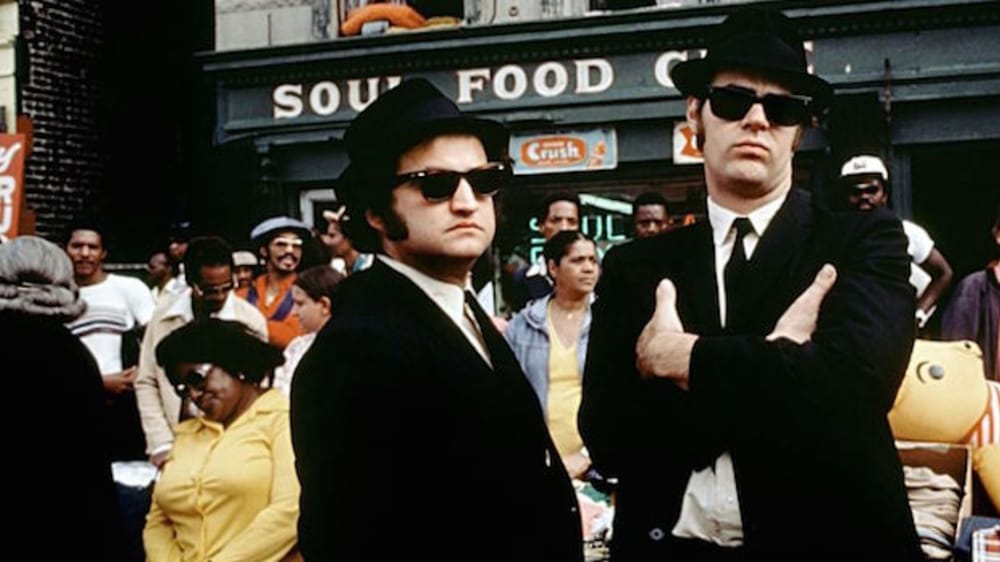
Back in March I celebrated the 40th anniversary of Australian classic Breaker Morant here on The Curb. Why stop there? The celluloid class of 1980 is a particularly fascinating one, with many films cut from a 1970s cloth but hinting at the 80s as we’d come to know them onscreen. The Blues Brothers and Fame, two American musicals released mid-1980, occupy that liminal sweet spot between the decade gone by and the decade ahead, and both would be very, very different films if produced a few years earlier or later.
In the end credits to Mallrats, Kevin Smith thanks John Landis (along with John Hughes) “for giving me something to do throughout my youth on Friday night”. I’d second that sentiment: as the director of The Blues Brothers, An American Werewolf in London, Trading Places, Spies Like Us, The Three Amigos, and Coming to America, among others, Landis’ work probably occupied more time in my VCR than any other director not named Spielberg or Lucas.
A commercial contemporary of both - and a brief collaborator with Spielberg on the ill-fated Twilight Zone: The Movie - Landis shares with Spielberg and Lucas that alchemic mix of deadly sincerity and ironic, calculated detachment that characterises their best work. There are other shared qualities as well. In Blockbuster, his study of the emergence of the movie blockbuster, author Tom Shone spends a lot of time highlighting what differentiates Jaws and Star Wars from their predecessors. Jaws is distinguished from its disaster movie precursors The Towering Inferno and The Poseidon Adventure - bloated, flat-footed, silly films that treat themselves like Doctor Zhivago with pyrotechnics - by its nimbleness and lightness of touch, its economy and colourful characterisation, with Richard Dreyfuss’ Hooper a Bugs Bunny-esque figure both within and removed from the story (see this, or this) unlike the stoic stiffs of Irwin Allen movies. Star Wars, meanwhile, is distinguished by its speed and its pluck, in sharp contrast to stately-paced predecessors like 2001: A Space Odyssey and Silent Running, not to mention subsequent space sagas like Star Trek: The Motion Picture and The Black Hole which capitalised on Star Wars’ success but missed this vital ingredient.
The Blues Brothers, the jewel in the crown of Landis’ career, is similarly a hip, fast-moving, knowing take on dog-eared genres and tropes: a “save the orphanage” musical where the hero is not a clerical-collared Bing Crosby, but an offbeat duo of singing and dancing Saturday Night Live alumni in suits, Ray-bans and fedoras. Jake (John Belushi) and Elwood Blues (Dan Aykroyd) are blues performers and criminal types reunited after Jake’s stint in prison. When the Catholic orphanage where they were raised is threatened with closure, Jake and Elwood launch a “mission from God” to stage a fundraiser to save the orphanage, a journey that sees them cross paths with Cab Calloway, James Brown, Aretha Franklin, Ray Charles, disgruntled police officers (topical!), disgruntled hillbillies, disgruntled Ku Klux Klan members (also, sadly, still topical), and a disgruntled ex (played by Carrie Fisher). Ridiculous amounts of vehicular mayhem and destruction are thrown in for good measure.
While the dyed-in-the-wool auteurist in me opened this piece with Landis, ‘The Blues Brothers’ as a concept was cooked up - or perhaps coked up is more apt - by Aykroyd and Belushi several years earlier. As chronicled in Nick de Semlyen’s excellent book Wild and Crazy Guys, Aykroyd and Belushi conceived the Blues Brothers at the height of their Saturday Night Live fame, first performing at Aykroyd’s New York speakeasy, The Blues Bar, then serving as an SNL warm-up. Jake and Elwood made their proper SNL debut in 1978, then performed as opening act for Steve Martin on the comedian’s stadium tour, and released their own album shortly thereafter.
Aykroyd, a great talent and a delightful giant weirdo, deserves particular credit for reconceiving and fleshing out the world of the Blues Brothers for film. While SNL has nurtured many gifted and funny performers, there’s an argument to be made that Aykroyd is the only cast member who could be considered a comedic visionary in the same vein as the Monty Python crew. Both The Blues Brothers and Ghostbusters, among others, sprang from his fertile imagination, though in both instances his earliest scripts were overreaching and un-filmable: his first Blues Brothers script clocked in at 324 pages and its author-star cited the lengthy period epics 1900 and Barry Lyndon as touchstones. Aykroyd’s best work as both actor and creator is generally when he’s reined in by a solid director and/or paired with someone onscreen who can level his excesses: pure undiluted Aykroyd straight from the tap - as seen in his directorial debut and swansong, the aggressively grotesque Nothing but Trouble - is an especially acquired taste. In Landis, then, Aykroyd found a perfect collaborator and editor who pared his sprawling opus into a luxurious but still palatable - and downright delicious - 133 minutes.
In Belushi, meanwhile, Aykroyd found his greatest muse, and it speaks to the huge import of their partnership - both personal and creative - that over the last 30 years one of Aykroyd’s pet projects has been the House of Blues restaurant and bar chain, nothing less than a 12-city shrine to his best friend and collaborator. Belushi’s struggles with substance abuse are well-documented, and The Blues Brothers shoot was not exempt. Landis, who’d directed the actor in his other signature film performance, as Bluto in Animal House, recalls that “it was terrifying. It’s like a drowning person: you jump in the water to try and save them and they punch you in the face” (Wild and Crazy Guys, p. 43). Yet Belushi and Aykroyd are a terrific pair onscreen, and the film is a testament to a talent lost far too early, albeit spared some of the cinematic indignities that would pepper other SNL alumni’s filmographies as the 80s and 90s unfolded (Aykroyd’s very much included).
While it is a simplification to say an older film would not be made today - not to mention giving dismissive side-eye to the present through a pair of nostalgia goggles - The Blues Brothers would most definitely never be made today, for three reasons. Firstly, expense. The film’s budget ballooned considerably, with an end cost of $32 million USD. That doesn’t sound particularly expensive now, but in 1980 was a substantial sum, and put The Blues Brothers alongside other late 70s spiralling-out-of-control productions like Apocalypse Now, Heaven’s Gate, Star Trek: The Motion Picture, and 1941. Indeed, The Blues Brothers was jokingly dubbed 1942 after the latter, Spielberg-directed/Belushi & Aykroyd-co-starring Pearl Harbour ‘comedy’. Although The Blues Brothers turned a profit, and is far more watchable than any of the other titles in that quintet - though all have their fans, and Apocalypse Now is rightly acclaimed - comedy today is a cheap business: the biggest blockbuster budgets are almost exclusively the domain of Disney, Marvel, DC, and a few select properties, so a comedy of The Blues Brothers’ scale and world-building ambition would get short shrift.
Secondly, cultural appropriation. The Blues Brothers is, to my mind, sincere in its appreciation of blues culture and artists. As Nick de Semlyen writes, “Aykroyd and Belushi were accustomed to mocking everyone and everything. But their new endeavour was irony-free. They took the music seriously, deadly seriously” (Wild and Crazy Guys, p. 37). Jerry Garcia of The Grateful Dead, after seeing Aykroyd and Belushi perform live, professed himself not a fan, calling their act “too good to be a parody, and not good enough to be good for what it was” (p. 38). The two stars would probably concur, and the movie highlights the charming dinkyess of Belushi and Aykroyd’s homage act, while the real giants of the genre - Calloway, Franklin, Charles, Brown - shine bright in their musical appearances. Nonetheless, as noted in a recent Guardian piece, to modern sensibilities The Blues Brothers could be regarded as a rather un-PC exercise in cultural appropriation. Having said that, I can think of much, much worse examples from both the 1980s - see 1986’s Soul Man, in which C. Thomas Howell pretends to be black to secure a Harvard scholarship - and indeed 1980 itself, such as the profitable re-release of Disney’s romantically racist Song of the South (on Martin Luther King Day no less).
And thirdly, the film’s car stunts, which transplant the Dixie-fried relish for vehicular mayhem of Smokey and the Bandit and its ilk to the big smoke. Landis’ early films - National Lampoon’s Animal House, The Blues Brothers, An American Werewolf in London - all have scenes of wanton, madcap destruction. A former stunt performer, Landis loved smashing and crashing things - vehicles, people, windows, objects - and there’s a tangible sense of abandon and danger in these sequences. That impulse was curbed noticeably in his work following the accidental deaths on the set of Twilight Zone: The Movie, and rightly so. But that 10-year-old-smashing-and-piling-on-matchbox-cars energy in on full display in The Blues Brothers. The abovementioned Guardian piece also noted visual echoes of recent events in the film, in images of vehicles cutting through crowds and heavily armed personnel converging in recognisable public spaces; while entirely unintentional, it’s the practical, tangible dimension of these scenes that gives them a whiff of prescience. Crazy stunts will continue in films as long as the likes of Tom Cruise and Christopher Nolan are active, but it’s unlikely in this decidedly (and, again, rightly) post-Twilight Zone landscape - not to mention this age of CGI saturation - that we’ll see gonzo stunt work again on the scale of The Blues Brothers, particularly in service of a comedy.
While the above points to The Blues Brothers as a time capsule, the film remains evergreen viewing. Its music, scale, stunts, and stars (both musical and comedic) are key ingredients, as is the particular combination of hipness and classicism that characterises Landis’s best 1980s work. Though his films starred the cutting-edge comedians of the era - Aykroyd, Belushi, Eddie Murphy, Chevy Chase, Steve Martin - they’re also throwbacks to classic Hollywood films and formulas in some way: Spies Like Us is a Hope & Crosby update, The Three Amigos is a love letter to Westerns and Old Hollywood, Coming to America is a comedy in the Ernst Lubitsch mould, and so on. This classicism combined with impeccable craftsmanship - Landis knows how to frame and execute a joke and how to setup and payoff a gag - mean The Blues Brothers and his other heyday films remain largely fresh viewing, even as some of his stars more ‘edgy’ flicks have aged poorly (again, Aykroyd’s very much included).
On a scene-by-scene basis The Blues Brothers offers riches upon riches. I particularly love the first car chase through Dixie Square Mall; the scene at Chez Paul restaurant where Jake and Elwood’s aggressively poor table manners pressure the maître d’ to re-join the band; Aretha Franklin’s barnstorming performance of ‘Think’ and Ray Charles’ delightful rendition of ‘Shake your Tail Feather’; and the list goes on. But my favourite scene - perhaps my favourite four minutes of celluloid - doesn’t involve car chases, sloppy dining, or singing and dancing the blues… though it does involve singing and dancing of another kind, is when Jake and Elwood erroneously book a gig at a hillbilly dive bar that plays ‘both kinds’ of music: “Country and Western”. Much 1980s comedy is built on contrasts - slobs vs. snobs, nerds vs. jocks, etc. - and inserting somebody where they don’t belong and watching them wreak havoc, be victimised, or a combination of the two. Sometimes it pays hilarious dividends - see Rodney Dangerfield and Bill Murray in Caddyshack - and sometimes it’s terribly offensive - see every visit to the Blue Oyster Bar in the Police Academy films. Here Jake and Elwood are out of their element - the crowd response to their rendition of ‘Gimme Some Lovin’ is downright hostile (“That ain’t no Hank Williams song…”) - but the city slickers manage to sway the crowd by performing ‘Rawhide’ and ‘Stand by your Man’. What makes the scene especially endearing is that it isn’t cruel, either at the crowd’s or Jake and Elwood’s expense: the ‘Good Ol’ Blues Brothers Boys Band’ endear themselves to the rowdy audience, and Elwood and - begrudgingly - Jake end up digging their new song-list too. It’s a hugely enjoyable scene, with the constant visual and aural accompaniment of breaking beer bottles adding an extra layer of mirth to it all (again, Landis likes smashing things).
The bottle also broke when Aykroyd and Landis attempted to recapture lightning eighteen years later for Blues Brothers 2000. The 1990s weren’t a banner period for either talent - though Aykroyd opened the decade with an Oscar nomination for Driving Miss Daisy and would do lovely character actor work in the likes of Sneakers and My Girl, and I’ll go to bat for Landis’ Oscar (no relation) any and every day of the week - and their reduced creative clout meant the production of Blues Brothers 2000 was heavily compromised. Landis has described the film as “very, very, very truncated … They [the studio] insisted it be PG-rated, which meant no profanity. They insisted it have a child. They were essentially doing everything they could to make us not make it” (Wild and Crazy Guys, p. 45). Stubbornness prevailed and they did make it, but the finished film is discernibly handicapped by studio interference and the absence of Belushi. Aykroyd is an entrepreneur as much as an artist - see also his franchising of Ghostbusters, his return to the Coneheads in the 90s, his House of Blues and Crystal Head Vodka businesses - but following Blues Brothers 2000 has thankfully shied away from further cinematic outings for Jake and Elwood.
Whatever stink Blues Brothers 2000 carries, 1980’s The Blues Brothers remains unimpeachable. The film was a financial success, coming in 9th at the US box office that year with $57 million and earning a worldwide total of $115 million. But box office is no barometer of a film’s worth and longevity; The Blues Brothers’ cult shadow stretches far and the film remains, as noted above, eminently more watchable than its expensive brethren and comedic contemporaries.
On the subject of box office though, it’s a fascinating and sobering exercise to compare the box office of 1980 to recent years. While a Star Wars film (The Empire Strikes Back) tops that year’s box office - not much has changed there - the rest of the top 10 are 9 to 5, Stir Crazy, Kramer vs. Kramer, Any Which Way You Can, Private Benjamin, Coal Miner’s Daughter, Smokey and the Bandit II, The Blues Brothers, and Ordinary People. That’s a predominantly and refreshingly earthbound, human-anchored selection of films, with only three sequels, three acclaimed dramas (two of them Best Picture Oscar winners) and six crowd-pleasing comedies (two of them female-led), with nary a superhero or Disney film in sight. Moreover, dig deeper into that year’s box office and you’ll see The Blues Brothers wasn’t the only musical to make bank in 1980: lower down the ranks there’s Popeye (no. 11), The Jazz Singer (no. 17), Xanadu (no. 21), and Alan Parker’s Fame at no. 24.
Though it’s commonplace thinking that the Hollywood musical died with the spectacular floppage of Doctor Dolittle and Hello, Dolly! in the late 1960s - and that’s true to a degree - the genre never really disappeared from screens. To name a handful, the 1970s gave us Fiddler on the Roof, Cabaret, The Rocky Horror Picture Show, and Grease; the 1990s gifted a slate of Disney animated musicals; and the 21st century has brought us Moulin Rouge, La La Land, The Greatest Showman, the delightful Sing Street, the Step Up and High School Musical and Pitch Perfect series, and screen versions of Chicago, Phantom of the Opera, Dreamgirls, Mama Mia! and 2019’s notorious Cats. And then there’s the 1980s, which on top of the abovementioned 1980 releases also offered up (deep breath) Annie, The Apple, The Best Little Whorehouse in Texas, Can’t Stop the Music, Dirty Dancing, Flashdance, Footloose, Grease 2, The Great Rock ‘n’ Roll Swindle, Hairspray, Little Shop of Horrors, Moonwalker, One From the Heart, Pink Floyd: The Wall, The Pirate Movie, Purple Rain, Rhinestone, Staying Alive, Streets of Fire, Victor Victoria, Yentl, and the Pavarotti-starring Yes, Giorgio. Toss in a couple of remakes of A Star is Born and a pair of Best Picture Oscar winners in Moonwalker and Chicago - okay, one of those didn’t win Best Picture - and that’s an impressive line-up for a genre constantly labelled an endangered species.
What, then, did Fame - released a few weeks before The Blues Brothers - bring to this busy table?
Youth. Gangly, awkward, vulnerable, messy, goofy, hubristic youth. And not youth ala Grease, in which the teen principles are essayed by John Travolta in his mid-twenties, Olivia Newton-John and Jeff Conway in their late twenties, and Stockard Channing in her mid-thirties. While it would be stretching to say the cast of Fame are age-appropriate, they’re not too far off orbit (Maureen Teefy is the anomaly at 26, and Barry Miller and Irene Cara are perhaps pushing it in their early twenties) and at least feel age-authentic.
Set at New York’s High School of Performing Arts, Fame chronicles four years in the lives of a handful of students as they journey from their auditions through to graduation. I don’t have a strong handle on where Fame sits right now in the popular consciousness, but I get the sense that people who’ve never seen it lump it together with Flashdance and Footloose as a cheesy 80s popcorn musical beginning with the letter ‘F’, reducing it to lycra and leg-warmers and its signature, catchy ear-worm of a title song. But Fame is a different animal; the film is sincere and at times deeply felt in its treatment of its teenage characters’ struggles - some silly, some existential, some all-too-real - and emotional highs and lows as well as their trivial pursuits, and it’s bruising when it shows adolescent concerns and aspirations brushing against the harsher realities of the adult world.
While it’s well-documented here at The Curb that Awards Don’t Matter, the fact that Fame was nominated for six Oscars, including Best Screenplay for Christopher Gore - and won Best Score for Michael Gore and Best Song for its titular ditty - should be enough to dismiss any lingering notions of the film as just another 80s cheese machine. It also speaks volumes that director Alan Parker made this as his follow-up to Midnight Express - a grim drama based on the experiences of an American imprisoned in Turkey - and right before Shoot the Moon, one of the most lacerating portraits of divorce on film. Fame’s not just a paycheck gig, or a soufflé whipped up between more serious projects; the film is handled with the same care and integrity Parker brought to the two films bookending it and the rest of his CV. Seemingly underrated despite being a two-time Oscar nominee, Parker was one of several British filmmakers hailing from advertising who rolled into Hollywood in the late 1970s and early 1980s, along with Ridley Scott, Tony Scott, and Adrian Lyne. Where Lyne and Tony Scott chased commerce and Ridley Scott pursued a marriage of commerce and art (and bloat, but that’s for another time...), Parker gravitated towards dramas - including Midnight Express, Shoot the Moon, Birdy, Angel Heart, Mississippi Burning, and Angela’s Ashes - and musicals. He would helm five musicals in total - his screen debut Bugsy Malone, then Fame, then Pink Floyd: The Wall, The Commitments, and Evita - none of them particularly alike. It’s an eclectic, wholly original filmography, and whilst there are some misses - and, like his Midnight Express scribe and Evita producer Oliver Stone, subtlety isn’t Parker’s strong suit - it’s an impressive body of work.
Befitting the work of a former commercial director, Fame has oodles of style. Parker and cinematographer Michael Seresin - a regular collaborator, who would later shoot entries in the Harry Potter and Planet of the Apes series - give the film a visual texture that outclasses most of its peers. Think of five other teen movies from the 1980s. Aesthetically, they’re all probably cut from very similar cloth: brightly lit, functionally composed, etc. Ditto for five musicals from the decade. Simply put, it’s hard to think of a teen movie or musical from the 1980s that looks as good as Fame.
As an ensemble picture, viewers will naturally gravitate towards some story threads and characters/performances over others. On this viewing I particularly enjoyed Gene Anthony Ray’s whirling dervish energy as a troubled dance student. Maureen Teefy, while a wide margin older than her character, does thoughtful work as a drama student emerging from her shell, as does Paul McCrane as her best friend, a reminder he’s much more than Robocop’s melting man (though really, what more do you need on a CV?). And I remain steadfast that Hollywood missed the boat on Irene Cara; while she’d win a Best Song Oscar three years later (‘What a Feeling’ for Flashdance), she’s a charismatic and likeable screen presence and deserved better in terms of subsequent movie roles.
Just as mileages will vary on different characters in an ensemble, so too will mileages vary on different numbers in a musical. While the song and dance numbers in Fame are sparse, they’re mostly winners. I’ll single out two here that are - at the risk of hyperbole - tremendously staged: ‘Hot Lunch Jam’ and the famous title song. Clips for both these set pieces are available on YouTube, here and here, but the ropey picture quality doesn’t do either justice. One of the long-running fantasy tropes of musicals is gifted performers breaking into random, spontaneous song and dance that is, somehow, exquisitely choreographed. These two sequences show what happens when gifted (albeit unrefined) performers break into random, spontaneous song and dance sans choreography: the results are living, breathing, writhing, swarming, colourful, organic, electric, spectacular messes. The work of late editor Gerry Hambling - another long-time Parker collaborator - helps create a rhythm from the artful chaos. While that impressionistic, fast-cutting style (MTV before MTV) would do more ill than good in the long run - serving to hide the limitations of singers who can’t dance, action stars who can’t fight, and actors who can’t climb fences in the decades that followed, in turn chipping away at the collective attention spans of several generations - here it finds a logical match in the untethered talent and raw energy of the performers.
As mentioned earlier, I’m not sure how many people know or talk about Fame nowadays; the IPs that seems to be most valued from the 1980s are the glossy popcorn entertainments, in contrast to the gritty and sombre fare held in high esteem from the 70s (with, of course, exceptions on both sides). Parker’s film straddles those two celluloid divides, belonging fully to neither camp. But Fame has had a surprisingly long pop culture tail: there have been multiple television offshoots (including a reality show), a stage musical, and the seemingly requisite remake, which was released in 2009. As far as remakes go, the 2009 Fame was serviceable and well-intended, but like Blues Brothers 2000 was somewhat sanitised and unnecessary. Had either Blues Brothers 2000 or Fame 2009 been released in 1980, we wouldn’t be talking about either film 40 years later; that, perhaps, is the greatest diss to those retreads and the greatest tribute to their 1980 originals.
The Blues Brothers
Director: John Landis
Cast: Dan Aykroyd, John Belushi, James Brown
Writers: Dan Aykroyd, John Landis
Fame
Director: Alan Parker
Cast: Eddie Barth, Irene Cara, Lee Curreri
Writer: Christopher Gore, (music by Michael Gore)