
In director Tribeny Rai’s Chhora Jastai (Shape of Momo, 2025), one of the most assured debut features to come out of India recently, the coming-of-age story meets the sensibilities of autofiction and the personal becomes universal. By probing and questioning her own choices and privilege, Rai’s journey to better understand her place in the world becomes a broader social commentary on the challenges many Indian women face when exercising their agency and fighting for independence in a patriarchal, conservative society.
Shape of Momo had its Indian premiere at the Kolkata International Film Festival (KIFF) on the back of a World Premiere at the Busan International Film Festival (BIFF). Our conversation takes place at KIFF, which feels like a spiritual homecoming for Rai, who is an alumnus of the Satyajit Ray Film and Television Institute (SRFTI) in Kolkata. It’s nearly 5 pm, and after three back-to-back films and gulping a dangerously unhealthy amount of caffeine, I find Rai in the festival lounge, gushing with nervous excitement post her film’s first screening at home. Rai's insights about the film and my observations (in italics) are woven together in the discussion below.
Tribeny Rai: I studied at the Satyajit Ray Film and Television Institute (SRFTI) in Kolkata. I went back to my remote village, a place where the road hadn’t even reached my home. I realised just how difficult it is to be part of a lived experience and yet maintain some distance to document it with some objectivity. Thankfully, I met Kislay, the film's co-writer, and he brought the required objective lens to the writing.
Rai’s film follows Bishnu (Gaumaya Gurung), a young woman who returns to her Himalayan village in Sikkim after quitting her city job in Delhi. Having spent many years away from her village studying and working, this return is not the welcome and long-awaited homecoming Bishnu anticipated. She returns to a house inhabited by three generations of women: her iPad-obsessed grandmother lying in wait to be whisked away to Dubai to be with her son and daughter-in-law, her tradition-bound mother who has forgotten to live for herself post the death of her husband, and her pregnant younger sister—a reminder of a future that Bishnu has avoided so far. For Bishnu, her family is a testament to what she doesn’t want to become: a passive woman waiting for life to run its course, rather than taking active responsibility for changing her present and, in turn, determining her future.
TR: I come from a house full of women. I am the third of four sisters. Growing up, I had this feeling that somehow, I was not good enough. My initial idea was to write a film about a woman in power. I had written a story about this protagonist, who is a sub-inspector of police. But during the writing process, I realised this is not the story I want to tell. Instead, my personal experiences and the experiences of all the women in my life, including my family and my village, should shape the story. Then I started working on this story [now seen in the film] that mirrors my lived experience.
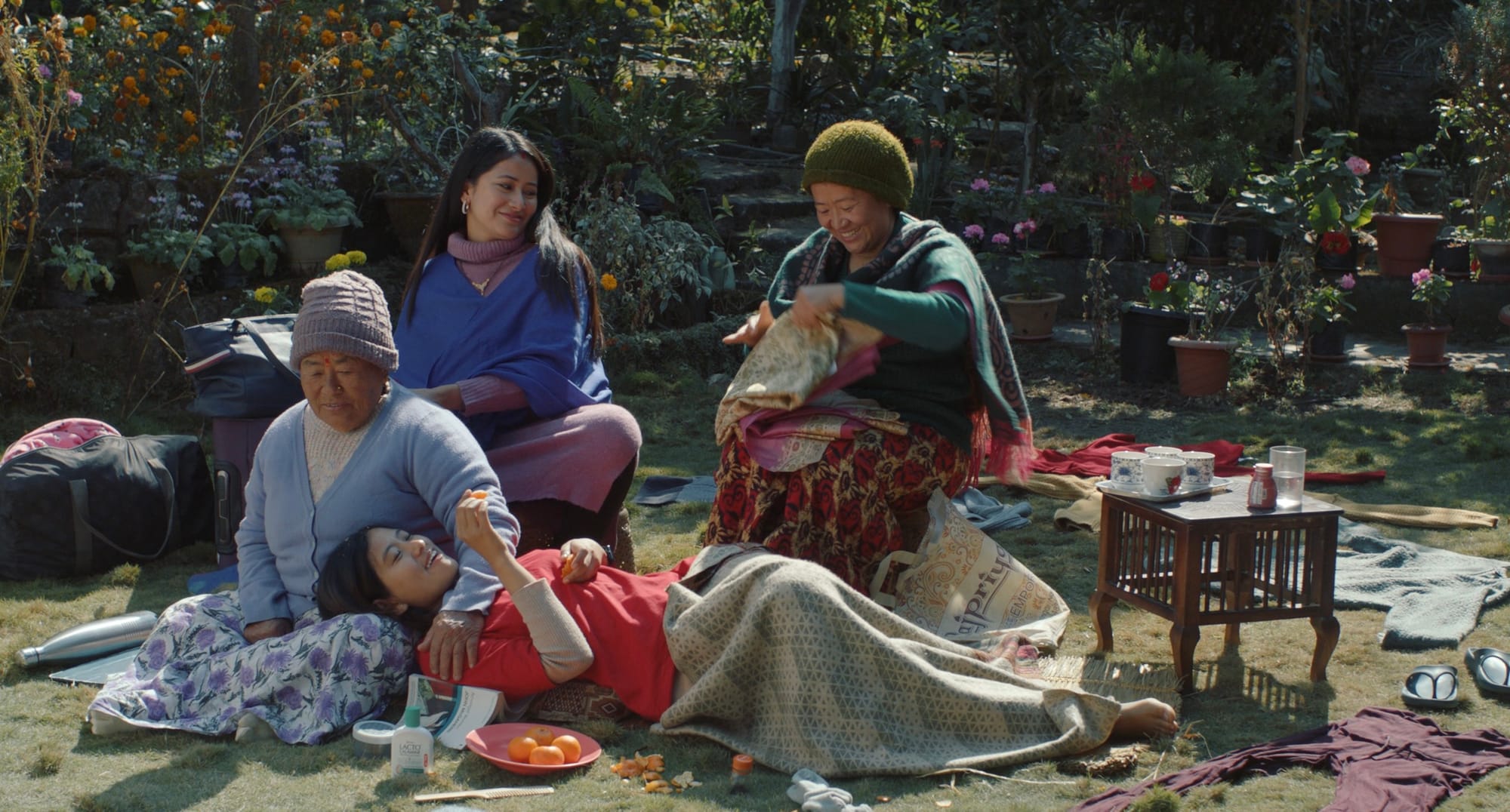
It's easy to read Bishnu as a misfit with a chip on her shoulder. She picks fights with her mother, arguing that her mother continues to prioritise others’ happiness over her own. She stands in judgment of her younger sister, believing that her decision to marry was a copout, and now her sister’s life will forever be governed by her in-laws. She pities her grandmother’s fate—an elderly woman whose desires seem forgotten. When co-writers Rai and Kislay turn this questioning gaze toward Bishnu herself, it reveals a flawed protagonist struggling to confront her own insecurities. Her judgmental exterior is a convenient armour that’s deployed to keep others at arm’s length in a society where showing vulnerability is perceived as a weakness, especially for women.
TR: The early drafts had a lot of me complaining about why this world wasn't working for a modern, independent, and strong-headed woman. When Kislay came in, we decided that one can't just be critical of the surroundings and the society. That critical lens needs to be turned inward. I need to be critical of my privilege as well. I am one of the very few practicing female filmmakers from Sikkim to have studied at a leading film institute. That kind of access is rare. We need to critique my position. That’s the only way of telling an honest story.
Intergenerational trauma and how mother-daughter relationships can become the focal point of its eruption is a subject that has come up in several recent Indian films. For example, Sundance winner Girls Will Be Girls (Shuchi Talati, 2024) pitched a teenage daughter and her single mother as adversaries, against the backdrop of a coming-of-age narrative. Rotterdam (IFFR) winner Bad Girl (Varsha Bharath, 2025) reframes a woman’s rebellion as an explicit rejection of a future where she’s expected to grow into her conformist, tradition-bound mother. Tribeca selection Pinch (Uttera Singh, 2025) presents a young daughter expecting her mother’s support when she confides in her about being sexually harassed by a known male figure, but is horrified when the parent questions the credibility of the incident instead.
Such films have given rise to the ‘difficult woman’ archetype: modern female protagonists branded as deviant and viewed negatively for wanting to break free from patriarchal norms and expectations. Other Indian films, such as Karan Kandhari’s Sister Midnight (2024) and Dominic Arun’s Malayalam-language superhero epic Lokah Chapter One: Chandra (2025), take this idea of deviancy to the extreme by reimagining their female protagonists as vampires on the run, hunted by society for threatening the status quo.
TR: Some of my close friends have told me that I am such a ‘difficult woman’. And because of this, I won’t ever find a man. If you’re vocal, if you’re opinionated, if you call a spade a spade, that’s it—you’re branded a ‘difficult woman’. It’s as if only men have the right to behave this way. People have told me that it's very difficult to be empathetic towards the protagonist [Bishnu] of our film. I hope people enjoy this complexity. In mainstream Indian films, women are usually portrayed as righteous, those who can do no wrong. But in reality, we [women] are all imperfect, and we are very complex. I wanted to capture that. The angst that Bishnu feels comes from my experiences. And I know several other women who can easily relate to this angst of surviving as a woman in India.
There is a level of internalised misogyny and gender bias that’s so deeply ingrained, even in how I think; it’s a kind of default wiring. For example, if there is an older man as a guest inside my house, my first instinct is to pull up a chair for them and fetch a glass of water. But if the guest is a woman, I don’t care. This process of looking inward was critical in informing the basis of the script. I am this Bishnu who has returned to her village. But it’s not just my truth. I’ve heard this from women across the board who have seen the film— ‘I’ve been living this reality for the past five years; how come you made a film about my life?’
Rai’s film is also critical of the incessant fetishisation and exoticisation that the Northeast region of India faces in mainstream screen representation. This has been a common complaint by several filmmakers from the region. When Meghalaya-based filmmaker Dominic Sangma came to Australia with his film Rimdogittanga (Rapture, 2024), which played the Sydney Film Festival and the Indian Festival of Melbourne, we discussed at length some of the negative stereotypes that Northeastern filmmakers have to fight against. From xenophobic perceptions around ethnicity because of how they look to their films being confined to regional labels, the quest for authentic representation is ongoing.
In Shape of Momo, Bishnu laments how the quiet labour of people from the mountains, such as her mother, remains invisible—an oppression on two fronts: her worth is minimised by her gender (as a woman) and by her localised identity (as part of a rural community). She calls the picture-perfect beauty of the surrounding mountains a form of “quiet performance rehearsing itself for the city-weary visitors.”
TR: We started with Dostoevsky’s quote: ‘Beauty will save the world’. I find it disingenuous when people come to Sikkim or the Northeast in general to shoot their films, purely because they find the region aesthetically beautiful. This goes hand in hand with perpetuating harmful stereotypes that people from the mountains are simpletons, fetishising us as exotic. That's how we have been portrayed in mainstream cinema. The stereotypes aren’t just limited to people. On the big screen, you’ll find that when characters head to the mountains, it becomes shorthand for a simpler lifestyle. It may be an easy and relaxing holiday for those who visit, but for the people actually living in those regions, it’s a hard life. So, the optics of who gets to own the narrative in terms of representation on screen is an important question to consider.
Bishnu’s sense of assuredness—she believes she knows what’s best for herself and her family; she carries a derogatory, classist attitude towards the village's workers; she has no plans to settle down or compromise her independence—is probed and challenged at every step. The film introduces Gyan (Rahul Mukhia), an affluent and city-educated architect and political scion, as a potential love interest. Gyan is everything Bishnu thinks she wants. But even this ‘promising young man’ is not immune to patriarchal conditioning.
TR: That’s how life works, Virat! They [men] look so good and ‘just right’ in the beginning on paper.
[Both laugh].
TR: But seriously, the idea to make Gyan a ‘suitable boy’ was deliberate. We wanted to highlight how patriarchy manifests in subtle ways. For example, Gyan objects to Bishnu smoking, but then quickly deflects by shifting the onus onto his mother, qualifying that he doesn’t mind, but that his mother would create a scene. Actually, it’s he who has a problem, but he doesn’t want to admit that. Making Gyan nice and likeable on the surface also made the journey of our protagonist even more difficult. Otherwise, it’s so convenient to say, ‘Oh, that guy was a prick, so she left him. Good riddance!’ But when Bishnu makes the harder choice, I feel that says a lot more about her character and the growth she experiences by the end of the film.
The beauty of Rai’s story is its steadfast empathy and humanism. Even though Bishnu can come across as judgmental, the film’s gaze doesn’t admonish her or any of the other characters for the choices they make. In a rare moment of self-reflection, Bishnu tries to see the world from her mother’s eyes, even though she doesn’t necessarily agree with her: “Only recently, I have begun to imagine you as a young woman with two daughters, balancing a world that never balanced for you.”
TR: One of the most important things I wanted to explore was the crossroads of choice: should my protagonist leave or stay back? Does leaving her mother behind make her a bad heroine? But for me, Bishnu has already lost the battle. The choice she makes is immaterial. Whether she chooses to leave or stay, she loses on both fronts. If she stays back with her mother, the possibility of an independent future disappears. On the other hand, if she leaves, she has to live with the burden of leaving her mother behind, which is its own kind of guilt. There is no ‘right’ choice. Still, I wanted my protagonist to decide. It’s in the act of choosing where she finds a particular kind of agency.
Shape of Momo had its World Premiere at the Busan International Film Festival and its Indian Premiere at the Kolkata International Film Festival, where it was awarded Best Film in the Indian Language Competition.