
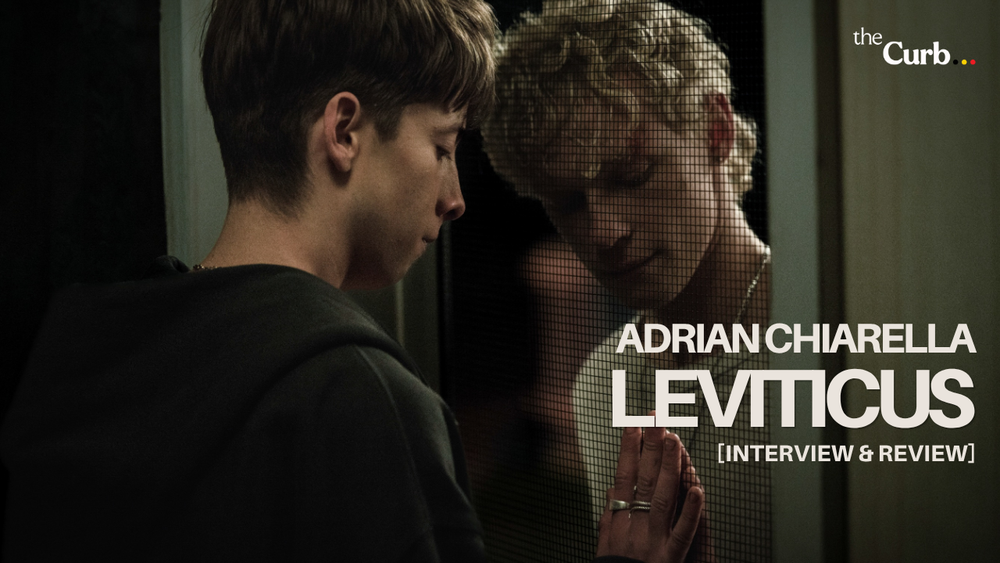
Leviticus, for those who haven’t had the Old Testament or Torah quoted to them, refers to a specific book outlining the laws to worship and obey God written by Moses. Particularly the mistranslated or misunderstood ‘Leviticus 18:22’ which has been used as proof that God condemned homosexuality. The small sentence which is still in debate as to its precise meaning is routinely used by Christian religions to call all homosexuality an abomination. There are some translations that add on the directive that homosexual acts are deserving of death.
Adrian Chiarella uses the title pointedly as he’s utilising how belief can be weaponised to “other” queer people, especially in communities that embrace Pentecostal and Charismatic Evangelism (and some branches of Catholicism). Niam (Joe Bird) and his mother Arlene (Mia Wasikowska) have relocated to a mid-sized rural town where Arlene has become very involved with the local ministry headed by Rod (Ewan Leslie). As much as Naim dislikes his new environs, there’s one thing he does like; the chance to hang out with the handsome Ryan (Stacy Clausen) who looks like the kind of guy who would otherwise ignore him or bully him. Instead, he finds himself in a budding romance mostly conducted in an abandoned mill. Naim isn’t quite ready to embrace his desires for Ryan but as he gets bolder, he spies Ryan and Hunter (Jeremy Blewitt), the pastor’s son hurling rocks at each other and then making out.
Out of jealousy and a heavy dose of internalised homophobia Naim tells Rod and his family about what he has seen leading to a Deliverance Healer (Nicholas Hope) being called in to spiritually rebuke the young men in front of the faithful. A ritual that gives birth to a demonic presence that takes the face of the person one most desires and then rips the cursed violently apart. Trying desperately to save Ryan, Naim admits to a social welfare officer that he is also gay, and his mother Arlene calls the same Healer in. Both Ryan and Naim are hunted by a demon version of the other who becomes smarter, more seductive, and ceaselessly vicious.
Leviticus is a remarkably clever and emotionally raw horror film that picks up on the loneliness and fear involved in being ostracised from all one cares for because of sexual identity. The immense confusion and self-castigation of the teen years become unbearably heightened when simply being honest means aggression from not only peers and a society that practices a twisted version of love and community care.
Mia Wasikowska is devastating as the emotionally unavailable and pious mother who wants her son to be afraid, but it’s the chemistry between Joe Bird and Stacy Clausen that makes Leviticus utterly engrossing. It’s not simply the chemistry of Naim and Ryan as a couple that works, it’s the matched vulnerability and fear of the two teens who externally appear very different but share something that only they can understand as they’re isolated further from a hostile community.
Leviticus is profoundly frightening, deeply romantic, smart, and a perfectly timed examination of homophobia in a society that is regressing in its attitudes towards queer people. A brilliant fable about the many levels of coercion and pressure young queer people face.
Nadine Whitney had the chance to speak to Adrian about his work on Leviticus.
Adrian! What an incredible film. I don't think I've seen anything quite like it in the Australian landscape before. Because of Australian secularism it seems an American styled story, because we don't think of those Pentecostal churches having quite such a hold in Australian communities.
Adrian Chiarella: They do in a lot of areas.
I see why you chose a rural community. In these smaller places, and even in larger cities and different cultural communities, there is the chance that you will be put through hell.
AC: Yes, even just sort of day-to-day micro aggressions to violent homophobia.
How did the concept of Leviticus come to you?
AC: I had a love of genre since I was a child, really. I always enjoyed horror movies, and I think when I grew up, I realised that's something I shared in common with a lot of other young queer people. I think we turned to these films for a very certain particular kind of comfort, in a way. I think there was something we saw in them about being othered, about the sense of destabilisation when you're on that journey of self-discovery.
I think horror movies are really about an exploration of fear, and homophobia is this very particular type of fear that I felt was right to explore through this genre. At first I thought about different forms of coercion, of course, the practices that are that are put on young queer people. I had read about exorcisms being performed on LGBTQ+ teenagers, and for a while I thought about a movie around that, something a bit like The Exorcist, but with a queer spin on it. The more I thought about that, the more I realised that's just going to justify the belief that people like that have about there being this sort of “gay demon.”
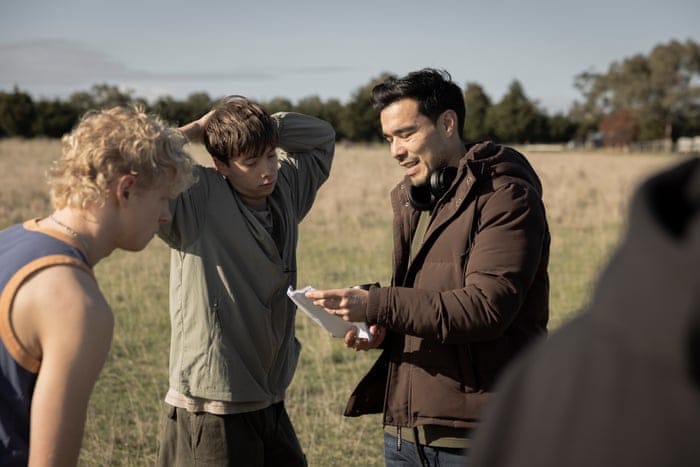
I started doing these writing exercises where I thought about what the opposite of that would be, and I came up with this idea of an entity, a horror movie monster, if you like, that takes the form of the person you desire the most. I knew that that would work for what I was trying to say, because it was essentially representing a way in which we are scared of our own desires and our own feelings. Once I had that, then I was able to focus on the love story, which was the other half of the film that I really wanted to get.
I spoke to a lot of LGBTQI plus people, and the experiences that we all shared, and especially people who grew up in regional parts of Australia. I had some who'd sort of moved around different towns, and they said, you know, when they were living in a town that was only a couple of 100 people, it was actually quite safe, because everyone knew each other, and they were a real, true tight community. It's when they moved to towns that were about five to 10,000 then they really felt they felt the aggression that was quite overt in those sorts of places, but actually the really small towns, there's a much, much stronger sense of like you're living amongst people who you see every day. People have to live with the consequences of what they say and do to your face.
I can't think of many places in Australia that are more purgatorial than rural suburbia. Tell me about crafting the love story.
AC: Formative male aggression was something that we talked about a lot in their performances (Joe Bird, Stacy Clausen, Jeremy Blewitt) and in rehearsal they did a lot of exercises where they were sort of screaming at each other, and they were sort of throwing stuff, I mean, it was all very safe, we had padding and things.
They kind of got a lot of this sort of aggression out in rehearsal before we filmed it, and I think that a lot of that carried into the performance, and in fact, I think it led a lot of the swearing in the movie. Some is actually in the script, but a lot of it's kind of improvised, and I think that came out of them just kind of getting in touch with something that just ended up in the performances.
Some of the script was inspired by when the conversation comes up amongst queer people, like, if you could take a pill and it could make you straight, would you do it? And I've heard some people very romantically say, well, no, well, then I never would have been with my partner, so why would I want that?
Personally, as a mating ritual, I would find someone throwing rocks at me really quite upsetting.
That aggression was in Hunter and all around them is aggression directed towards them. Can you tell me a bit about Arlene? A mother who it seems would prefer to have a dead child than a gay child.
AC: Arlene is someone who really would put all of her trust into some form of coercion/conversion. She'd rather her child get scared out of his feelings, even if he does not survive that fear. We tried lots of versions of this story with that character, we did try some versions in the script where we redeemed her a little, but it didn't feel true after what she had done to him. So that's why it was important, as much as we had that side of that character, I think that's why it's important that we had the ending with the two boys that we ended up having, that we kind of showed that shade to it. It's probably more confronting than any stuff with the monster in the film; what you see at the heart of the psychology of that that character.
It's funny that the most, the most biting horror movies we've seen recently have had this social commentary where the true terror has come from something well-meaning. So, to me, Get Out wasn't, it wasn't just about overt racism, it was about these well-meaning white people. I think what we ended up exploring with Arlene was a kind of homophobia that, on the face of it, is coming from this well-meaning sense of protection, but then you realise no, that's almost worse to do that than to be open about your homophobia.
The film was made because I feel like a lot of the progress we have made in the last couple of decades has really regressed lately, and I think some of that in Australia came from all of that rhetoric during the marriage equality debates, you know. We won that one, but in the aftermath, we're living with all that rhetoric that came up, and people have just not shut up since about some of the ideas that they were spouting during that. I know in America, and in other parts of the world, they're facing this move backwards as well, and I wanted to do something. I wanted to make a film that, at the same time, wasn't going backwards, but was actually exploring something sort of new for me.
That kind of homophobia and queerphobia in general. Then we put on top of it transphobia, which is one of the most bizarre “moral panics” I've ever come across in my life. It is actually more unsafe for many.
I think your film addresses it really well and Leviticus is a deeply moving and frightening film. I'm so pleased that overseas audiences are responding to it the way that they are.
AC: I just love that this story and these characters have taken on a life of their own. I mean, there are people online creating fan edits and fan art and all kinds of things in response to the two young men at the centre of this story. That's something I never would have imagined as a filmmaker, as a storyteller, that people would take this and run with it, and really make it their own, and feel something so personal out of what you've created. It's really one of the great signs that an audience has really responded to your work, that is just really special for me.
Director: Adrian Chiarella
Writer: Adrian Chiarella
Cast: Joe Bird, Stacy Clausen, Mia Wasikowska, Jeremy Blewitt, Ewan Leslie, Nicholas Hope
Music: Jed Kurzel
Cinematography: Tyson Perkins
Producers: Kristina Ceyton, Samantha Jennings, Hannah Ngo
Leviticus opens in Australian cinemas via Maslow Entertainment on June 18 and via Neon in other territories on June 19.