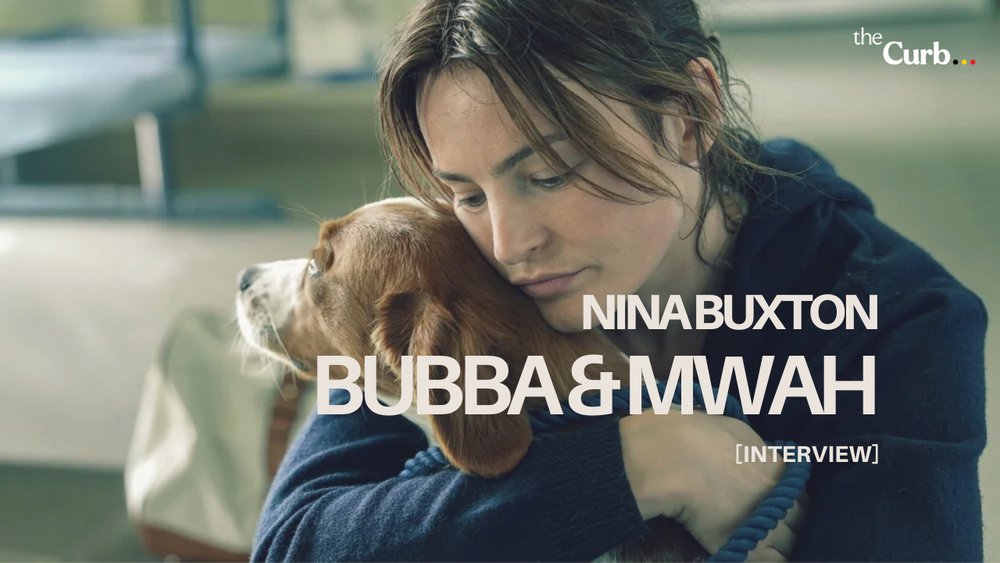
Nina Buxton is a storyteller who has worked in films and TV. On the TV front, she’s been the director behind shows like The InBESTigators, Paper Dolls, and Planet Lulin, light, fun fare, while on the filmic front, she’s directed impactful short films like 2017’s Mwah and her latest short film Bubba, which screened as part of the 2026 FlickerFest line-up.
Mwah is a mostly wordless film which follows Bethany Whitmore’s teenage girl as she rides home at night on mostly empty streets. She pulls up to a stop sign and encounters a man in a car who kisses into the air at her. The film then follows her home, unsure what might happen on these silent streets at night. The film invites viewers to understand how women are often forced to live with the pervasive feeling of always being at threat from the men in the world, unsure who might cause them harm.
In Bubba, the cause of harm comes from someone that Mia (Hannah Monson) knows. Her partner inflicts coercive control on her, monitoring where she is, ensuring she can’t spend money without his permission, even tracking her to the vet where she goes to try and make an escape from her abusive relationship. This is a tense, taut film that exposes how coercive control and domestic violence can be hidden in plain sight, existing in ways that even cause those living through it to question if that’s even what is happening at all.
In the following conversation with Nina Buxton, recorded ahead of the films screening at FlickerFest, Nina talks about her vision as a filmmaker, the research that went into making Bubba a film that presents the often unspoken and unseen side of coercive control, and the importance of telling these stories on screen in a nation where violence against women is a continuing threat.
Readers should note that this interview contains discussions about coercive control, domestic violence, violence against animals, and violence against women. If this interview brings up any difficult feelings, please make sure to reach out to The National Sexual Assault, Family and Domestic Violence Counselling Line – 1800 RESPECT (1800 737 732) for support.
This interview has been edited for clarity purposes.
I’ve been aware of your work over the years, from the kids shows you’ve worked on to the haunting short Mwah. I saw that at the Revelation Film Festival here in Perth. It has left such a mark on me that I couldn’t tell you the film that I watched it with was. It set a benchmark of what short films can do.
Nina Buxton: Andrew, thank you. It was based on a personal experience like that actually happened to me. I've been cat-called a lot in my life. All women pretty much have. I was interested in making a film that showed how freaky it can be when something like that happens to you, and the sense of, once the danger is gone and actually nothing ends up happening, how you just kind of have to move on with your day. And then no one ever talks about it like. You can be made to feel unsafe and it’s just an ordinary part of your day. I found the extreme feeling of danger and also the mundane everydayness of it really interesting. It's kind of the same with Bubba; that mundane, everyday kind of scenario. I find the drama in the everyday really interesting.
You're bringing forth stories which we so often only read about the aftermath in the news. Outside of the headline, we don’t get to hear the human side of the story. With both of these films, I feel that you're inviting us to really understand what is going on when we talk about ‘violence against women in Australia.’ I feel it's so often not clearly understood what that means or looks like.
NB: True, it's really misrepresented in the media. You only ever hear about a woman being killed, but you don't really hear about the signs that lead up to that. I think that's why I was interested in making Bubba.
With Mwah, when I was casting the role of the guy who's in the car making kissing noises at this teenage girl, I auditioned a lot of men who did it in a really creepy or over the top or menacing way, and I really wanted to find a guy that just looked like a nice everyday guy, like a dad, you know? The same with Bubba. I cast this great actor, Thomas Cocquerel, in that role because I wanted to find somebody who was instantly likable and charming. Because so often when you do hear in the news that a woman has been killed by an intimate partner, or terribly violent things have happened, often a perpetrator is described by the next-door neighbour or a work colleague as, ‘Oh, he was such a nice guy.’ And you expect domestic violence to always look angry and violent, but often coercive control can come across as looking like a loving relationship or someone acting caring or concerned, and that's not really represented in film and TV.
I agree. Here in WA, we've had a lot of advertising in public spaces which talks about what coercive control looks like. I've been impressed by it because people might read about what has happened and think, ‘Well, that's just them being concerned or that's just their way of being loving.’ Coercive control has the ability to just kind of be there and feel normal, and it's not.
NB: Yes, exactly. That's why I wanted to set the film in a public setting. The whole film is set at this vet clinic, and to somebody watching this couple, they might just look like a couple going to an ordinary vet appointment where they're concerned for their dog. I wanted to make all the signs of coercive control subtle, but in plain sight, so that if you know what to look for, you can spot all those things.
If you listen carefully, you find out that she has no access to a car, that he's tracking her location, that she has no money and no ability to pay for the appointment. It's suggested that he's the one who hurt the dog. There are all these little signs, but on top of that, there's this layer of him also appearing really loving and concerned and gaslighting her as well.
What I found powerful and important to see on screen – and correct me if I'm reading this incorrectly – there is that moment where he's sitting there and she leans into him, or rather, he pulls her into him, and there's this look on her face for just a moment where she's like, ‘actually, this does kind of feel safe, maybe he's not so bad.’
NB: I love that you noticed that moment. That's one of my favourite moments, because in that moment, she actually smells him, she leans into his body, and then she sort of breathes him in, in this intimate way with a partner. It’s like he feels safe and also dangerous at the same time; she's in love with him, but also afraid of him. That was one of the main ideas I wanted to explore: what does it look like when you're in love with the person who you're afraid of? I wanted to show that she does love him, and she obviously loves the dog as well, so she's trapped, not just by fear, but also by love. That's one of the only little moments where you sort of see that, so thank you for noticing.
I felt that it was so important because it undercuts people who might say, ‘How can it be domestic violence or coercive control when she likes being with him?’ Statements like that put the onus back on the woman in the relationship as being at fault, rather than man's actions.
NB: And people always ask that question, ‘Why didn't she just leave?’ The blame is always put on a woman rather than asking, ‘Why does he do it?’
Another powerful aspect of the film is the relationship of Bubba the dog. There was a welcome change to legislation which provides stronger protections for animals and victim-survivors of domestic and family violence who can be used as coercive control or domestic violence.[1] What was the drive to centre the dog in this particular situation?
NB: It came from our research. We spoke to a lot of veterinarians who had witnessed pets being used as tools in abusive relationships. We spoke to a lot of a lot of vets when we were location scouting. One of them told us that a man had brought the family dog in to be put down, and he said his wife was too upset to come along, and she'd already said goodbye to the dog. The vet had never met this man before, and just something about it fell off, so she called the woman that she knew to be the pets owner, and she was horrified. She had no idea that he was there with the dog and that it was that close to being put down because she was in an abusive relationship. Vets see this kind of thing all the time.
When you're a kid and you go, ‘Oh, I want to be a vet when I grow up,’ because it seems like such a lovely job because you get to spend time with animals, but what we found when we were doing our research was that vets are put under this enormous strain where they see a lot. There's a lot of burnout. There's a high rate of suicide amongst vets; they carry such an emotional burden, so I felt like it was important that in our film we showed that the vet knows exactly what's going on, even though she doesn't say it, and she gives the main character an opportunity to leave. She creates a distraction and gives her an opportunity to go to the waiting room alone to fill out paperwork. There's eye contact between them, showing that she knows the situation.
In general, I feel like audiences are really desensitised to violence. Thematically, I feel like people are so used to seeing people treat each other badly, but when you put an animal in a film, it makes people pay attention. So, I think putting a dog into the film, it kind of raises the stakes. Obviously, children and pets get used in abusive relationships. But it was a way in to allow the audience to see it [happening].
I really appreciate it. For context, I was a vet nurse for eight years. There was one situation where I had a dad come in with his son, and they had a Labrador puppy, no more than eight months old. The puppy was the most beautiful dog in the world. He said, ‘I’ve brought this dog in to be put to sleep because my son won't clean up after it.’ The son was maybe six years old. We took the dog in and found it a home. It wasn't a safe situation. That was my first real exposure to the way the animals can be treated in toxic relationships and can be used against families.
It's hard as a vet and as a vet nurse; you're not just there to treat the animals, you're there to look after and support the owners too. Getting to see that play out on screen was powerful. I watched the film twice, once through the perspective of the woman's point of view, then from the vet's perspective. I appreciate that level of storytelling. Thank you.
NB: Oh, thank you. Oh, my gosh, it's so great to speak with somebody who really understands the film. I hope that people who work in that industry can watch it and feel seen, and to know that the work that they do is appreciated. It was amazing the stories that we heard and the [level of] burnout. Everyone in the industry knows about it, but not many people really know and talk about that.
I appreciate that. I've spoken to Hannah Ngo before. She's a wonderful producer. What it was like to work with her as a producer here?
NB: Hannah made the film happen. I mean, both Hannah's did. I wrote the film with Hannah Samuel. I couldn't have made the film on my own. Films are so hard to make. I also work in television, and that, in comparison, is so easy, because as a director, you turn up and the locations are there, [the show] is cast, everything's funded. But with a short film, it feels like you're pushing a boulder up a hill, and so with Hannah Ngo and Hannah Samuel, it was the three of us pushing the boulder up together. And it felt lighter because they really believed in the story and in me and they made it fun.
The helped me with the logistics and getting the crew. We sent out so many emails to people telling them about our story. I love the way they got people excited about it. We ended up with this crew of people who really cared. Everyone we did it over a weekend, so just two days, it was very short. Honestly, I'm humbled.
Before making this film, I would go to a film festival and watch a whole lot of films, and be looking for the best one and hoping that the films were good, you know? After making this film, I would go to a film festival and just want to stand up and applaud anyone who's finished a film. I don't care whether it's a good film or a bad film, if somebody finishes a short film, if they make it, actually get people to come together and make it, then I think that is just the biggest achievement. There's nothing harder than making a short film because you have to really believe in your idea enough to sell it to twenty people or more, to try and get people to give up their free time on a weekend to make it happen. And that's what we did. So, it was great working with both Hannah’s.
It's a huge achievement. As I mentioned, I saw Mwah in 2017 or so, and for that to still resonate my mind-
NB: And those films were quite similar. It was very ‘no permits’. I remember on Mwah we were running around at 3am in Heidelberg on the roads and stuff like. We had no money. Same with this film. We had no money. With Mwah, we needed all these tracking shots of a girl riding a bike, and so we hired one of those bikes that parents ride with their kids in the front with a carriage attached to it. Our grip rode the bike and our DOP was sitting in the carriage with the camera, and that's how we shot tracking shots.
With Bubba it was the same thing. Totally guerrilla. No permits. The first thing we shot was at the train station, the first scene of her having a panic attack on the train. We did not have permission to film on a train. It was just me, camera, sound and the actor on the platform, and the train pulled up, we just turned over, got onto the train, and started filming. Hannah Monson, who played Mia, she was so amazing. She blew us away. We hadn't had rehearsals. We hadn't done anything. We didn't get to rehearse it, we just had to start filming because we had no permit. So we jumped onto the train and started filming.
She just leant against the window and did this amazing take where she did the first scene where Mia gets a voicemail from her partner to say that he knows she's gone, which, by the way, we didn't reveal, I didn't want to make it too obvious from the very first moment of the movie what it's about. You hear a male voice on the other end of the phone, but that's meant to be her realising that her partner knows that she is not at home, and he's going to be on to her. She did this amazing performance, she cried, and the train pulled up at the next stop and we all got off the train. All the people who were on the train who watched it all clapped her. We got off and didn't need to do it again. It was perfect, moving on.
It really does have the feeling of somebody trying to hold back a panic attack, and that's really hard to do.
NB: She was. I just can't believe it. We all got off the train and sat down on a bench, and the first AC, who was pulling focus, he was speechless. He was just like, “Whoa. That was amazing.” That kind of set the tone for the shoot. We didn't get a lot of coverage, which is also really different from TV.
Obviously, working in TV, you have to get a lot of options for the edit, but because I was editing this myself, I kind of knew I could just be really lean. I didn't cover everything from every angle. A lot of what is in the film is the only thing we got. That was really joyful. I loved that process of just being really lean with it. We didn't do too many takes. It felt really wonderful. It was hard to pull together, but once we were there doing it, it was the best experience.
Watching what you've done with kids shows and things like that, which have a levity to them, and then watching your shorts which are heavy, I wonder if there is a relief for you in balancing the two. On the one hand you can step away from the heaviness to work in the playfulness of the kids shows.
NB: I think there's something beautiful about working on a comedy. I love working on kids shows and comedies because they're so fun to make, and it's a joy, so I really enjoy that. But also, there's something really personal about the short films that I've made. They're all based on my own personal experiences. I think it's very cathartic making short films. It's kind of like therapy in a way.
I love the stuff that I do in TV as well, but one of the reasons I wanted to make Bubba was because I wanted to move into directing TV drama. I think it's helped me to because when I made it, I was able to take it to production companies, producers, and show them ‘this is [what I can do]’. I love directing suspense and I'm really interested in that drama and the everyday and the mundane, and also female perspective. I hope that as I go on in my career, I'm able to direct more television that aligns to the tone of the short films.
I hope so too. I really enjoy the work that you've done with the TV series, but the shorts are, for me, what has really stuck with me, and having watched Mwah and now Bubba, they're films that I know will stick with me. It's not just because of the story, it's the way that you're telling that story. They're powerful pieces of work. They are also very important discussion starters about the current state of Australia as well. I'm grateful that they exist, because we need these kinds of stories out there.
NB: I'd love to take one of these short films and make it the opening scene of a feature or of a TV series; that would be the dream. So, thank you, that means so much to me.
You make short films, and then they just go out into the world. So to know that you watched one, [and to know it] left an impact, that's amazing. I go to a lot of film festivals, and there are so many films I've watched that have really stayed with me. You often don't ever get to meet those directors or the crew or the cast, but that's the beauty of a short film. You can watch a short film and it can stay with you. I have some that have stayed with me for years and others that have really helped me sort through things. It's funny, often you don't know the impact of a short film, so that's why I think they're so wonderful to make.
That's the power of something like Bubba, where you leave us on an inhale instead of an exhale.
NB: It's great. I didn't have to come up with a neat ending. I could just suddenly pull the pin and be like, ‘Actually, this film's over.’
‘Now you, the audience, have to sit with this feeling that I've created in your chest.’
NB: I was reading some advice for making a short film, a writer had a list of things, and one of them was impact. ‘End on maximum impact.’ That's what led me to finish the last scene halfway through the scene, because I wanted the final moment to feel like it had a breath in. I think that's the best way to end a film.
It's also the question which I feel is most pertinent to the story and its themes: what is she going to do next? Everything is closing in, what is she going to do next? Coming back to the newspaper articles and things like that, we always read about the violent, horrible conclusion, and the question of ‘what is she going to do next’ has never been answered along the way.
NB: It’s so true, it's terrible. When I was writing the script, I had some advice from people saying, ‘Oh, you know, does he really seem that bad? Maybe you should get him to punch the window of the car and it breaks, or maybe she should have a bruise visible on her face or her back, just so the audience really knows who the antagonist of the story is and understand her plight.’ But one of the most important things about it is that there's no physical evidence of any violence. If he did do anything physical, then she would be able to take that to the court.
One of the biggest things about coercive control is that there's no physical evidence. A lot of the time it's hidden in plain sight, it's things that can't be traced, which is why you can become so confused when you're being gaslit, you lose touch with reality, and you can believe that it's not really happening. I think that was important to have him be a nice guy and at in the end, when he's outside the car, you can imagine that she might get out of the car, and she might be told ‘you were acting crazy. Stop acting crazy. You're scaring our dog. What are you doing?’ Make her believe that it was all in her head.
If you've been in an abusive relationship, once you've gone through it, you can see it from a mile away, in the way somebody changes the tone of their voice, or the way someone tenses up, or the question they might ask; it becomes so visible to you. I'm sure that women who have experienced this will know exactly what it's about, and maybe people who don't will become more familiar with how to spot it.
Well, Nina, thank you for the lovely conversation. It's been great.
NB: The loveliest conversation. I really appreciate you taking the time and thank you for all your kind words. It's really appreciated.
[1] Across Australia, there are many organisations that run ‘Safe Beds for Pets’ initiatives which provide safe spaces for pets to be cared for and looked after to empower women and children escaping domestic violence.